Watch: Shock waves from mega M7.5 Venezuela earthquake ripple through North America
A rare earthquake doublet struck northern Venezuela, with a 7.2 foreshock followed 39 seconds later by a magnitude 7.5 mainshock. The sequence killed at least 32 people, damaged Caracas and sent seismic waves to instruments across North America.
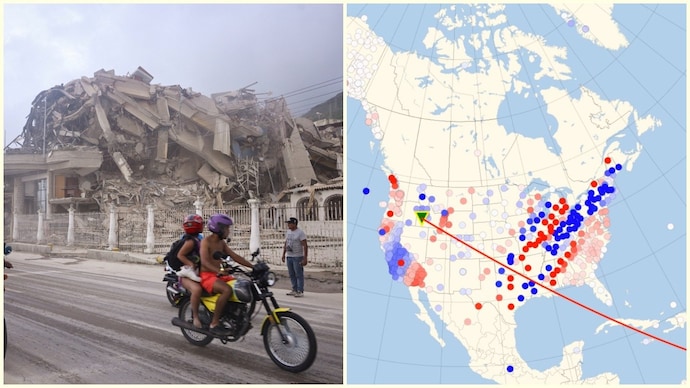
A rare earthquake doublet struck northern Venezuela that was felt across North America.
Two powerful earthquakes measuring magnitude 7.1 and 7.5 hit just 39 seconds apart on June 25, killing at least 32 people, injuring more than 700, and damaging buildings across the capital, Caracas.
The back-to-back quakes, triggered along an active fault system beneath the Caribbean region, have left scientists studying one of the world's rarest seismic phenomena while emergency teams continue rescue and relief operations.
HOW DID SHOCKWAVES REACH CANADA?
The magnitude 7.5 earthquake released a massive amount of energy that travelled through the Earth as seismic waves.
These waves move in different ways. The fastest, known as P-waves (primary waves), travel through the Earth's interior by compressing and expanding rock. They are followed by S-waves (secondary waves), which move more slowly and shake the ground from side to side.
The slowest are surface waves, which travel along the Earth's crust. Although they move at a lower speed, they can carry energy over very long distances.
As these waves spread outward from the earthquake's epicentre, they travelled thousands of kilometres across North America.
By the time the seismic waves reached the United States and Canada, the ground movement had weakened to just fractions of a millimetre, far too small for people to notice but easily detected by sensitive seismometers.
The viral animations circulating online show these instruments recording the passage of the seismic waves. They do not indicate that the earthquake itself travelled across continents or caused damage outside Venezuela, but rather capture the distant vibrations produced by one of the world's most powerful earthquakes.
WHY DID VENEZUELA QUAKE STRIKE TWICE?
The United States Geological Survey (USGS) calls what struck Venezuela a doublet. The word describes something that is not meant to happen.
Usually, a large earthquake, the mainshock, releases so much built-up strain that whatever follows is smaller, an aftershock. Here, a magnitude 7.2 quake went first, and instead of settling the fault, it shoved its load onto the next stretch of rock and broke that too.
Thirty-nine seconds later came the magnitude 7.5, the real mainshock.
The first quake was a foreshock, the tremor that arrives before the largest one. Both were shallow, the 7.2 about 22 km down, the 7.5 only around 10km. The shallower the break, the less rock there is to soften it, and the harder the surface shakes.
WHY IS THE GROUND IN VENEZUELA NEVER STILL?
Northern Venezuela sits on a seam in the planet. The Caribbean plate, one of the great slabs that make up Earth's outer shell, grinds eastward past the South American plate at about 20 millimetres a year.
That movement is taken up by strike-slip faults, cracks where two blocks of rock slide horizontally past each other, rather than one riding over the other.
The Bocono fault system, which the USGS ties to this sequence, is Venezuela's answer to California's San Andreas Fault.
This was Venezuela's strongest earthquake since 1900. The last comparable disaster was the Caracas earthquake of 1812, which killed an estimated 30,000 people.
A rare earthquake doublet struck northern Venezuela that was felt across North America.
Two powerful earthquakes measuring magnitude 7.1 and 7.5 hit just 39 seconds apart on June 25, killing at least 32 people, injuring more than 700, and damaging buildings across the capital, Caracas.
The back-to-back quakes, triggered along an active fault system beneath the Caribbean region, have left scientists studying one of the world's rarest seismic phenomena while emergency teams continue rescue and relief operations.
HOW DID SHOCKWAVES REACH CANADA?
The magnitude 7.5 earthquake released a massive amount of energy that travelled through the Earth as seismic waves.
These waves move in different ways. The fastest, known as P-waves (primary waves), travel through the Earth's interior by compressing and expanding rock. They are followed by S-waves (secondary waves), which move more slowly and shake the ground from side to side.
The slowest are surface waves, which travel along the Earth's crust. Although they move at a lower speed, they can carry energy over very long distances.
As these waves spread outward from the earthquake's epicentre, they travelled thousands of kilometres across North America.
By the time the seismic waves reached the United States and Canada, the ground movement had weakened to just fractions of a millimetre, far too small for people to notice but easily detected by sensitive seismometers.
The viral animations circulating online show these instruments recording the passage of the seismic waves. They do not indicate that the earthquake itself travelled across continents or caused damage outside Venezuela, but rather capture the distant vibrations produced by one of the world's most powerful earthquakes.
WHY DID VENEZUELA QUAKE STRIKE TWICE?
The United States Geological Survey (USGS) calls what struck Venezuela a doublet. The word describes something that is not meant to happen.
Usually, a large earthquake, the mainshock, releases so much built-up strain that whatever follows is smaller, an aftershock. Here, a magnitude 7.2 quake went first, and instead of settling the fault, it shoved its load onto the next stretch of rock and broke that too.
Thirty-nine seconds later came the magnitude 7.5, the real mainshock.
The first quake was a foreshock, the tremor that arrives before the largest one. Both were shallow, the 7.2 about 22 km down, the 7.5 only around 10km. The shallower the break, the less rock there is to soften it, and the harder the surface shakes.
WHY IS THE GROUND IN VENEZUELA NEVER STILL?
Northern Venezuela sits on a seam in the planet. The Caribbean plate, one of the great slabs that make up Earth's outer shell, grinds eastward past the South American plate at about 20 millimetres a year.
That movement is taken up by strike-slip faults, cracks where two blocks of rock slide horizontally past each other, rather than one riding over the other.
The Bocono fault system, which the USGS ties to this sequence, is Venezuela's answer to California's San Andreas Fault.
This was Venezuela's strongest earthquake since 1900. The last comparable disaster was the Caracas earthquake of 1812, which killed an estimated 30,000 people.

