Water's greatest energy mystery solved? Renowned India-born physicist claims science-defying discovery
For over a century, electric sparks fired into water have produced explosions stronger than science can explain. An 84-year-old Indian-origin physicist claims he has finally solved the mystery, and says the answer points to clean energy from ordinary water.
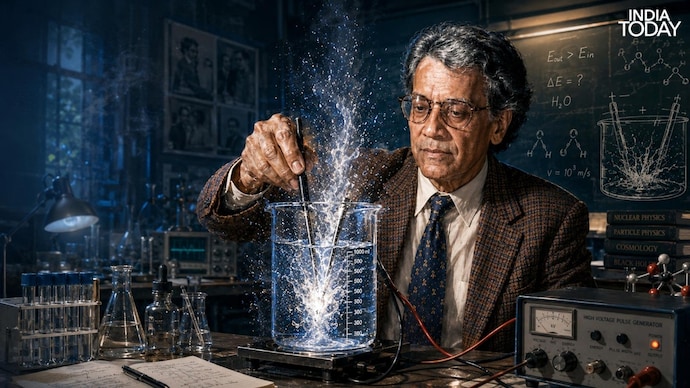
What if the water in your glass could light up your home?
It sounds like a fantasy. But an 84-year-old Indian-origin physicist believes he has taken the first real step towards it, by solving a genuine scientific mystery that has puzzled researchers for more than a hundred years.
His name is Yogendra Narain Srivastava. Born in Gorakhpur, Uttar Pradesh, in 1941, he was a child prodigy who finished school at 12 and earned a PhD in physics from Indiana University at 23.
He spent his career as a professor in Boston and in Italy, wrote more than 500 research papers, and once had the legendary physicist Richard Feynman tell him, after a long discussion, "You know what, I think you are right."
Srivastava's standing in the world of physics is not in question. The Royal Swedish Academy has invited him three times to help nominate candidates for the Nobel Prize, an honour extended to only a select group of scientists worldwide. He is a fellow of the American Physical Society, and his research papers span cosmology, black holes and particle physics, alongside a career-long effort to turn nuclear physics into real-world solutions.
Now, in what he calls the final stretch of his life, Srivastava, who is professor emeritus at Northeastern University, has told India Today Digital that he has cracked a puzzle hiding inside the most ordinary thing on Earth: water. And if he is right, he says, it could point the way to cheap, clean energy at room temperature.
That is a very big "if". Most scientists will disagree with him, and we will explain why. But the mystery he is chasing is real, and it begins with something astonishing that water does when you shock it with electricity.
This is the first of a two-part series. Part 1 tells the story of a century-old mystery and the physicist who claims to have solved it, in his own words.
In Part 2, India Today Digital will take his claims to independent physicists in India and abroad, experts on water, energy and nuclear fusion, and ask them the hard questions: could this really be true, and if not, what explains a hundred years of exploding water?
WHAT HAPPENS WHEN ELECTRICITY IS FIRED INTO WATER?
You have seen an electric spark. Lightning is a giant one. The tiny flash when you pull a plug out of a socket is a small one.
Now imagine firing a powerful spark not through air, but inside a cup of water.
Something strange happens. The water explodes.
The water instantly shatters into a thick white mist and blasts outwards with shocking force, like a gunshot.
Scientists first photographed this in 1907 and have been puzzled ever since. The strangest part is that the water stays cold. This is not boiling. It is not steam. Something else, something nobody fully understood, was hurling that water outwards.
How powerful is it? In the 1980s, scientists at the Massachusetts Institute of Technology (MIT) ran the most famous version of this experiment. They fired a burst of electricity, carrying roughly the energy an ordinary lightbulb uses in a minute, into less than two teaspoons of salty water.
That water shot out at nearly one kilometre per second, about three times faster than a passenger jet, and punched a clean hole through a metal plate. A plate of solid aluminium, as thick as four one-rupee coins stacked together.
Think about that. Two teaspoons of water. A hole through metal. No fire, no heat, no burn marks. The water was found lying around afterwards, cool to the touch, as if nothing had happened.
Where did all that power come from? The electricity that was put in was nowhere near enough to explain it. That is the mystery.
WHY DO SCIENTISTS SAY WATER GAVE OUT MORE ENERGY THAN IT TOOK?
In 2000, a father and son team of scientists, Peter and Neal Graneau, did the most careful version of this experiment and published something jaw-dropping.
They measured the energy of the electricity going in. Then they measured the energy of the exploding mist coming out.
The energy coming out was more than the energy going in. This happened in five of their eight firings, and in the best one, the gain was 60 per cent.
To understand why that sounds impossible, think of your bank account. If you deposit 100 rupees and withdraw 160, the extra 60 had to come from somewhere. Money does not appear from nothing. Energy is the same. It is the strictest rule in all of physics: you can never get more energy out of something than was put into it, unless the extra was already hiding inside.
So either their measurement was wrong, or water was hiding energy inside itself, and the electric shock was somehow unlocking it.
Mainstream science chose the first answer, filed the experiments away, and moved on. The mystery went to sleep for 25 years.
Until Srivastava says he woke it up.
WHAT DOES SRIVASTAVA CLAIM HE HAS FOUND?
Srivastava is no stranger to water. He has spent 25 years studying its odd behaviour, because water, despite being everywhere, is genuinely one of the strangest liquids known to science.
His answer to the mystery comes down to one idea: water is like a stretched rubber band.
Here is what he means. Water molecules hold on to each other with tiny connections, like billions of little hands gripping each other. These grips are called hydrogen bonds, and they are the reason water forms drops and the reason small insects can walk on its surface.
Srivastava says these grips are not relaxed. They are tense, like stretched rubber bands, quietly storing energy. Every glass of water, in his telling, is full of tiny loaded springs.
Normally, that stored energy stays locked away. But when a sharp, sudden electric pulse, what he calls an impulsive shot, shatters the water into a mist of droplets far finer than fog, billions of those rubber bands snap and rearrange at once. And when a stretched rubber band snaps, it releases its energy.
That, he says, is the hidden power behind the explosions. Electricity is not the energy source. It is only the trigger. The energy was sitting inside the water all along.
"Once you have a quantitative fit, you can say, now I understand," Srivastava told India Today Digital, explaining that when he calculated the force his theory predicts, it came out very close to the force the experimenters had actually measured all those years ago.
For a scientist, numbers matching is the moment a guess starts to look like an answer.
WHY WOULD THIS MATTER TO ORDINARY PEOPLE?
Because of what it would mean if it is true.
Coal pollutes. Petrol runs out. Solar needs sunshine. Nuclear needs uranium. But water covers most of the planet, falls from the sky, and flows through every home.
If ordinary water really stores usable energy, and if that energy can be released gently and captured, then in principle, you have a new source of clean power that needs no fuel, no fire and no smoke, working quietly at room temperature.
Srivastava says later experiments have shown the energy release even without violent sparks, using gentle electric sprays instead, which is why he believes a safe, practical device is possible. His recipe would need nothing more exotic than water with a pinch of salt.
For a country like India, hungry for energy and choking on pollution, it is not hard to see why an idea like this makes the heart beat faster.
But this is exactly where you, the reader, must slow down. Because there is another side to this story, and it is the side most scientists are on.
WHY WOULD MOST SCIENTISTS NOT BELIEVE IT?
Three reasons, and they are strong ones.
First, the rule. The law that energy cannot come from nowhere is the most thoroughly tested rule in the history of science. Nothing has ever broken it. So whenever an experiment seems to break it, scientists have learnt that the boring explanation is almost always the right one: somebody measured something wrong.
Second, the measurements really could be wrong. The old experiments did not measure the mist's energy directly, because you cannot put a speeding cloud on a weighing scale. They measured it indirectly, through a chain of clever calculations, and in such chains, a small mistake at one end becomes a huge error at the other.
The energy gain also appeared in only five firings out of eight, and the famous 60 per cent figure came from just one, the single best shot. In three of the eight, the water actually gave back less energy than it received. That is exactly how noisy, imperfect measurements behave.
Third, the missing machine. Here is the simplest test of all. If water truly gives out more energy than it takes, you could feed a little of the output back in as the input, and the device would run forever, powering your house for free. In nearly 120 years of these experiments, nobody, anywhere, has ever built such a machine. That silence speaks loudly.
And there is one more thing that must be said plainly. Srivastava's theory is, right now, only a claim. It has not been published. It has not been peer-reviewed, the process where independent experts check a scientist's work before the world accepts it.
No one else has verified it. His calculations currently have an audience of exactly one: himself. He knows this, which is why he says experiments to test his idea are being planned in Boston with his former colleagues, paid for from his own pocket.
Until those results come, the honest status of this idea is a single word: unproven.
WHY IS HE KEEPING THE DETAILS SECRET?
This is where the story takes its strangest turn. Srivastava refuses to reveal exactly how it all works.
His reason is chilling in its simplicity. Remember the two teaspoons of water that punched through metal? A technology that can hurl matter with such efficiency, he argues, would not remain a peaceful power source for long in the wrong hands.
"Anything can be weaponised," he told India Today Digital. "A projectile of deadly dimensions."
So, he wants a responsible government to examine his work before it is made public. His dream is a collaboration between India and the United States. His timeline, if the tests succeed, is two to three years, "after which," he says, "engineers, lawyers, politicians and businessmen shall take over."
He turns 85 this year. He calls himself a man in a hurry.
SO, HAS THE MYSTERY REALLY BEEN SOLVED?
Nobody knows yet. That is the truthful answer.
What is certain is that the mystery itself is real. For 119 years, water shocked by electricity has exploded with more violence than anyone can fully explain.
A scientist at Harvard captured the first photograph of one of these strange white clouds in 1907, and researchers have been puzzled ever since. But it took nearly 90 years to learn what the cloud actually was. Only in the mid-1990s, when the father-and-son scientist-duo, Peter and Neal Graneau, filmed the explosions with high-speed cameras, did it become clear that the white blast was not steam but a dense, cold fog, barely warmer than the room.
What is uncertain is everything else. Srivastava may have found the answer that eluded a century of scientists. Or he may have found a beautiful pattern in messy old measurements, something even brilliant minds sometimes do.
The deciding vote belongs to the experiments now being planned. If they fail, this becomes one more fascinating footnote in the long, strange story of water.
If they succeed, and are then confirmed by independent scientists around the world, an 84-year-old man from Gorakhpur, racing his own clock, will have changed how humanity powers itself.
Either way, you may never look at a glass of water the same way again.
What if the water in your glass could light up your home?
It sounds like a fantasy. But an 84-year-old Indian-origin physicist believes he has taken the first real step towards it, by solving a genuine scientific mystery that has puzzled researchers for more than a hundred years.
His name is Yogendra Narain Srivastava. Born in Gorakhpur, Uttar Pradesh, in 1941, he was a child prodigy who finished school at 12 and earned a PhD in physics from Indiana University at 23.
He spent his career as a professor in Boston and in Italy, wrote more than 500 research papers, and once had the legendary physicist Richard Feynman tell him, after a long discussion, "You know what, I think you are right."
Srivastava's standing in the world of physics is not in question. The Royal Swedish Academy has invited him three times to help nominate candidates for the Nobel Prize, an honour extended to only a select group of scientists worldwide. He is a fellow of the American Physical Society, and his research papers span cosmology, black holes and particle physics, alongside a career-long effort to turn nuclear physics into real-world solutions.
Now, in what he calls the final stretch of his life, Srivastava, who is professor emeritus at Northeastern University, has told India Today Digital that he has cracked a puzzle hiding inside the most ordinary thing on Earth: water. And if he is right, he says, it could point the way to cheap, clean energy at room temperature.
That is a very big "if". Most scientists will disagree with him, and we will explain why. But the mystery he is chasing is real, and it begins with something astonishing that water does when you shock it with electricity.
This is the first of a two-part series. Part 1 tells the story of a century-old mystery and the physicist who claims to have solved it, in his own words.
In Part 2, India Today Digital will take his claims to independent physicists in India and abroad, experts on water, energy and nuclear fusion, and ask them the hard questions: could this really be true, and if not, what explains a hundred years of exploding water?
WHAT HAPPENS WHEN ELECTRICITY IS FIRED INTO WATER?
You have seen an electric spark. Lightning is a giant one. The tiny flash when you pull a plug out of a socket is a small one.
Now imagine firing a powerful spark not through air, but inside a cup of water.
Something strange happens. The water explodes.
The water instantly shatters into a thick white mist and blasts outwards with shocking force, like a gunshot.
Scientists first photographed this in 1907 and have been puzzled ever since. The strangest part is that the water stays cold. This is not boiling. It is not steam. Something else, something nobody fully understood, was hurling that water outwards.
How powerful is it? In the 1980s, scientists at the Massachusetts Institute of Technology (MIT) ran the most famous version of this experiment. They fired a burst of electricity, carrying roughly the energy an ordinary lightbulb uses in a minute, into less than two teaspoons of salty water.
That water shot out at nearly one kilometre per second, about three times faster than a passenger jet, and punched a clean hole through a metal plate. A plate of solid aluminium, as thick as four one-rupee coins stacked together.
Think about that. Two teaspoons of water. A hole through metal. No fire, no heat, no burn marks. The water was found lying around afterwards, cool to the touch, as if nothing had happened.
Where did all that power come from? The electricity that was put in was nowhere near enough to explain it. That is the mystery.
WHY DO SCIENTISTS SAY WATER GAVE OUT MORE ENERGY THAN IT TOOK?
In 2000, a father and son team of scientists, Peter and Neal Graneau, did the most careful version of this experiment and published something jaw-dropping.
They measured the energy of the electricity going in. Then they measured the energy of the exploding mist coming out.
The energy coming out was more than the energy going in. This happened in five of their eight firings, and in the best one, the gain was 60 per cent.
To understand why that sounds impossible, think of your bank account. If you deposit 100 rupees and withdraw 160, the extra 60 had to come from somewhere. Money does not appear from nothing. Energy is the same. It is the strictest rule in all of physics: you can never get more energy out of something than was put into it, unless the extra was already hiding inside.
So either their measurement was wrong, or water was hiding energy inside itself, and the electric shock was somehow unlocking it.
Mainstream science chose the first answer, filed the experiments away, and moved on. The mystery went to sleep for 25 years.
Until Srivastava says he woke it up.
WHAT DOES SRIVASTAVA CLAIM HE HAS FOUND?
Srivastava is no stranger to water. He has spent 25 years studying its odd behaviour, because water, despite being everywhere, is genuinely one of the strangest liquids known to science.
His answer to the mystery comes down to one idea: water is like a stretched rubber band.
Here is what he means. Water molecules hold on to each other with tiny connections, like billions of little hands gripping each other. These grips are called hydrogen bonds, and they are the reason water forms drops and the reason small insects can walk on its surface.
Srivastava says these grips are not relaxed. They are tense, like stretched rubber bands, quietly storing energy. Every glass of water, in his telling, is full of tiny loaded springs.
Normally, that stored energy stays locked away. But when a sharp, sudden electric pulse, what he calls an impulsive shot, shatters the water into a mist of droplets far finer than fog, billions of those rubber bands snap and rearrange at once. And when a stretched rubber band snaps, it releases its energy.
That, he says, is the hidden power behind the explosions. Electricity is not the energy source. It is only the trigger. The energy was sitting inside the water all along.
"Once you have a quantitative fit, you can say, now I understand," Srivastava told India Today Digital, explaining that when he calculated the force his theory predicts, it came out very close to the force the experimenters had actually measured all those years ago.
For a scientist, numbers matching is the moment a guess starts to look like an answer.
WHY WOULD THIS MATTER TO ORDINARY PEOPLE?
Because of what it would mean if it is true.
Coal pollutes. Petrol runs out. Solar needs sunshine. Nuclear needs uranium. But water covers most of the planet, falls from the sky, and flows through every home.
If ordinary water really stores usable energy, and if that energy can be released gently and captured, then in principle, you have a new source of clean power that needs no fuel, no fire and no smoke, working quietly at room temperature.
Srivastava says later experiments have shown the energy release even without violent sparks, using gentle electric sprays instead, which is why he believes a safe, practical device is possible. His recipe would need nothing more exotic than water with a pinch of salt.
For a country like India, hungry for energy and choking on pollution, it is not hard to see why an idea like this makes the heart beat faster.
But this is exactly where you, the reader, must slow down. Because there is another side to this story, and it is the side most scientists are on.
WHY WOULD MOST SCIENTISTS NOT BELIEVE IT?
Three reasons, and they are strong ones.
First, the rule. The law that energy cannot come from nowhere is the most thoroughly tested rule in the history of science. Nothing has ever broken it. So whenever an experiment seems to break it, scientists have learnt that the boring explanation is almost always the right one: somebody measured something wrong.
Second, the measurements really could be wrong. The old experiments did not measure the mist's energy directly, because you cannot put a speeding cloud on a weighing scale. They measured it indirectly, through a chain of clever calculations, and in such chains, a small mistake at one end becomes a huge error at the other.
The energy gain also appeared in only five firings out of eight, and the famous 60 per cent figure came from just one, the single best shot. In three of the eight, the water actually gave back less energy than it received. That is exactly how noisy, imperfect measurements behave.
Third, the missing machine. Here is the simplest test of all. If water truly gives out more energy than it takes, you could feed a little of the output back in as the input, and the device would run forever, powering your house for free. In nearly 120 years of these experiments, nobody, anywhere, has ever built such a machine. That silence speaks loudly.
And there is one more thing that must be said plainly. Srivastava's theory is, right now, only a claim. It has not been published. It has not been peer-reviewed, the process where independent experts check a scientist's work before the world accepts it.
No one else has verified it. His calculations currently have an audience of exactly one: himself. He knows this, which is why he says experiments to test his idea are being planned in Boston with his former colleagues, paid for from his own pocket.
Until those results come, the honest status of this idea is a single word: unproven.
WHY IS HE KEEPING THE DETAILS SECRET?
This is where the story takes its strangest turn. Srivastava refuses to reveal exactly how it all works.
His reason is chilling in its simplicity. Remember the two teaspoons of water that punched through metal? A technology that can hurl matter with such efficiency, he argues, would not remain a peaceful power source for long in the wrong hands.
"Anything can be weaponised," he told India Today Digital. "A projectile of deadly dimensions."
So, he wants a responsible government to examine his work before it is made public. His dream is a collaboration between India and the United States. His timeline, if the tests succeed, is two to three years, "after which," he says, "engineers, lawyers, politicians and businessmen shall take over."
He turns 85 this year. He calls himself a man in a hurry.
SO, HAS THE MYSTERY REALLY BEEN SOLVED?
Nobody knows yet. That is the truthful answer.
What is certain is that the mystery itself is real. For 119 years, water shocked by electricity has exploded with more violence than anyone can fully explain.
A scientist at Harvard captured the first photograph of one of these strange white clouds in 1907, and researchers have been puzzled ever since. But it took nearly 90 years to learn what the cloud actually was. Only in the mid-1990s, when the father-and-son scientist-duo, Peter and Neal Graneau, filmed the explosions with high-speed cameras, did it become clear that the white blast was not steam but a dense, cold fog, barely warmer than the room.
What is uncertain is everything else. Srivastava may have found the answer that eluded a century of scientists. Or he may have found a beautiful pattern in messy old measurements, something even brilliant minds sometimes do.
The deciding vote belongs to the experiments now being planned. If they fail, this becomes one more fascinating footnote in the long, strange story of water.
If they succeed, and are then confirmed by independent scientists around the world, an 84-year-old man from Gorakhpur, racing his own clock, will have changed how humanity powers itself.
Either way, you may never look at a glass of water the same way again.
What if the water in your glass could light up your home?
It sounds like a fantasy. But an 84-year-old Indian-origin physicist believes he has taken the first real step towards it, by solving a genuine scientific mystery that has puzzled researchers for more than a hundred years.
His name is Yogendra Narain Srivastava. Born in Gorakhpur, Uttar Pradesh, in 1941, he was a child prodigy who finished school at 12 and earned a PhD in physics from Indiana University at 23.
He spent his career as a professor in Boston and in Italy, wrote more than 500 research papers, and once had the legendary physicist Richard Feynman tell him, after a long discussion, "You know what, I think you are right."
Srivastava's standing in the world of physics is not in question. The Royal Swedish Academy has invited him three times to help nominate candidates for the Nobel Prize, an honour extended to only a select group of scientists worldwide. He is a fellow of the American Physical Society, and his research papers span cosmology, black holes and particle physics, alongside a career-long effort to turn nuclear physics into real-world solutions.
Now, in what he calls the final stretch of his life, Srivastava, who is professor emeritus at Northeastern University, has told India Today Digital that he has cracked a puzzle hiding inside the most ordinary thing on Earth: water. And if he is right, he says, it could point the way to cheap, clean energy at room temperature.
That is a very big "if". Most scientists will disagree with him, and we will explain why. But the mystery he is chasing is real, and it begins with something astonishing that water does when you shock it with electricity.
This is the first of a two-part series. Part 1 tells the story of a century-old mystery and the physicist who claims to have solved it, in his own words.
In Part 2, India Today Digital will take his claims to independent physicists in India and abroad, experts on water, energy and nuclear fusion, and ask them the hard questions: could this really be true, and if not, what explains a hundred years of exploding water?
WHAT HAPPENS WHEN ELECTRICITY IS FIRED INTO WATER?
You have seen an electric spark. Lightning is a giant one. The tiny flash when you pull a plug out of a socket is a small one.
Now imagine firing a powerful spark not through air, but inside a cup of water.
Something strange happens. The water explodes.
The water instantly shatters into a thick white mist and blasts outwards with shocking force, like a gunshot.
Scientists first photographed this in 1907 and have been puzzled ever since. The strangest part is that the water stays cold. This is not boiling. It is not steam. Something else, something nobody fully understood, was hurling that water outwards.
How powerful is it? In the 1980s, scientists at the Massachusetts Institute of Technology (MIT) ran the most famous version of this experiment. They fired a burst of electricity, carrying roughly the energy an ordinary lightbulb uses in a minute, into less than two teaspoons of salty water.
That water shot out at nearly one kilometre per second, about three times faster than a passenger jet, and punched a clean hole through a metal plate. A plate of solid aluminium, as thick as four one-rupee coins stacked together.
Think about that. Two teaspoons of water. A hole through metal. No fire, no heat, no burn marks. The water was found lying around afterwards, cool to the touch, as if nothing had happened.
Where did all that power come from? The electricity that was put in was nowhere near enough to explain it. That is the mystery.
WHY DO SCIENTISTS SAY WATER GAVE OUT MORE ENERGY THAN IT TOOK?
In 2000, a father and son team of scientists, Peter and Neal Graneau, did the most careful version of this experiment and published something jaw-dropping.
They measured the energy of the electricity going in. Then they measured the energy of the exploding mist coming out.
The energy coming out was more than the energy going in. This happened in five of their eight firings, and in the best one, the gain was 60 per cent.
To understand why that sounds impossible, think of your bank account. If you deposit 100 rupees and withdraw 160, the extra 60 had to come from somewhere. Money does not appear from nothing. Energy is the same. It is the strictest rule in all of physics: you can never get more energy out of something than was put into it, unless the extra was already hiding inside.
So either their measurement was wrong, or water was hiding energy inside itself, and the electric shock was somehow unlocking it.
Mainstream science chose the first answer, filed the experiments away, and moved on. The mystery went to sleep for 25 years.
Until Srivastava says he woke it up.
WHAT DOES SRIVASTAVA CLAIM HE HAS FOUND?
Srivastava is no stranger to water. He has spent 25 years studying its odd behaviour, because water, despite being everywhere, is genuinely one of the strangest liquids known to science.
His answer to the mystery comes down to one idea: water is like a stretched rubber band.
Here is what he means. Water molecules hold on to each other with tiny connections, like billions of little hands gripping each other. These grips are called hydrogen bonds, and they are the reason water forms drops and the reason small insects can walk on its surface.
Srivastava says these grips are not relaxed. They are tense, like stretched rubber bands, quietly storing energy. Every glass of water, in his telling, is full of tiny loaded springs.
Normally, that stored energy stays locked away. But when a sharp, sudden electric pulse, what he calls an impulsive shot, shatters the water into a mist of droplets far finer than fog, billions of those rubber bands snap and rearrange at once. And when a stretched rubber band snaps, it releases its energy.
That, he says, is the hidden power behind the explosions. Electricity is not the energy source. It is only the trigger. The energy was sitting inside the water all along.
"Once you have a quantitative fit, you can say, now I understand," Srivastava told India Today Digital, explaining that when he calculated the force his theory predicts, it came out very close to the force the experimenters had actually measured all those years ago.
For a scientist, numbers matching is the moment a guess starts to look like an answer.
WHY WOULD THIS MATTER TO ORDINARY PEOPLE?
Because of what it would mean if it is true.
Coal pollutes. Petrol runs out. Solar needs sunshine. Nuclear needs uranium. But water covers most of the planet, falls from the sky, and flows through every home.
If ordinary water really stores usable energy, and if that energy can be released gently and captured, then in principle, you have a new source of clean power that needs no fuel, no fire and no smoke, working quietly at room temperature.
Srivastava says later experiments have shown the energy release even without violent sparks, using gentle electric sprays instead, which is why he believes a safe, practical device is possible. His recipe would need nothing more exotic than water with a pinch of salt.
For a country like India, hungry for energy and choking on pollution, it is not hard to see why an idea like this makes the heart beat faster.
But this is exactly where you, the reader, must slow down. Because there is another side to this story, and it is the side most scientists are on.
WHY WOULD MOST SCIENTISTS NOT BELIEVE IT?
Three reasons, and they are strong ones.
First, the rule. The law that energy cannot come from nowhere is the most thoroughly tested rule in the history of science. Nothing has ever broken it. So whenever an experiment seems to break it, scientists have learnt that the boring explanation is almost always the right one: somebody measured something wrong.
Second, the measurements really could be wrong. The old experiments did not measure the mist's energy directly, because you cannot put a speeding cloud on a weighing scale. They measured it indirectly, through a chain of clever calculations, and in such chains, a small mistake at one end becomes a huge error at the other.
The energy gain also appeared in only five firings out of eight, and the famous 60 per cent figure came from just one, the single best shot. In three of the eight, the water actually gave back less energy than it received. That is exactly how noisy, imperfect measurements behave.
Third, the missing machine. Here is the simplest test of all. If water truly gives out more energy than it takes, you could feed a little of the output back in as the input, and the device would run forever, powering your house for free. In nearly 120 years of these experiments, nobody, anywhere, has ever built such a machine. That silence speaks loudly.
And there is one more thing that must be said plainly. Srivastava's theory is, right now, only a claim. It has not been published. It has not been peer-reviewed, the process where independent experts check a scientist's work before the world accepts it.
No one else has verified it. His calculations currently have an audience of exactly one: himself. He knows this, which is why he says experiments to test his idea are being planned in Boston with his former colleagues, paid for from his own pocket.
Until those results come, the honest status of this idea is a single word: unproven.
WHY IS HE KEEPING THE DETAILS SECRET?
This is where the story takes its strangest turn. Srivastava refuses to reveal exactly how it all works.
His reason is chilling in its simplicity. Remember the two teaspoons of water that punched through metal? A technology that can hurl matter with such efficiency, he argues, would not remain a peaceful power source for long in the wrong hands.
"Anything can be weaponised," he told India Today Digital. "A projectile of deadly dimensions."
So, he wants a responsible government to examine his work before it is made public. His dream is a collaboration between India and the United States. His timeline, if the tests succeed, is two to three years, "after which," he says, "engineers, lawyers, politicians and businessmen shall take over."
He turns 85 this year. He calls himself a man in a hurry.
SO, HAS THE MYSTERY REALLY BEEN SOLVED?
Nobody knows yet. That is the truthful answer.
What is certain is that the mystery itself is real. For 119 years, water shocked by electricity has exploded with more violence than anyone can fully explain.
A scientist at Harvard captured the first photograph of one of these strange white clouds in 1907, and researchers have been puzzled ever since. But it took nearly 90 years to learn what the cloud actually was. Only in the mid-1990s, when the father-and-son scientist-duo, Peter and Neal Graneau, filmed the explosions with high-speed cameras, did it become clear that the white blast was not steam but a dense, cold fog, barely warmer than the room.
What is uncertain is everything else. Srivastava may have found the answer that eluded a century of scientists. Or he may have found a beautiful pattern in messy old measurements, something even brilliant minds sometimes do.
The deciding vote belongs to the experiments now being planned. If they fail, this becomes one more fascinating footnote in the long, strange story of water.
If they succeed, and are then confirmed by independent scientists around the world, an 84-year-old man from Gorakhpur, racing his own clock, will have changed how humanity powers itself.
Either way, you may never look at a glass of water the same way again.

