What is black rain? Moscow reports oily drizzle after Ukraine's refinery attack
A Ukrainian drone strike on Moscow's Kapotnya refinery was followed by reports of dark, oily drizzle across nearby districts. The fallout drew attention to black rain, a form of precipitation contaminated by smoke and soot.
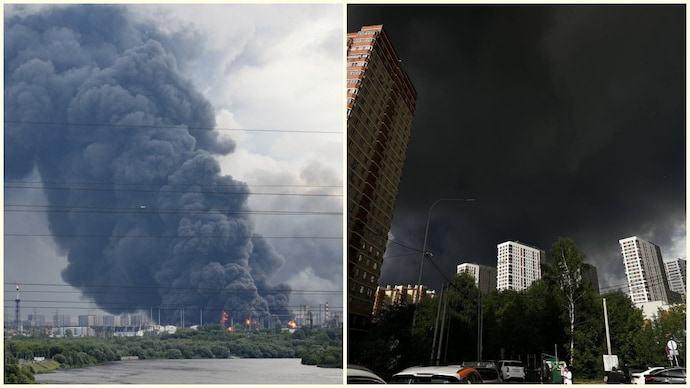
Residents across parts of Moscow reported black stains on cars, roads, and clothing after a Ukrainian drone attack triggered a massive fire at a key oil refinery, raising concerns about a phenomenon commonly known as black rain.
The reports emerged after drones struck the Kapotnya oil refinery in southeast Moscow, one of the city's most important fuel facilities.
The attack, described by Russian officials as part of the largest drone assault on Moscow since the war began, ignited large fires and sent towering plumes of thick black smoke into the atmosphere.
As smoke drifted across the city, residents in districts including Balashikha, Lyubertsy, and southeastern Moscow reported a light drizzle carrying dark, oily particles.
Some described finding black spots on clothes and vehicles, while social media videos showed a thin layer of soot-like residue covering surfaces.
WHAT IS BLACK RAIN?
Black rain occurs when smoke, soot, ash, and other airborne pollutants become mixed with moisture in the atmosphere before falling back to the ground as precipitation.
Instead of clear raindrops, the rain contains tiny particles of carbon, unburnt hydrocarbons, and other contaminants, giving it a dark appearance or leaving black stains after it evaporates.
The phenomenon is most commonly associated with large industrial fires, volcanic eruptions, wildfires, and wartime bombardments. One of the most famous examples occurred after the atomic bombing of Hiroshima in 1945, when radioactive soot and ash mixed with rain clouds and fell as dark-colored precipitation.
In Moscow's case, the likely source was the enormous smoke plume generated by burning petroleum products at the Kapotnya refinery. When oil, diesel, and fuel storage tanks burn, they release large quantities of soot, carbon particles, sulfur compounds, and oily aerosols into the air.
If these particles encounter humid conditions or light rainfall, they can be scavenged from the atmosphere and deposited back onto the surface.
Experts note that such fallout is not literally "oil raining from the sky." Instead, it is precipitation contaminated by airborne pollution generated by the fire.
Depending on the substances involved, exposure can irritate the eyes, skin, and respiratory system, particularly among children, older adults, and people with asthma or other lung conditions.
Although Moscow authorities rejected claims of "oil rain," they advised residents near the affected area to keep windows closed and encouraged vulnerable groups to temporarily leave the district.
The precaution reflects concerns that smoke particles and petroleum-related pollutants may remain suspended in the air even after the visible fire subsides.
With the Kapotnya refinery reportedly supplying around 40 per cent of Moscow's petrol and half of its diesel fuel, the strike has not only disrupted energy infrastructure but also created a striking example of how major industrial fires can alter the local environment, sometimes quite literally causing the sky to rain black.
Residents across parts of Moscow reported black stains on cars, roads, and clothing after a Ukrainian drone attack triggered a massive fire at a key oil refinery, raising concerns about a phenomenon commonly known as black rain.
The reports emerged after drones struck the Kapotnya oil refinery in southeast Moscow, one of the city's most important fuel facilities.
The attack, described by Russian officials as part of the largest drone assault on Moscow since the war began, ignited large fires and sent towering plumes of thick black smoke into the atmosphere.
As smoke drifted across the city, residents in districts including Balashikha, Lyubertsy, and southeastern Moscow reported a light drizzle carrying dark, oily particles.
Some described finding black spots on clothes and vehicles, while social media videos showed a thin layer of soot-like residue covering surfaces.
WHAT IS BLACK RAIN?
Black rain occurs when smoke, soot, ash, and other airborne pollutants become mixed with moisture in the atmosphere before falling back to the ground as precipitation.
Instead of clear raindrops, the rain contains tiny particles of carbon, unburnt hydrocarbons, and other contaminants, giving it a dark appearance or leaving black stains after it evaporates.
The phenomenon is most commonly associated with large industrial fires, volcanic eruptions, wildfires, and wartime bombardments. One of the most famous examples occurred after the atomic bombing of Hiroshima in 1945, when radioactive soot and ash mixed with rain clouds and fell as dark-colored precipitation.
In Moscow's case, the likely source was the enormous smoke plume generated by burning petroleum products at the Kapotnya refinery. When oil, diesel, and fuel storage tanks burn, they release large quantities of soot, carbon particles, sulfur compounds, and oily aerosols into the air.
If these particles encounter humid conditions or light rainfall, they can be scavenged from the atmosphere and deposited back onto the surface.
Experts note that such fallout is not literally "oil raining from the sky." Instead, it is precipitation contaminated by airborne pollution generated by the fire.
Depending on the substances involved, exposure can irritate the eyes, skin, and respiratory system, particularly among children, older adults, and people with asthma or other lung conditions.
Although Moscow authorities rejected claims of "oil rain," they advised residents near the affected area to keep windows closed and encouraged vulnerable groups to temporarily leave the district.
The precaution reflects concerns that smoke particles and petroleum-related pollutants may remain suspended in the air even after the visible fire subsides.
With the Kapotnya refinery reportedly supplying around 40 per cent of Moscow's petrol and half of its diesel fuel, the strike has not only disrupted energy infrastructure but also created a striking example of how major industrial fires can alter the local environment, sometimes quite literally causing the sky to rain black.

