Higher pay, better opportunities, more recognition: Why scientists are leaving Isro
More than 100 scientists have resigned or taken voluntary retirement from Isro, prompting the Department of Space to tighten exit rules for staff on flagship missions.
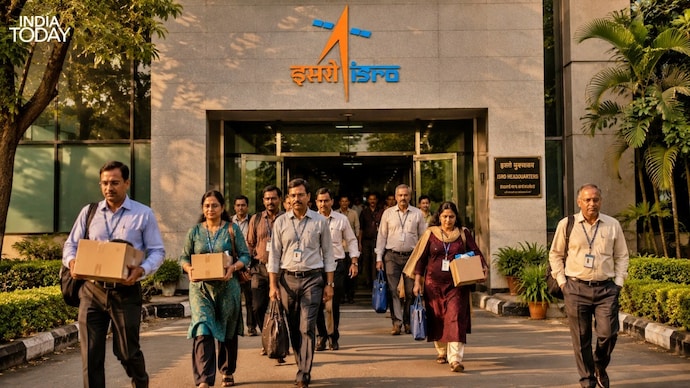
India's space programme is facing an unexpected challenge, not from failed launches or technical setbacks, but from a growing exodus of experienced scientists from the Indian Space Research Organisation (Isro).
Over 100 scientists have either resigned or taken voluntary retirement from the space agency within the last few months.
The Department of Space (DoS) has now stepped in to stem the departures, issuing a fresh directive that restricts resignations and voluntary retirement of scientists working on flagship missions such as Gaganyaan.
While the move points to the strategic importance of retaining talent, it also raises a larger question: Why are scientists choosing to leave Isro at a time when India's space ambitions have never been bigger?
WHY ARE SCIENTISTS LEAVING ISRO?
Industry experts and senior officials within Isro point to a combination of factors ranging from the explosive growth of India's private space sector to organisational bottlenecks and uncertainty surrounding major national missions.
One of the biggest drivers is the emergence of a vibrant private space ecosystem.
Since the space sector was opened to private participation in 2020, startups such as Skyroot Aerospace, Agnikul Cosmos, Pixxel, Bellatrix Aerospace, Dhruva Space, Digantara and several others have transformed India's aerospace landscape.
These companies are developing rockets, satellites, propulsion systems and space-based services at a pace that was unimaginable just a few years ago.
For Isro scientists, the appeal is obvious.
Private companies often offer significantly better salaries, stock options, greater flexibility and the opportunity to work in fast-moving environments where ideas move quickly from the drawing board to hardware.
Unlike traditional government organisations, startups also provide leadership roles at an earlier stage of a scientist's career, along with the opportunity to build entirely new technologies.
The trend is being reinforced by former Isro veterans themselves.
Over the past few years, several retired and former senior Isro officials have gone on to establish or mentor aerospace startups, helping create an ecosystem that is increasingly attracting talent away from the national space agency. Their experience, combined with growing private investment, has opened career paths that previously did not exist for India's aerospace engineers.
However, the attraction of private industry tells only part of the story.
DELAYS, EXTENDED TIMELINE, LOW ACCOUNTABILITY
The departures also come at a time when Isro is grappling with an unusual slowdown in mission execution.
Several high-profile missions, including the Gaganyaan G1 test flight, SSLV-L1, GSLV-F17 and the industry-built PSLV-N1, have slipped beyond their announced timelines.
The twin PSLV setbacks earlier this year have further delayed launch activities, with the agency yet to publicly release a detailed failure assessment.
Within sections of the organisation, there is also growing discussion about decision-making becoming increasingly centralised.
Multiple current and former officials, speaking privately, have suggested that major technical and administrative decisions are now concentrated within the Chairman's Office, slowing approvals and limiting operational flexibility.
EMPLOYMENT MODEL NEEDS TO CHANGE
Senior officials, on condition of anonymity, also said that the space agency needs to look at western space agencies like Nasa and the European Space Agency for their employment models, which are mostly project-based. Nasa's workforce structure combines permanent civil servants, contractors, and project-specific hires.
This gives the agency flexibility while retaining critical institutional expertise. Many space policy experts believe Isro could benefit from expanding this hybrid model.
As India's private space ecosystem grows, Isro can increasingly focus on:
- Mission design and systems engineering.
- Human spaceflight and deep-space exploration.
- Advanced R&D such as reusable rockets and nuclear propulsion.
ISRO RUSHING TO PLUG THE ISSUE
The Department of Space's July 14 memorandum reflects concerns that the departures are affecting nationally important programmes.
Scientists associated with Gaganyaan and other flagship missions will no longer be allowed to leave through routine approvals; instead, every resignation must now be cleared by the Department of Space.
Although the number of departures represents only a small fraction of Isro's workforce of over 14,600 employees, the impact is disproportionately large because many of those leaving possess years of specialised expertise gained through missions such as Chandrayaan-3, SpaDeX and Gaganyaan.
Such knowledge cannot be replaced simply by recruiting new graduates.
The talent shift also reflects a broader transition in India's space sector. For decades, Isro was virtually the only destination for ambitious aerospace engineers.
Today, it has become the anchor of a much larger ecosystem where private companies offer alternative career paths with competitive compensation, faster growth and the opportunity to shape the next generation of space technology.
For Isro, the challenge is no longer just attracting the country's brightest minds, it is also retaining them.
India's space programme is facing an unexpected challenge, not from failed launches or technical setbacks, but from a growing exodus of experienced scientists from the Indian Space Research Organisation (Isro).
Over 100 scientists have either resigned or taken voluntary retirement from the space agency within the last few months.
The Department of Space (DoS) has now stepped in to stem the departures, issuing a fresh directive that restricts resignations and voluntary retirement of scientists working on flagship missions such as Gaganyaan.
While the move points to the strategic importance of retaining talent, it also raises a larger question: Why are scientists choosing to leave Isro at a time when India's space ambitions have never been bigger?
WHY ARE SCIENTISTS LEAVING ISRO?
Industry experts and senior officials within Isro point to a combination of factors ranging from the explosive growth of India's private space sector to organisational bottlenecks and uncertainty surrounding major national missions.
One of the biggest drivers is the emergence of a vibrant private space ecosystem.
Since the space sector was opened to private participation in 2020, startups such as Skyroot Aerospace, Agnikul Cosmos, Pixxel, Bellatrix Aerospace, Dhruva Space, Digantara and several others have transformed India's aerospace landscape.
These companies are developing rockets, satellites, propulsion systems and space-based services at a pace that was unimaginable just a few years ago.
For Isro scientists, the appeal is obvious.
Private companies often offer significantly better salaries, stock options, greater flexibility and the opportunity to work in fast-moving environments where ideas move quickly from the drawing board to hardware.
Unlike traditional government organisations, startups also provide leadership roles at an earlier stage of a scientist's career, along with the opportunity to build entirely new technologies.
The trend is being reinforced by former Isro veterans themselves.
Over the past few years, several retired and former senior Isro officials have gone on to establish or mentor aerospace startups, helping create an ecosystem that is increasingly attracting talent away from the national space agency. Their experience, combined with growing private investment, has opened career paths that previously did not exist for India's aerospace engineers.
However, the attraction of private industry tells only part of the story.
DELAYS, EXTENDED TIMELINE, LOW ACCOUNTABILITY
The departures also come at a time when Isro is grappling with an unusual slowdown in mission execution.
Several high-profile missions, including the Gaganyaan G1 test flight, SSLV-L1, GSLV-F17 and the industry-built PSLV-N1, have slipped beyond their announced timelines.
The twin PSLV setbacks earlier this year have further delayed launch activities, with the agency yet to publicly release a detailed failure assessment.
Within sections of the organisation, there is also growing discussion about decision-making becoming increasingly centralised.
Multiple current and former officials, speaking privately, have suggested that major technical and administrative decisions are now concentrated within the Chairman's Office, slowing approvals and limiting operational flexibility.
EMPLOYMENT MODEL NEEDS TO CHANGE
Senior officials, on condition of anonymity, also said that the space agency needs to look at western space agencies like Nasa and the European Space Agency for their employment models, which are mostly project-based. Nasa's workforce structure combines permanent civil servants, contractors, and project-specific hires.
This gives the agency flexibility while retaining critical institutional expertise. Many space policy experts believe Isro could benefit from expanding this hybrid model.
As India's private space ecosystem grows, Isro can increasingly focus on:
- Mission design and systems engineering.
- Human spaceflight and deep-space exploration.
- Advanced R&D such as reusable rockets and nuclear propulsion.
ISRO RUSHING TO PLUG THE ISSUE
The Department of Space's July 14 memorandum reflects concerns that the departures are affecting nationally important programmes.
Scientists associated with Gaganyaan and other flagship missions will no longer be allowed to leave through routine approvals; instead, every resignation must now be cleared by the Department of Space.
Although the number of departures represents only a small fraction of Isro's workforce of over 14,600 employees, the impact is disproportionately large because many of those leaving possess years of specialised expertise gained through missions such as Chandrayaan-3, SpaDeX and Gaganyaan.
Such knowledge cannot be replaced simply by recruiting new graduates.
The talent shift also reflects a broader transition in India's space sector. For decades, Isro was virtually the only destination for ambitious aerospace engineers.
Today, it has become the anchor of a much larger ecosystem where private companies offer alternative career paths with competitive compensation, faster growth and the opportunity to shape the next generation of space technology.
For Isro, the challenge is no longer just attracting the country's brightest minds, it is also retaining them.
India's space programme is facing an unexpected challenge, not from failed launches or technical setbacks, but from a growing exodus of experienced scientists from the Indian Space Research Organisation (Isro).
Over 100 scientists have either resigned or taken voluntary retirement from the space agency within the last few months.
The Department of Space (DoS) has now stepped in to stem the departures, issuing a fresh directive that restricts resignations and voluntary retirement of scientists working on flagship missions such as Gaganyaan.
While the move points to the strategic importance of retaining talent, it also raises a larger question: Why are scientists choosing to leave Isro at a time when India's space ambitions have never been bigger?
WHY ARE SCIENTISTS LEAVING ISRO?
Industry experts and senior officials within Isro point to a combination of factors ranging from the explosive growth of India's private space sector to organisational bottlenecks and uncertainty surrounding major national missions.
One of the biggest drivers is the emergence of a vibrant private space ecosystem.
Since the space sector was opened to private participation in 2020, startups such as Skyroot Aerospace, Agnikul Cosmos, Pixxel, Bellatrix Aerospace, Dhruva Space, Digantara and several others have transformed India's aerospace landscape.
These companies are developing rockets, satellites, propulsion systems and space-based services at a pace that was unimaginable just a few years ago.
For Isro scientists, the appeal is obvious.
Private companies often offer significantly better salaries, stock options, greater flexibility and the opportunity to work in fast-moving environments where ideas move quickly from the drawing board to hardware.
Unlike traditional government organisations, startups also provide leadership roles at an earlier stage of a scientist's career, along with the opportunity to build entirely new technologies.
The trend is being reinforced by former Isro veterans themselves.
Over the past few years, several retired and former senior Isro officials have gone on to establish or mentor aerospace startups, helping create an ecosystem that is increasingly attracting talent away from the national space agency. Their experience, combined with growing private investment, has opened career paths that previously did not exist for India's aerospace engineers.
However, the attraction of private industry tells only part of the story.
DELAYS, EXTENDED TIMELINE, LOW ACCOUNTABILITY
The departures also come at a time when Isro is grappling with an unusual slowdown in mission execution.
Several high-profile missions, including the Gaganyaan G1 test flight, SSLV-L1, GSLV-F17 and the industry-built PSLV-N1, have slipped beyond their announced timelines.
The twin PSLV setbacks earlier this year have further delayed launch activities, with the agency yet to publicly release a detailed failure assessment.
Within sections of the organisation, there is also growing discussion about decision-making becoming increasingly centralised.
Multiple current and former officials, speaking privately, have suggested that major technical and administrative decisions are now concentrated within the Chairman's Office, slowing approvals and limiting operational flexibility.
EMPLOYMENT MODEL NEEDS TO CHANGE
Senior officials, on condition of anonymity, also said that the space agency needs to look at western space agencies like Nasa and the European Space Agency for their employment models, which are mostly project-based. Nasa's workforce structure combines permanent civil servants, contractors, and project-specific hires.
This gives the agency flexibility while retaining critical institutional expertise. Many space policy experts believe Isro could benefit from expanding this hybrid model.
As India's private space ecosystem grows, Isro can increasingly focus on:
- Mission design and systems engineering.
- Human spaceflight and deep-space exploration.
- Advanced R&D such as reusable rockets and nuclear propulsion.
ISRO RUSHING TO PLUG THE ISSUE
The Department of Space's July 14 memorandum reflects concerns that the departures are affecting nationally important programmes.
Scientists associated with Gaganyaan and other flagship missions will no longer be allowed to leave through routine approvals; instead, every resignation must now be cleared by the Department of Space.
Although the number of departures represents only a small fraction of Isro's workforce of over 14,600 employees, the impact is disproportionately large because many of those leaving possess years of specialised expertise gained through missions such as Chandrayaan-3, SpaDeX and Gaganyaan.
Such knowledge cannot be replaced simply by recruiting new graduates.
The talent shift also reflects a broader transition in India's space sector. For decades, Isro was virtually the only destination for ambitious aerospace engineers.
Today, it has become the anchor of a much larger ecosystem where private companies offer alternative career paths with competitive compensation, faster growth and the opportunity to shape the next generation of space technology.
For Isro, the challenge is no longer just attracting the country's brightest minds, it is also retaining them.

