28°C heatwave big concern: 2026 Fifa World Cup in US, Mexico, Canada at high risk
With the world's biggest sporting event just weeks away, scientists are warning that climate change has made dangerous temperatures at the tournament nearly twice as likely as they were the last time the US hosted it.
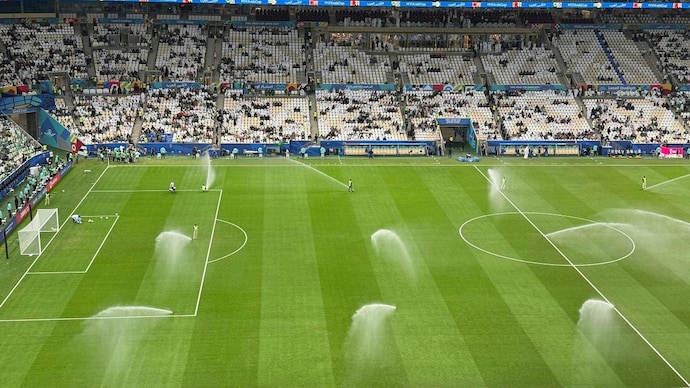
The 2026 FIFA World Cup, set to kick off on June 12 across the United States, Mexico, and Canada this summer, is shaping up to be one of the hottest editions of the global sporting event, where temperatures could spike at one place and rainfall could cancel matches at the other.
A new analysis by climate research group World Weather Attribution has found that roughly a quarter of the tournament's 104 matches are likely to be played in conditions that exceed safety limits recommended by FIFPRO, the global players' union.
That is nearly double the risk recorded at the 1994 World Cup, the last time the United States hosted the tournament. Furthermore, around five matches could take place in conditions so dangerous that postponement would be advised.
The warning lands as concerns about the tournament's climate vulnerability have been building for months.
Similarly, a separate 2025 report titled "Pitches in Peril," found that 14 of the 16 host stadiums across the three countries crossed safety thresholds in 2025 for extreme heat, unplayable rainfall, and flooding.
Cities like Dallas, Houston, Miami, Kansas City, and Atlanta exceeded safe heat limits for two months or more last summer alone.
HOW HOT IS TOO HOT?
Scientists used the Wet Bulb Globe Temperature (WBGT) index to assess risk, which is a measure of how effectively the human body can cool itself, accounting for heat, humidity, and sunlight combined.
FIFPRO recommends mandatory cooling breaks when WBGT crosses 26°C and says matches should be postponed if it exceeds 28°C, which is a level of WBGT equivalent to around 38°C in dry heat or 30°C in high humidity.
More than a third of games with at least a 10% chance of breaching the 26-degree threshold are scheduled at stadiums without air conditioning, including Miami, Kansas City, New York, and Philadelphia.
Even the final at MetLife Stadium in New Jersey now faces a one-in-eight chance of exceeding that threshold, double the risk it would have carried in 1994.
"These estimations justify the need for, and implementation of, a series of mitigation strategies with a view to better protecting players' health and performance when they are exposed to hot conditions," Vincent Gouttebarge, FIFPRO's medical director told news agency Reuters.
FIFA has confirmed it has heat-risk plans in place, including three-minute hydration breaks per half, cooling infrastructure for players and fans, and enhanced medical readiness scaled to real-time conditions.
A CHANGING GAME, A CHANGING FUTURE
Experts stress that the greater risk may be less about medical emergencies and more about the quality of football itself.
"It will be more of a performance issue than a health issue," said Chris Mullington, consultant anaesthetist and clinical senior lecturer at Imperial College London. "These players are elite athletes and acclimatised. You'll see players self-pacing. So you may end up with more conservative football."
The concern also extends well beyond the pitch.
FIFPRO warned that even where air-conditioned stadiums protect players inside, fans at matches and outdoor fan festivals could still face prolonged exposure to dangerous heat.
A survey of 3,600 fans found that 91% want the upcoming tournament to set the standard for sustainability.
Friederike Otto, professor of climate science at Imperial College London, said the findings point to a deeper structural problem.
"From a health point of view, it would be advisable to have these World Cups either earlier or later in the year," she said, "so you can have a football party rather than something that is a massive health risk for the whole city."
The 2026 FIFA World Cup, set to kick off on June 12 across the United States, Mexico, and Canada this summer, is shaping up to be one of the hottest editions of the global sporting event, where temperatures could spike at one place and rainfall could cancel matches at the other.
A new analysis by climate research group World Weather Attribution has found that roughly a quarter of the tournament's 104 matches are likely to be played in conditions that exceed safety limits recommended by FIFPRO, the global players' union.
That is nearly double the risk recorded at the 1994 World Cup, the last time the United States hosted the tournament. Furthermore, around five matches could take place in conditions so dangerous that postponement would be advised.
The warning lands as concerns about the tournament's climate vulnerability have been building for months.
Similarly, a separate 2025 report titled "Pitches in Peril," found that 14 of the 16 host stadiums across the three countries crossed safety thresholds in 2025 for extreme heat, unplayable rainfall, and flooding.
Cities like Dallas, Houston, Miami, Kansas City, and Atlanta exceeded safe heat limits for two months or more last summer alone.
HOW HOT IS TOO HOT?
Scientists used the Wet Bulb Globe Temperature (WBGT) index to assess risk, which is a measure of how effectively the human body can cool itself, accounting for heat, humidity, and sunlight combined.
FIFPRO recommends mandatory cooling breaks when WBGT crosses 26°C and says matches should be postponed if it exceeds 28°C, which is a level of WBGT equivalent to around 38°C in dry heat or 30°C in high humidity.
More than a third of games with at least a 10% chance of breaching the 26-degree threshold are scheduled at stadiums without air conditioning, including Miami, Kansas City, New York, and Philadelphia.
Even the final at MetLife Stadium in New Jersey now faces a one-in-eight chance of exceeding that threshold, double the risk it would have carried in 1994.
"These estimations justify the need for, and implementation of, a series of mitigation strategies with a view to better protecting players' health and performance when they are exposed to hot conditions," Vincent Gouttebarge, FIFPRO's medical director told news agency Reuters.
FIFA has confirmed it has heat-risk plans in place, including three-minute hydration breaks per half, cooling infrastructure for players and fans, and enhanced medical readiness scaled to real-time conditions.
A CHANGING GAME, A CHANGING FUTURE
Experts stress that the greater risk may be less about medical emergencies and more about the quality of football itself.
"It will be more of a performance issue than a health issue," said Chris Mullington, consultant anaesthetist and clinical senior lecturer at Imperial College London. "These players are elite athletes and acclimatised. You'll see players self-pacing. So you may end up with more conservative football."
The concern also extends well beyond the pitch.
FIFPRO warned that even where air-conditioned stadiums protect players inside, fans at matches and outdoor fan festivals could still face prolonged exposure to dangerous heat.
A survey of 3,600 fans found that 91% want the upcoming tournament to set the standard for sustainability.
Friederike Otto, professor of climate science at Imperial College London, said the findings point to a deeper structural problem.
"From a health point of view, it would be advisable to have these World Cups either earlier or later in the year," she said, "so you can have a football party rather than something that is a massive health risk for the whole city."

