Anushka Yadav's heavy metal miracle at The Kalinga
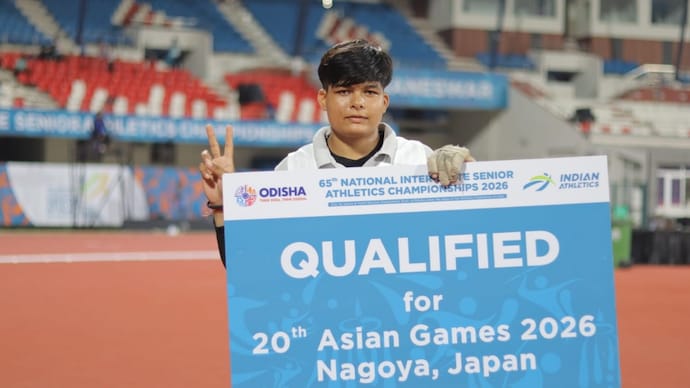
At the Kalinga Stadium, 18-year-old Anushka Yadav broke the women's hammer throw national record twice in one night, throwing 67.02m to qualify for the 2026 Asian Games. She announced herself as one of India's brightest field-event prospects.
In the cage, the world is restricted to a circular 2.135 meters. Out there, in the distance where the hammer lands, reside fame and fortune, certainly, but also something far more precious, self-respect and a sense of belonging within the hammer throwing fraternity.
The community is close-knit, self-contained, and entirely unflamboyant. Unlike the explosive sprinters or the theatrical shot-putters, their expressions, even while competing, remain concealed behind a dense curtain of chains, removed from the direct connection that athletes in other events enjoy with the crowd.
They tend to keep to themselves. Unless someone is exceptionally open, venturing beyond the familiar company of fellow throwers and family, coaxing them into conversation is much like attempting a hammer throw without the ball and chain; plenty of effort, but nothing really moves.
On the evening of June 24, 2026, an extremely humid night, eleven women hammer throwers lined up at the Kalinga Stadium in Bhubaneswar.
At stake was qualification for the upcoming 2026 Asian Games.
Anushka Yadav was there, the 18-year-old 2025 National Games champion with a personal best of 62.89m.
Training alongside her was her senior partner, Tanya Chaudhary, 7th at the 2022 Asian Games with a personal best of 65.77m, on paper, the definitive favourite.
Delhi’s Harshita Sehrawat, the 2024 Interstate Champion with a personal best of 62.77m, and the 2026 Federation Cup champion, Punjab’s Manpreet Kaur, rounded out a formidable field.
Also in the fray were Fed Cup silver medallist, Rajasthan’s Kulvinder, and the bronze medallist Divya Shandilya of the host state, Odisha.
FROM DARK HORSE TO CHAMPION
Before the competition, and through the tense lead-up, a quiet conversation had been building around Anushka.
She was spoken of not only as a dark horse for qualification, but whispers from the training camps suggested her practice throws were consistently crossing the 70m mark.
That straight away made her the perceived frontrunner even though critics pointed toward her age, just 18, and questioned whether she could handle the suffocating stress of a major national trial.
Her first throw of 62.07m set an immediate, punishing tone.
For a thrower, a solid opening mark provides an instant cushion of confidence while dropping pressure onto the rest of the field.
None of the others, including Tanya, could touch the 60m line in the opening round.
On her second attempt, Anushka didn’t just lead; she wiped out history.
She smashed the long-standing national record of 65.25m, held by Sarita Singh since 2017, with a stunning throw of 65.64m, instantly securing her ticket to the Asian Games.
Pulling ahead of her now required a herculean, almost impossible effort; the rest of the field needed to start throwing out of their skins.
Tanya and Harshita rallied, crossing 60m each.
On her third, Anushka pulled out a 64.81m; consistency was her mantra now.
The fourth measured 61.89m, her lowest of the night, followed by a foul on her fifth.
Then came the sixth and final throw.
The Uttar Pradesh girl from Baleni village in Baghpat swung through her turns with flawless rhythm and launched an astonishing 67.02m.
The rest of the field could only watch it sail into the dark Odisha sky.
Not only had the Asian Games qualifying mark been blown away, but she set a marker that none probably could now, or in the near future, hunt down.
The new National Record of 67.02m was deeply embedded into the Kalinga night.
ANUSHKA YADAV'S JOURNEY
To understand the trajectory of the steel ball that Anushka threw into the night, one must look towards Baleni village in Baghpat.
Anushka’s journey to the national record books is a narrative of choices, that in retrospect, can be termed as destiny redirecting.
Hailing from a farming family, where her father, Sushil Yadav’s, hammer throwing career was cut short by the realities of rural life.
“I had to leave the sport when I was 18 due to family responsibilities and my marriage,” Sushil Yadav recalled on the Kalinga sidelines, his eyes reflecting the stadium floodlights.
“Since then, I wanted to make one of my kids a hammer thrower. Initially, my son started, and Anushka just started coming along to the ground.
Then, I realized that her body type, her leverage, and her natural rotational movements were perfectly conducive for the event."
Anushka’s first love wasn’t the cage.
She wanted to run; the 100m.
“My first choice was running,” Anushka admitted with a smile.
“But when Papa said that I have to do the hammer throw, I did so.
I train at our local ground, which is a hub for throwers, we have international athletes like Tanya training right there.
Between my father, Chirag Yadav, and Gagan Yadav, I have three personal coaches.
When Papa is at the farm in the morning, the seniors look after me.
When he returns in the evening, he takes over.”
A FREAK ACCIDENT BEFORE INTERSTATE
The road to the Kalinga Stadium, however, was nearly derailed three months ago by a freak agricultural accident at home.
In March 2026, while attempting to help her father connect a heavy tiller to their farm tractor, her brother mistakenly engaged the vehicle, causing it to run over her foot and inflict a severe ligament fracture in her right knee.
For two months, she couldn’t throw.
“It was a big setback,” Anushka said.
“But I did small drills and kept in touch with the movement.”
Her father added, “To come out of the injury and break the national record twice in the space of six throws is fulfilling.”
Rarely has a field athlete come into the consciousness of a nation so young.
'I WANT PEOPLE TO KNOW HAMMER THROW'
In the hierarchy of Indian athletics media, sprinters like Gurindervir Singh and Animesh Kujur are traditionally the pomp of the track show.
The 100-meter dash is an uncomplicated, immediate showstopper.
But Anushka’s historic mark in Bhubaneswar signals that the field events are demanding their own spotlight.
“Not many people know hammer throw in India, but everybody knows javelin throw because of Neeraj bhaiya,” Anushka stated candidly.
“I want people to know hammer throw just like javelin throw.
I am looking for a gold in the upcoming Asian Games.”
ANUSHKA vs THE WORLD
To gauge the magnitude of Anushka’s 67.02m, one must contextualize it within international parameters.
On the continental stage, her new record instantly vaults her into elite company.
At the last Asian Games, South Korea’s Kim Tae-hui secured the bronze medal with a throw of 64.14m, a mark Anushka comfortably bypassed three times on Wednesday night.
The continental gold standard, however, remains with China, where throwers like Wang Zheng have historically dominated, routinely clearing the 74-to-75-meter threshold.
On the global stage, the gap between domestic excellence and world-tier dominance underscores the massive mountain Indian throwers have yet to climb.
The absolute peak in the sport is currently occupied by Canada’s world and Olympic champion Camryn Rodgers, who recently launched an astonishing 81.13m in April 2026, at Austin, Texas chasing Anita Wlodarczyk’s legendary world record of 82.98m.
For an 18-year-old Indian athlete training on a village college ground, throwing 67.02m is not just a ‘headline’ milestone; it is a significant step toward narrowing that global deficit.
With the inherent talent in her arms, her technical proficiency can only improve by the time she hits her physical peak around the age of 22 to 24.
That is the maturation window where heavy throwers finally master their centre of gravity and implement those precise technical shifts that can increase throwing margins by an additional five to six meters.
Once Anushka consistently crosses that elusive 70-meter barrier, she will enter completely uncharted territory for Indian women's athletics.
Big championships, however, bring their own unique brand of isolating pressure.
For Anushka Yadav, the long, grinding journey toward meeting those expectations begins now; the relatively straightforward task of displaying raw talent is finished.
Eventually, to survive at the absolute top of the international circle, it is relentless consistency, not just a solitary Kalinga night miracle that matters.
In the cage, the world is restricted to a circular 2.135 meters. Out there, in the distance where the hammer lands, reside fame and fortune, certainly, but also something far more precious, self-respect and a sense of belonging within the hammer throwing fraternity.
The community is close-knit, self-contained, and entirely unflamboyant. Unlike the explosive sprinters or the theatrical shot-putters, their expressions, even while competing, remain concealed behind a dense curtain of chains, removed from the direct connection that athletes in other events enjoy with the crowd.
They tend to keep to themselves. Unless someone is exceptionally open, venturing beyond the familiar company of fellow throwers and family, coaxing them into conversation is much like attempting a hammer throw without the ball and chain; plenty of effort, but nothing really moves.
On the evening of June 24, 2026, an extremely humid night, eleven women hammer throwers lined up at the Kalinga Stadium in Bhubaneswar.
At stake was qualification for the upcoming 2026 Asian Games.
Anushka Yadav was there, the 18-year-old 2025 National Games champion with a personal best of 62.89m.
Training alongside her was her senior partner, Tanya Chaudhary, 7th at the 2022 Asian Games with a personal best of 65.77m, on paper, the definitive favourite.
Delhi’s Harshita Sehrawat, the 2024 Interstate Champion with a personal best of 62.77m, and the 2026 Federation Cup champion, Punjab’s Manpreet Kaur, rounded out a formidable field.
Also in the fray were Fed Cup silver medallist, Rajasthan’s Kulvinder, and the bronze medallist Divya Shandilya of the host state, Odisha.
FROM DARK HORSE TO CHAMPION
Before the competition, and through the tense lead-up, a quiet conversation had been building around Anushka.
She was spoken of not only as a dark horse for qualification, but whispers from the training camps suggested her practice throws were consistently crossing the 70m mark.
That straight away made her the perceived frontrunner even though critics pointed toward her age, just 18, and questioned whether she could handle the suffocating stress of a major national trial.
Her first throw of 62.07m set an immediate, punishing tone.
For a thrower, a solid opening mark provides an instant cushion of confidence while dropping pressure onto the rest of the field.
None of the others, including Tanya, could touch the 60m line in the opening round.
On her second attempt, Anushka didn’t just lead; she wiped out history.
She smashed the long-standing national record of 65.25m, held by Sarita Singh since 2017, with a stunning throw of 65.64m, instantly securing her ticket to the Asian Games.
Pulling ahead of her now required a herculean, almost impossible effort; the rest of the field needed to start throwing out of their skins.
Tanya and Harshita rallied, crossing 60m each.
On her third, Anushka pulled out a 64.81m; consistency was her mantra now.
The fourth measured 61.89m, her lowest of the night, followed by a foul on her fifth.
Then came the sixth and final throw.
The Uttar Pradesh girl from Baleni village in Baghpat swung through her turns with flawless rhythm and launched an astonishing 67.02m.
The rest of the field could only watch it sail into the dark Odisha sky.
Not only had the Asian Games qualifying mark been blown away, but she set a marker that none probably could now, or in the near future, hunt down.
The new National Record of 67.02m was deeply embedded into the Kalinga night.
ANUSHKA YADAV'S JOURNEY
To understand the trajectory of the steel ball that Anushka threw into the night, one must look towards Baleni village in Baghpat.
Anushka’s journey to the national record books is a narrative of choices, that in retrospect, can be termed as destiny redirecting.
Hailing from a farming family, where her father, Sushil Yadav’s, hammer throwing career was cut short by the realities of rural life.
“I had to leave the sport when I was 18 due to family responsibilities and my marriage,” Sushil Yadav recalled on the Kalinga sidelines, his eyes reflecting the stadium floodlights.
“Since then, I wanted to make one of my kids a hammer thrower. Initially, my son started, and Anushka just started coming along to the ground.
Then, I realized that her body type, her leverage, and her natural rotational movements were perfectly conducive for the event."
Anushka’s first love wasn’t the cage.
She wanted to run; the 100m.
“My first choice was running,” Anushka admitted with a smile.
“But when Papa said that I have to do the hammer throw, I did so.
I train at our local ground, which is a hub for throwers, we have international athletes like Tanya training right there.
Between my father, Chirag Yadav, and Gagan Yadav, I have three personal coaches.
When Papa is at the farm in the morning, the seniors look after me.
When he returns in the evening, he takes over.”
A FREAK ACCIDENT BEFORE INTERSTATE
The road to the Kalinga Stadium, however, was nearly derailed three months ago by a freak agricultural accident at home.
In March 2026, while attempting to help her father connect a heavy tiller to their farm tractor, her brother mistakenly engaged the vehicle, causing it to run over her foot and inflict a severe ligament fracture in her right knee.
For two months, she couldn’t throw.
“It was a big setback,” Anushka said.
“But I did small drills and kept in touch with the movement.”
Her father added, “To come out of the injury and break the national record twice in the space of six throws is fulfilling.”
Rarely has a field athlete come into the consciousness of a nation so young.
'I WANT PEOPLE TO KNOW HAMMER THROW'
In the hierarchy of Indian athletics media, sprinters like Gurindervir Singh and Animesh Kujur are traditionally the pomp of the track show.
The 100-meter dash is an uncomplicated, immediate showstopper.
But Anushka’s historic mark in Bhubaneswar signals that the field events are demanding their own spotlight.
“Not many people know hammer throw in India, but everybody knows javelin throw because of Neeraj bhaiya,” Anushka stated candidly.
“I want people to know hammer throw just like javelin throw.
I am looking for a gold in the upcoming Asian Games.”
ANUSHKA vs THE WORLD
To gauge the magnitude of Anushka’s 67.02m, one must contextualize it within international parameters.
On the continental stage, her new record instantly vaults her into elite company.
At the last Asian Games, South Korea’s Kim Tae-hui secured the bronze medal with a throw of 64.14m, a mark Anushka comfortably bypassed three times on Wednesday night.
The continental gold standard, however, remains with China, where throwers like Wang Zheng have historically dominated, routinely clearing the 74-to-75-meter threshold.
On the global stage, the gap between domestic excellence and world-tier dominance underscores the massive mountain Indian throwers have yet to climb.
The absolute peak in the sport is currently occupied by Canada’s world and Olympic champion Camryn Rodgers, who recently launched an astonishing 81.13m in April 2026, at Austin, Texas chasing Anita Wlodarczyk’s legendary world record of 82.98m.
For an 18-year-old Indian athlete training on a village college ground, throwing 67.02m is not just a ‘headline’ milestone; it is a significant step toward narrowing that global deficit.
With the inherent talent in her arms, her technical proficiency can only improve by the time she hits her physical peak around the age of 22 to 24.
That is the maturation window where heavy throwers finally master their centre of gravity and implement those precise technical shifts that can increase throwing margins by an additional five to six meters.
Once Anushka consistently crosses that elusive 70-meter barrier, she will enter completely uncharted territory for Indian women's athletics.
Big championships, however, bring their own unique brand of isolating pressure.
For Anushka Yadav, the long, grinding journey toward meeting those expectations begins now; the relatively straightforward task of displaying raw talent is finished.
Eventually, to survive at the absolute top of the international circle, it is relentless consistency, not just a solitary Kalinga night miracle that matters.

