India-Pakistan handshake row: MCC admits it cannot force players to shake hands
The Marylebone Cricket Club (MCC) would like to see India and Pakistan players shake hands, but admits it cannot insist on the customary gesture amid instructions from higher authorities. The club's Laws Manager and Head of Cricket, Fraser Stewart, said the issue was beyond its control, with bigger matters at play.
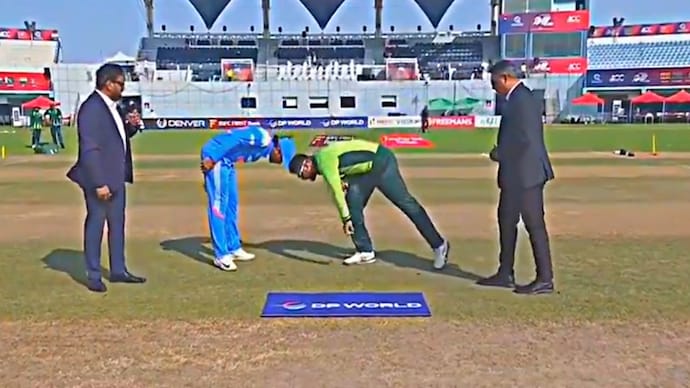
The India-Pakistan handshake row has once again come into focus after the two teams avoided the customary exchange of greetings following their Asia Cup Rising Stars match in Doha on Sunday. While the Marylebone Cricket Club (MCC) is the custodian of the Laws of Cricket, it has little authority over such decisions, with matters involving player conduct and international cricket falling under the jurisdiction of the International Cricket Council (ICC) and, in certain cases, individual cricket boards.
India A, led by Tilak Varma, lost to Pakistan on Sunday, but the absence of handshakes once again drew attention. Players from the two sides did not exchange greetings either before or after the match, continuing a practice followed by Indian cricket teams since last year's Asia Cup in Dubai.
The MCC and the ICC have distinct roles in the administration of cricket. The MCC, founded in 1787, is responsible for maintaining, interpreting, and updating the Laws of Cricket, which define how the game is played. The ICC, meanwhile, is the global governing body of international cricket. It oversees international tournaments, frames playing conditions and enforces its Code of Conduct, which deals with player behaviour and disciplinary matters.
While the MCC can advocate sportsmanship and fair play, it cannot compel players to shake hands or intervene in decisions taken by teams and their governing boards.
"If there are edicts coming from above about handshakes, that's not something that MCC can control. We would like to see it, but we realise there are bigger issues at play, and that's something beyond our control," Fraser Stewart, the MCC's Laws Manager and Head of Cricket, said.
India A vs Pakistan A, Rising Stars Asia Cup Highlights
Stewart, who is in the UAE for the ongoing ILT20 season, declined to comment directly on the no-handshake policy followed during India-Pakistan matches, saying the issue went beyond cricket.
"There are certain instances that transcend cricket and come from a level that's above my station to talk about geopolitical situations. What we can control is that, on the field, the players respect each other, they respect the umpires, the authority of the umpires and the game," he said.
He added that the MCC could only focus on conduct within the sport and had no authority to challenge decisions taken at a higher level.
FREE HITS IN TEST CRICKET? MCC OPEN TO IDEA
Stewart also revealed that the MCC could consider introducing free hits after no-balls in Test cricket.
Free hits are currently part of the playing regulations in limited-overs cricket but are not included in the Laws of Cricket. The MCC has discussed extending the provision to all formats but has not taken a decision.
"Free hits, they're not in the laws at the moment. It's something we will consider. So they only exist as playing regulations," Stewart said.
"We've discussed it, but at the moment we've stopped short of bringing free hits into all cricket, but you never know. Eventually we'll get there," he added.
MCC LOOKS TO MAKE CRICKET LAWS MORE ACCESSIBLE
The MCC is also working with national sports bodies to translate cricket's laws into regional languages, making them easier for players and fans to understand.
The rule book is now available in Hindi, Urdu, Kannada, Marathi and Bangla, alongside English. Stewart said he had visited India in October to launch the translations and was headed to Sri Lanka to introduce two more language versions.
"I was in India at the beginning of October launching that, and we have it in Urdu, Hindi, Kannada, Marathi and Bangla, as well as English, obviously. And I'm off to Sri Lanka tonight, and we'll be launching it in two more languages for Sri Lankan people," he said.
"Part of our role is to make the game accessible. The laws are complicated. They're not an easy read, particularly when they're not in your first language, so it's on us to try to make those laws understandable," Stewart added.

