How the mighty have fallen: What went wrong for Germany and Italy
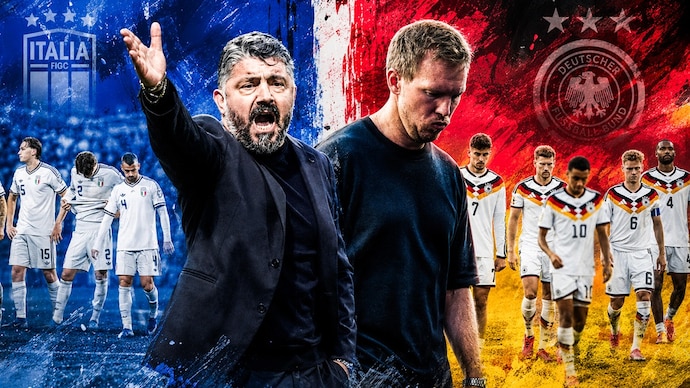
Once football's gold standard, Germany and Italy are no longer setting the benchmark. Germany lost its edge. Italy lost its way. Both have watched the rest of the football world overtake them. The climb back to the top will demand far more than another man in the dugout.
Let's go back to Belo Horizonte, Brazil, July 8, 2014, for a second. If you're not a die-hard football fan, you might not know this game off the top of your head, but you've probably heard the score somewhere, because it's become one of those numbers people just repeat: 7-1.
That was Germany, in a World Cup semifinal, against Brazil, the host nation, playing in front of their own fans. It wasn't a close game that got out of hand late. It was a total, humiliating dismantling, the kind of result people still bring up years later as the go-to example of a team getting torn apart on the biggest stage there is. Four days after that, Germany went on to win the whole tournament. For a while after that, it felt like nobody could touch them.
Twelve years, as it turns out, is enough time to make untouchable look like a long time ago.
Fast-forward to this summer's World Cup. Jose Canale, a 29-year-old center-back playing his first match ever for Paraguay, jogs up to take a penalty after two of his teammates had already missed theirs. He'd said four months earlier he didn't think he'd ever get a cap. Now here he is, staring down Manuel Neuer, 40 years old and somehow still Manuel Neuer, and he buries it.
Cue bedlam. A Paraguayan TV reporter apparently shot out of his chair mid-broadcast and started sobbing under his desk. Somewhere off to the side, eleven Germans stood there not looking at each other, the way people do when something has just ended and nobody's ready to say it out loud.
Germany didn't just lose to Paraguay on penalties in the Round of 32, they watched the last bit of their old aura get taken off them, in real time, by a team that had never beaten them before.
After Germany's loss, the conversation swung south, almost immediately, to a country that's been living this exact nightmare for years. Italy isn't dealing with one bad tournament. They just missed their third World Cup in a row, beaten on penalties by Bosnia and Herzegovina in a qualifying playoff in Zenica, a small industrial town that now means something it was never supposed to mean in Italian football history. The Azzurri stood and watched the home fans celebrate. There wasn't much else to do.
So here we are. Two nations, eight World Cup titles between them, decades spent as the standard everyone else measured themselves against. And in the summer of 2026, both are getting asked the same blunt question: what happened to you?
Turns out the answer isn't the same for both of them. Not even close.
DIE MANNSCHAFT'S IDENTITY CRISIS
Italy's decline has gone on so long it barely qualifies as news anymore. Germany's is different. Every couple of years, it looks as though they've turned the corner, right before they don't.
This tournament followed the same pattern. For a stretch, Germany looked like Germany. Deniz Undav came off the bench against Ivory Coast in Toronto, equalised inside seven minutes and scored the winner late. His goals kept Germany's tournament alive. Without him, they're probably out in the group stage.
Then Nagelsmann hooked him on the hour against Paraguay, and it all unravelled. Extra time. Penalties. Germany's first World Cup shootout defeat. Since winning the World Cup in 2014, they have not won a single knockout match or kept a clean sheet in one.
Ashley Westwood, who came through Manchester United's academy and now manages Kerala Blasters in the Indian Super League, is part of Zee5's expert panel for the FIFA World Cup. He's not interested in lumping Germany's exit together with Italy's collapse.
"It's hard to compare with anything else," he told India Today in an exclusive interview. "What we do know is Germany have just not been good enough, and they need to have a little bit of a reset."
Much of the criticism has centred on Julian Nagelsmann's habit of changing systems from game to game. Even Philipp Lahm, who captained Germany to the 2014 title, has said this team never found any continuity. Westwood understands the thinking behind the tactical flexibility but believes it missed the point.
"Arguably, that's not what Germany needed," he said. "They needed to concentrate on what they do well and purify that, rather than tweaking and changing, put your key players in the right positions and get the best out of them. I can see why he does it, but it hasn't worked for Germany."
HOW TEAMS BREAK DOWN GERMANY
On the pitch, that has produced a team that's easy to scout and hard to watch. The build-up has become slow and predictable, allowing deep defensive blocks to absorb pressure and force Germany into hopeful crosses and long-range efforts. There's no genuine No. 10 pulling the strings, creativity falls on the full-backs, and transitions leave too much space through midfield.
Even set-pieces, once a German strength, have become a weakness. Injuries to Lennart Karl, Serge Gnabry and Nico Schlotterbeck didn't help, but bigger nations can usually absorb the loss of a starter or two. Germany, despite being Europe's biggest football nation, couldn't.
Here's the part that should worry German football most: they've solved this problem before. In the early 2000s, Germany were technically limited, tactically behind the curve and relying heavily on Oliver Kahn. The DFB tore up the old model, invested heavily in academies, prioritised technical players and carried that philosophy through to the senior side under Jurgen Klinsmann and Joachim Low. Ten years later came the 2014 World Cup.
That system isn't producing players the way it once did. What's missing, according to Westwood, isn't a plan. It's a certain calibre of player.
"What the Germans do well is they have a lot of very good players. Probably Musiala is the most talented right now," he said. "But they don't have millions of them, like France, who've got eight or nine match-winners. I wouldn't say they're doing too much wrong favouring individual brilliance. I think they're just a little bit short of the highest grade of world-class players."
Strip away the coaching debate, and that's the story. No financial crisis. No crumbling stadiums. No talent drain. Just a very good group of players managed like they need constant reinvention, when what they probably needed all along was someone to pick a plan and stick with it.
ITALY SAW THIS COMING AND DID NOTHING
Germany's problem is a stumble. Italy's is closer to something that's been rotting quietly for twenty years while everyone kept insisting it would sort itself out.
To understand how far Italy have fallen, you have to remember how high they once stood. Through the 1980s and 1990s, Serie A wasn't just good, It was the best league in the world. Juventus, Milan, Inter and Napoli were packed with the game's biggest stars. Diego Maradona is still revered in Naples for what he did there. The national team matched that success, winning the World Cup in 1982 and coming within a penalty shootout of another title in 1994. Roberto Baggio's missed spot-kick against Brazil now looks almost like a warning in hindsight.
There was one more great chapter left. Italy won the 2006 World Cup, beating France in the final just weeks after the biggest corruption scandal in Italian football history - Calciopoli - tore the game apart.
Thirteen clubs were dragged into a two-year investigation into manipulated referee appointments. Juventus were stripped of their title and relegated, and Deloitte estimated Serie A lost €236 million in revenue, largely because of that decision, even as the wider European football economy continued to grow.
But Calciopoli didn't start Italy's decline. It simply accelerated it. While the Premier League spent the 1990s transforming itself into a global product through huge broadcast deals and international expansion, Serie A largely relied on its reputation. By the time the scandal broke, England had already overtaken it. Calciopoli only widened the gap.
If you want one statistic that captures the decline, look at 2010, the last time an Italian club won the Champions League. Inter beat Bayern Munich in the final without starting a single Italian player.
Fifteen years later, little has changed. Only two Italian clubs reached the knockout stages of European football last season, Bologna in the Europa League and Fiorentina in the Conference League.
The stadiums tell much of the story. San Siro, the Olimpico, the Maradona and the Marassi remain iconic, but most are ageing because the clubs do not own them. Local governments control the stadiums, often lack the money to modernise them and are reluctant to sell. It is no coincidence that Juventus, the one major Italian club to own its stadium, has also been the country's most consistently competitive side over the last two decades.
That financial reality filters down to youth development. Clubs dependent on prize money and under constant pressure to win are reluctant to trust young players. Instead, many spend years moving between Serie A and Serie B on loan, never settling long enough to develop. Too often, players who looked exceptional at 17 become little more than solid Serie A professionals by 24.
Italy's league structure doesn't help either. Lower-league clubs collapse with alarming regularity, disrupting academies and player development, particularly in the poorer south where football infrastructure is already fragile.
Roberto Baggio warned about all of this long before it became impossible to ignore. As the federation's technical director, he produced a 900-page blueprint for rebuilding Italian football from the grassroots up. He resigned in 2013 after repeatedly failing to convince those in charge.
"I presented my project in December 2011, 900 pages, but they remained empty words," Baggio said at the time. "I don't like just sitting on a chair without doing anything, so reluctantly I decided to leave."
Ashley Westwood believes the problem wasn't that Italy ignored the warning, but that nobody wanted to confront how expensive and time-consuming the solution would be.
"It looks like they've identified the failures now," he said. "But it takes a long time, it's not a quick fix. You go back to St George's Park in England, three, four, five hundred million pounds went into that National Training Centre. It's a massive plan, and that's what it takes to get back to the highest level."
That's what should worry Italy most. Baggio sounded the alarm 15 years ago. The federation is still trying to catch up.
SAME DIAGNOSIS, DIFFERENT DISEASES
It'd be easy to put Germany and Italy into one story about fallen giants. Ashley Westwood keeps pushing back against that idea, and he's right to. These are two very different situations.
Italy's problems run much deeper. Their stadiums are ageing, the lower leagues are struggling to produce enough young talent, and Serie A fell behind England and Spain financially years ago and has never truly recovered.
Germany's problems, by comparison, are simpler. They have a good but not great generation of players, led by a coach whose search for the perfect system may have got in the way of letting them play to their strengths.
Yet both Westwood and India defender Sandesh Jhingan agree on one thing: the rest of the football world has caught up.
"I won't say it's a lack of elite talent or the football systems have stopped producing players. I think it's great for football. So many other teams are investing in grassroots football and spending money on their senior teams for both men and women. The sport is growing globally, and because of that the competition is increasing. Germany and Italy will be disappointed, but that's what makes football so beautiful. No matter how rich your history is, nobody stands still," Jhingan, who is part of Zee5's FIFA World Cup expert panel, said.
"Everybody's catching up. Everybody's developing," Westwood said. "There are hundreds, if not thousands, of African players playing in the top leagues in the world now. The money to be a top footballer is massive, and that filters down. Coaching, tactics, analysts, nutrition, sports science, it's all available to everyone now, not just the big federations."
CAN THE GIANTS RISE AGAIN?
The fallout didn't take long to arrive. Germany's disappointing campaign has already claimed its first big casualty: Julian Nagelsmann has stepped down as head coach in the wake of that Round of 32 exit to Paraguay. The DFB confirmed it will now open talks with Jurgen Klopp, the former Liverpool manager, about taking over the national team. It's a move the German public has wanted for a while. Klopp is the closest thing German football has to a messiah figure right now, and bringing him in plays well with a fan base that's furious and looking for someone, anyone, to fix this.
But sacking Nagelsmann and rolling out the red carpet for Klopp might calm the noise but will not solve anything underneath it. Klopp made his name at Liverpool by building a specific kind of team: high-octane, emotionally charged, built around signings he handpicked to fit his system. A national team doesn't work that way. He can't go out and buy the players Germany is missing. He inherits whatever the pipeline hands him, and right now that pipeline is producing very good players, not the handful of genuine match-winners a team needs to go all the way. This was never really a Nagelsmann problem. It's a systemic one, and systemic problems don't get solved by a managerial change, no matter how iconic the replacement is.
Italy's reckoning has been even more brutal. The playoff defeat to Bosnia and Herzegovina didn't just end their World Cup hopes. It blew up the entire federation. President Gabriele Gravina resigned. So did national team delegation chief Gianluigi Buffon and head coach Gennaro Gattuso. Three of the most recognizable names in Italian football, gone within days of each other. That's not a coaching change. That's a federation admitting, in public, that everything about the current setup has failed.
What comes next actually matters, for once. The FIGC has already launched new youth development projects aimed at fixing the pipeline that's been leaking talent for years. On the stadium front, real change means the government finally cutting through the bureaucracy that's kept clubs locked out of owning their own grounds, so more of them can do what Juventus did. And at the top, the wave of resignations, ugly as it's been, at least sends the right signal: the old way of running Italian football is no longer acceptable to anyone, including the people who used to run it.
None of this will be fixed overnight. A four-time World Cup winner should never be written off, and Italy's history demands respect. But this is no longer a bad tournament. It's three straight World Cups missed. The way back will not come through a new coach or a rousing speech. It will take years of patient, disciplined rebuilding.
Germany has rebuilt before and knows what it demands. Italy is only now beginning the process after wasting three World Cup cycles. Both nations have the pedigree to return. Whether they have the patience to do what it takes is the question that will define the next decade.
FIFA World Cup | FIFA World Cup Schedule | FIFA World Cup Points Table | Football News
Let's go back to Belo Horizonte, Brazil, July 8, 2014, for a second. If you're not a die-hard football fan, you might not know this game off the top of your head, but you've probably heard the score somewhere, because it's become one of those numbers people just repeat: 7-1.
That was Germany, in a World Cup semifinal, against Brazil, the host nation, playing in front of their own fans. It wasn't a close game that got out of hand late. It was a total, humiliating dismantling, the kind of result people still bring up years later as the go-to example of a team getting torn apart on the biggest stage there is. Four days after that, Germany went on to win the whole tournament. For a while after that, it felt like nobody could touch them.
Twelve years, as it turns out, is enough time to make untouchable look like a long time ago.
Fast-forward to this summer's World Cup. Jose Canale, a 29-year-old center-back playing his first match ever for Paraguay, jogs up to take a penalty after two of his teammates had already missed theirs. He'd said four months earlier he didn't think he'd ever get a cap. Now here he is, staring down Manuel Neuer, 40 years old and somehow still Manuel Neuer, and he buries it.
Cue bedlam. A Paraguayan TV reporter apparently shot out of his chair mid-broadcast and started sobbing under his desk. Somewhere off to the side, eleven Germans stood there not looking at each other, the way people do when something has just ended and nobody's ready to say it out loud.
Germany didn't just lose to Paraguay on penalties in the Round of 32, they watched the last bit of their old aura get taken off them, in real time, by a team that had never beaten them before.
After Germany's loss, the conversation swung south, almost immediately, to a country that's been living this exact nightmare for years. Italy isn't dealing with one bad tournament. They just missed their third World Cup in a row, beaten on penalties by Bosnia and Herzegovina in a qualifying playoff in Zenica, a small industrial town that now means something it was never supposed to mean in Italian football history. The Azzurri stood and watched the home fans celebrate. There wasn't much else to do.
So here we are. Two nations, eight World Cup titles between them, decades spent as the standard everyone else measured themselves against. And in the summer of 2026, both are getting asked the same blunt question: what happened to you?
Turns out the answer isn't the same for both of them. Not even close.
DIE MANNSCHAFT'S IDENTITY CRISIS
Italy's decline has gone on so long it barely qualifies as news anymore. Germany's is different. Every couple of years, it looks as though they've turned the corner, right before they don't.
This tournament followed the same pattern. For a stretch, Germany looked like Germany. Deniz Undav came off the bench against Ivory Coast in Toronto, equalised inside seven minutes and scored the winner late. His goals kept Germany's tournament alive. Without him, they're probably out in the group stage.
Then Nagelsmann hooked him on the hour against Paraguay, and it all unravelled. Extra time. Penalties. Germany's first World Cup shootout defeat. Since winning the World Cup in 2014, they have not won a single knockout match or kept a clean sheet in one.
Ashley Westwood, who came through Manchester United's academy and now manages Kerala Blasters in the Indian Super League, is part of Zee5's expert panel for the FIFA World Cup. He's not interested in lumping Germany's exit together with Italy's collapse.
"It's hard to compare with anything else," he told India Today in an exclusive interview. "What we do know is Germany have just not been good enough, and they need to have a little bit of a reset."
Much of the criticism has centred on Julian Nagelsmann's habit of changing systems from game to game. Even Philipp Lahm, who captained Germany to the 2014 title, has said this team never found any continuity. Westwood understands the thinking behind the tactical flexibility but believes it missed the point.
"Arguably, that's not what Germany needed," he said. "They needed to concentrate on what they do well and purify that, rather than tweaking and changing, put your key players in the right positions and get the best out of them. I can see why he does it, but it hasn't worked for Germany."
HOW TEAMS BREAK DOWN GERMANY
On the pitch, that has produced a team that's easy to scout and hard to watch. The build-up has become slow and predictable, allowing deep defensive blocks to absorb pressure and force Germany into hopeful crosses and long-range efforts. There's no genuine No. 10 pulling the strings, creativity falls on the full-backs, and transitions leave too much space through midfield.
Even set-pieces, once a German strength, have become a weakness. Injuries to Lennart Karl, Serge Gnabry and Nico Schlotterbeck didn't help, but bigger nations can usually absorb the loss of a starter or two. Germany, despite being Europe's biggest football nation, couldn't.
Here's the part that should worry German football most: they've solved this problem before. In the early 2000s, Germany were technically limited, tactically behind the curve and relying heavily on Oliver Kahn. The DFB tore up the old model, invested heavily in academies, prioritised technical players and carried that philosophy through to the senior side under Jurgen Klinsmann and Joachim Low. Ten years later came the 2014 World Cup.
That system isn't producing players the way it once did. What's missing, according to Westwood, isn't a plan. It's a certain calibre of player.
"What the Germans do well is they have a lot of very good players. Probably Musiala is the most talented right now," he said. "But they don't have millions of them, like France, who've got eight or nine match-winners. I wouldn't say they're doing too much wrong favouring individual brilliance. I think they're just a little bit short of the highest grade of world-class players."
Strip away the coaching debate, and that's the story. No financial crisis. No crumbling stadiums. No talent drain. Just a very good group of players managed like they need constant reinvention, when what they probably needed all along was someone to pick a plan and stick with it.
ITALY SAW THIS COMING AND DID NOTHING
Germany's problem is a stumble. Italy's is closer to something that's been rotting quietly for twenty years while everyone kept insisting it would sort itself out.
To understand how far Italy have fallen, you have to remember how high they once stood. Through the 1980s and 1990s, Serie A wasn't just good, It was the best league in the world. Juventus, Milan, Inter and Napoli were packed with the game's biggest stars. Diego Maradona is still revered in Naples for what he did there. The national team matched that success, winning the World Cup in 1982 and coming within a penalty shootout of another title in 1994. Roberto Baggio's missed spot-kick against Brazil now looks almost like a warning in hindsight.
There was one more great chapter left. Italy won the 2006 World Cup, beating France in the final just weeks after the biggest corruption scandal in Italian football history - Calciopoli - tore the game apart.
Thirteen clubs were dragged into a two-year investigation into manipulated referee appointments. Juventus were stripped of their title and relegated, and Deloitte estimated Serie A lost €236 million in revenue, largely because of that decision, even as the wider European football economy continued to grow.
But Calciopoli didn't start Italy's decline. It simply accelerated it. While the Premier League spent the 1990s transforming itself into a global product through huge broadcast deals and international expansion, Serie A largely relied on its reputation. By the time the scandal broke, England had already overtaken it. Calciopoli only widened the gap.
If you want one statistic that captures the decline, look at 2010, the last time an Italian club won the Champions League. Inter beat Bayern Munich in the final without starting a single Italian player.
Fifteen years later, little has changed. Only two Italian clubs reached the knockout stages of European football last season, Bologna in the Europa League and Fiorentina in the Conference League.
The stadiums tell much of the story. San Siro, the Olimpico, the Maradona and the Marassi remain iconic, but most are ageing because the clubs do not own them. Local governments control the stadiums, often lack the money to modernise them and are reluctant to sell. It is no coincidence that Juventus, the one major Italian club to own its stadium, has also been the country's most consistently competitive side over the last two decades.
That financial reality filters down to youth development. Clubs dependent on prize money and under constant pressure to win are reluctant to trust young players. Instead, many spend years moving between Serie A and Serie B on loan, never settling long enough to develop. Too often, players who looked exceptional at 17 become little more than solid Serie A professionals by 24.
Italy's league structure doesn't help either. Lower-league clubs collapse with alarming regularity, disrupting academies and player development, particularly in the poorer south where football infrastructure is already fragile.
Roberto Baggio warned about all of this long before it became impossible to ignore. As the federation's technical director, he produced a 900-page blueprint for rebuilding Italian football from the grassroots up. He resigned in 2013 after repeatedly failing to convince those in charge.
"I presented my project in December 2011, 900 pages, but they remained empty words," Baggio said at the time. "I don't like just sitting on a chair without doing anything, so reluctantly I decided to leave."
Ashley Westwood believes the problem wasn't that Italy ignored the warning, but that nobody wanted to confront how expensive and time-consuming the solution would be.
"It looks like they've identified the failures now," he said. "But it takes a long time, it's not a quick fix. You go back to St George's Park in England, three, four, five hundred million pounds went into that National Training Centre. It's a massive plan, and that's what it takes to get back to the highest level."
That's what should worry Italy most. Baggio sounded the alarm 15 years ago. The federation is still trying to catch up.
SAME DIAGNOSIS, DIFFERENT DISEASES
It'd be easy to put Germany and Italy into one story about fallen giants. Ashley Westwood keeps pushing back against that idea, and he's right to. These are two very different situations.
Italy's problems run much deeper. Their stadiums are ageing, the lower leagues are struggling to produce enough young talent, and Serie A fell behind England and Spain financially years ago and has never truly recovered.
Germany's problems, by comparison, are simpler. They have a good but not great generation of players, led by a coach whose search for the perfect system may have got in the way of letting them play to their strengths.
Yet both Westwood and India defender Sandesh Jhingan agree on one thing: the rest of the football world has caught up.
"I won't say it's a lack of elite talent or the football systems have stopped producing players. I think it's great for football. So many other teams are investing in grassroots football and spending money on their senior teams for both men and women. The sport is growing globally, and because of that the competition is increasing. Germany and Italy will be disappointed, but that's what makes football so beautiful. No matter how rich your history is, nobody stands still," Jhingan, who is part of Zee5's FIFA World Cup expert panel, said.
"Everybody's catching up. Everybody's developing," Westwood said. "There are hundreds, if not thousands, of African players playing in the top leagues in the world now. The money to be a top footballer is massive, and that filters down. Coaching, tactics, analysts, nutrition, sports science, it's all available to everyone now, not just the big federations."
CAN THE GIANTS RISE AGAIN?
The fallout didn't take long to arrive. Germany's disappointing campaign has already claimed its first big casualty: Julian Nagelsmann has stepped down as head coach in the wake of that Round of 32 exit to Paraguay. The DFB confirmed it will now open talks with Jurgen Klopp, the former Liverpool manager, about taking over the national team. It's a move the German public has wanted for a while. Klopp is the closest thing German football has to a messiah figure right now, and bringing him in plays well with a fan base that's furious and looking for someone, anyone, to fix this.
But sacking Nagelsmann and rolling out the red carpet for Klopp might calm the noise but will not solve anything underneath it. Klopp made his name at Liverpool by building a specific kind of team: high-octane, emotionally charged, built around signings he handpicked to fit his system. A national team doesn't work that way. He can't go out and buy the players Germany is missing. He inherits whatever the pipeline hands him, and right now that pipeline is producing very good players, not the handful of genuine match-winners a team needs to go all the way. This was never really a Nagelsmann problem. It's a systemic one, and systemic problems don't get solved by a managerial change, no matter how iconic the replacement is.
Italy's reckoning has been even more brutal. The playoff defeat to Bosnia and Herzegovina didn't just end their World Cup hopes. It blew up the entire federation. President Gabriele Gravina resigned. So did national team delegation chief Gianluigi Buffon and head coach Gennaro Gattuso. Three of the most recognizable names in Italian football, gone within days of each other. That's not a coaching change. That's a federation admitting, in public, that everything about the current setup has failed.
What comes next actually matters, for once. The FIGC has already launched new youth development projects aimed at fixing the pipeline that's been leaking talent for years. On the stadium front, real change means the government finally cutting through the bureaucracy that's kept clubs locked out of owning their own grounds, so more of them can do what Juventus did. And at the top, the wave of resignations, ugly as it's been, at least sends the right signal: the old way of running Italian football is no longer acceptable to anyone, including the people who used to run it.
None of this will be fixed overnight. A four-time World Cup winner should never be written off, and Italy's history demands respect. But this is no longer a bad tournament. It's three straight World Cups missed. The way back will not come through a new coach or a rousing speech. It will take years of patient, disciplined rebuilding.
Germany has rebuilt before and knows what it demands. Italy is only now beginning the process after wasting three World Cup cycles. Both nations have the pedigree to return. Whether they have the patience to do what it takes is the question that will define the next decade.
FIFA World Cup | FIFA World Cup Schedule | FIFA World Cup Points Table | Football News

