Saved World Cup from big stain: Trump says he sought review of US player's red card
FIFA World Cup 2026: US President Donald Trump confirmed he asked FIFA president Gianni Infantino to review Folarin Balogun's red card, insisting the decision was unfair and not a sending-off offence. He later welcomed FIFA's reversal, which made the USA striker available for the World Cup Round of 16 against Belgium.
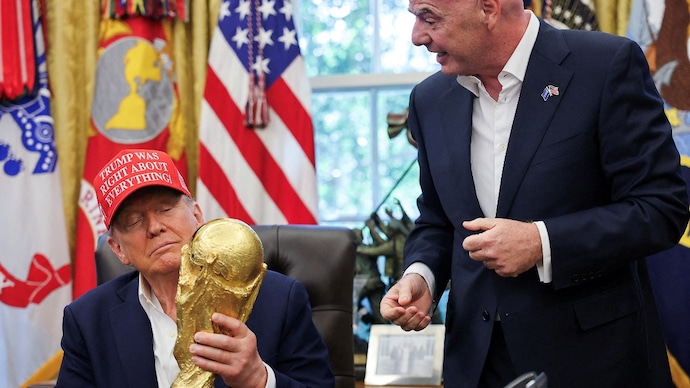
President Donald Trump has defended his involvement in the disciplinary case surrounding United States striker Folarin Balogun, saying he asked FIFA president Gianni Infantino to review a red card decision because he did not believe it was a sending-off offence. His remarks came after FIFA suspended Balogun's automatic one-match ban, clearing the striker to face Belgium in the World Cup Round of 16.
The episode has sparked a wider debate over football governance, disciplinary consistency and the role of political figures after FIFA's decision to overturn Balogun's suspension using a rarely invoked provision in its disciplinary code.
"I saw the play, and I'm a person that loves sports – that wasn't a foul. That wasn't even an infraction," Trump told reporters at the Oval Office. "This referee, who is a little bit suspect if you check his past, made a call that nobody could believe. (Balogun is) our best player, or one of our best players... I asked for a review by FIFA."
Defending his actions, Trump insisted he had merely sought a reassessment of the incident rather than pressuring FIFA.
"All I did was ask for a review because I didn't think it was a foul," he said. "I think they made a really brilliant decision. If they would not allow a top player to play, I think it would have had a big stain. I related that feeling." He later celebrated the decision on Truth Social, writing: "Thank you to FIFA for doing what was right, and reversing a great injustice!"
Following the reversal on Balogun's suspension, Trump took to Truth Social to hail FIFA for overturning the suspension, calling it the reversal of a "great injustice."
The controversy stems from Balogun’s red card during the United States’ 2-0 win over Bosnia and Herzegovina in the Round of 32, when he was dismissed for serious foul play on defender Tarik Muharemovic. The challenge, which left the defender in visible pain and requiring treatment, initially triggered an automatic suspension under FIFA rules.
However, FIFA’s Disciplinary Committee later invoked Article 27 of its Disciplinary Code to suspend the implementation of the ban, placing it under a one-year probationary period instead of enforcing an immediate suspension. The move effectively allowed Balogun to remain available for selection in the Round of 16 clash against Belgium.
FIFA PRESIDENT STANDS BY DECISION
Following Trump's remarks, FIFA president Gianni Infantino has now come out and defended the independence of the governing body's disciplinary process following the controversy over Folarin Balogun's suspended ban. He stressed that FIFA's judicial bodies operate independently and that their decisions are based solely on the regulations and facts of each case.
“FIFA’s judicial bodies are independent. They operate autonomously, apply the FIFA Disciplinary Code, and decide cases based on the applicable regulations and the specific facts before them,” Infantino said in a statment. He added that their independence “is essential to the credibility and integrity of football, and this must always be respected.”
Infantino did confirm that he received a call from US President Donald Trump but denied any political influence on the outcome.
“During our conversation, I explained that there was an ongoing legal process involving FIFA’s independent judicial bodies and that the case would be decided in due course,” he said, adding that while he may sometimes agree or disagree with disciplinary rulings, he always respects “the autonomy of the bodies that make them” to protect the integrity of FIFA's competitions.
FIFA DECISION SPARKS GOVERNANCE DEBATE
The decision has divided opinion across the footballing world, with Belgium expressing strong opposition to the reversal. The Royal Belgian Football Association said it was “astonished” by the ruling and argued that FIFA’s own competition regulations clearly mandate an automatic suspension following a red card, with only additional sanctions to follow.
Belgian officials pointed to tournament guidelines and pre-competition circulars, claiming the interpretation applied in Balogun’s case undermines consistency in disciplinary enforcement. The federation has indicated it is reviewing all available options in response to the decision, raising concerns over sporting integrity ahead of a crucial knockout fixture.
The United States, meanwhile, has welcomed the outcome, with Balogun now available for selection after already scoring three goals in the tournament so far.
The situation has added further scrutiny to FIFA’s disciplinary processes, particularly the use of rarely applied provisions that can suspend or alter standard sanction procedures in exceptional circumstances.
The debate has also intensified scrutiny of external influence in football administration, given Trump’s public remarks and reported communication with FIFA leadership. With the World Cup entering its decisive knockout phase, the focus remains on whether the ruling sets a precedent for future disciplinary interventions in high-profile matches.
President Donald Trump has defended his involvement in the disciplinary case surrounding United States striker Folarin Balogun, saying he asked FIFA president Gianni Infantino to review a red card decision because he did not believe it was a sending-off offence. His remarks came after FIFA suspended Balogun's automatic one-match ban, clearing the striker to face Belgium in the World Cup Round of 16.
The episode has sparked a wider debate over football governance, disciplinary consistency and the role of political figures after FIFA's decision to overturn Balogun's suspension using a rarely invoked provision in its disciplinary code.
"I saw the play, and I'm a person that loves sports – that wasn't a foul. That wasn't even an infraction," Trump told reporters at the Oval Office. "This referee, who is a little bit suspect if you check his past, made a call that nobody could believe. (Balogun is) our best player, or one of our best players... I asked for a review by FIFA."
Defending his actions, Trump insisted he had merely sought a reassessment of the incident rather than pressuring FIFA.
"All I did was ask for a review because I didn't think it was a foul," he said. "I think they made a really brilliant decision. If they would not allow a top player to play, I think it would have had a big stain. I related that feeling." He later celebrated the decision on Truth Social, writing: "Thank you to FIFA for doing what was right, and reversing a great injustice!"
Following the reversal on Balogun's suspension, Trump took to Truth Social to hail FIFA for overturning the suspension, calling it the reversal of a "great injustice."
The controversy stems from Balogun’s red card during the United States’ 2-0 win over Bosnia and Herzegovina in the Round of 32, when he was dismissed for serious foul play on defender Tarik Muharemovic. The challenge, which left the defender in visible pain and requiring treatment, initially triggered an automatic suspension under FIFA rules.
However, FIFA’s Disciplinary Committee later invoked Article 27 of its Disciplinary Code to suspend the implementation of the ban, placing it under a one-year probationary period instead of enforcing an immediate suspension. The move effectively allowed Balogun to remain available for selection in the Round of 16 clash against Belgium.
FIFA PRESIDENT STANDS BY DECISION
Following Trump's remarks, FIFA president Gianni Infantino has now come out and defended the independence of the governing body's disciplinary process following the controversy over Folarin Balogun's suspended ban. He stressed that FIFA's judicial bodies operate independently and that their decisions are based solely on the regulations and facts of each case.
“FIFA’s judicial bodies are independent. They operate autonomously, apply the FIFA Disciplinary Code, and decide cases based on the applicable regulations and the specific facts before them,” Infantino said in a statment. He added that their independence “is essential to the credibility and integrity of football, and this must always be respected.”
Infantino did confirm that he received a call from US President Donald Trump but denied any political influence on the outcome.
“During our conversation, I explained that there was an ongoing legal process involving FIFA’s independent judicial bodies and that the case would be decided in due course,” he said, adding that while he may sometimes agree or disagree with disciplinary rulings, he always respects “the autonomy of the bodies that make them” to protect the integrity of FIFA's competitions.
FIFA DECISION SPARKS GOVERNANCE DEBATE
The decision has divided opinion across the footballing world, with Belgium expressing strong opposition to the reversal. The Royal Belgian Football Association said it was “astonished” by the ruling and argued that FIFA’s own competition regulations clearly mandate an automatic suspension following a red card, with only additional sanctions to follow.
Belgian officials pointed to tournament guidelines and pre-competition circulars, claiming the interpretation applied in Balogun’s case undermines consistency in disciplinary enforcement. The federation has indicated it is reviewing all available options in response to the decision, raising concerns over sporting integrity ahead of a crucial knockout fixture.
The United States, meanwhile, has welcomed the outcome, with Balogun now available for selection after already scoring three goals in the tournament so far.
The situation has added further scrutiny to FIFA’s disciplinary processes, particularly the use of rarely applied provisions that can suspend or alter standard sanction procedures in exceptional circumstances.
The debate has also intensified scrutiny of external influence in football administration, given Trump’s public remarks and reported communication with FIFA leadership. With the World Cup entering its decisive knockout phase, the focus remains on whether the ruling sets a precedent for future disciplinary interventions in high-profile matches.

