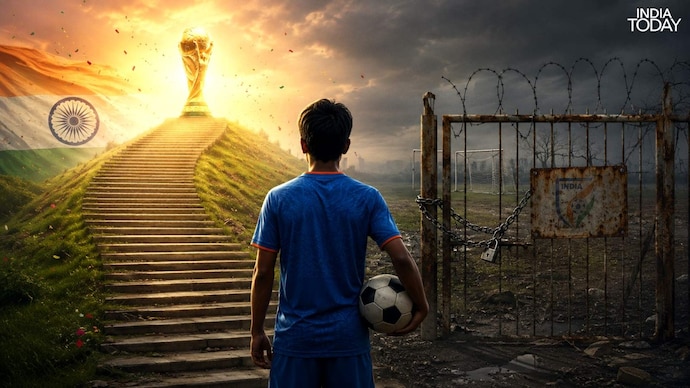
I am Indian football, and I will tell you why I am not at the FIFA World Cup
I am Indian football, and I know you are tired of hearing about my failures. But before you give up on me, hear me out. Today, let me take you through the football fields of Kashmir and tell you a story that you have never heard before.
Kashmir, 2026. It is 3 PM in the afternoon. School is over. This is the most exciting part of the day for me. I am finally free to go out of the classroom, onto the open grass, and get a good kickabout while watching the meadows. I play through the sunset while gazing at the gorgeous, snow-capped Himalayas. I breathe in the fresh air as I listen to Jhelum crashing onto the riverbank. When I am in the middle of the pitch, I have no worries.
Oh. Hi there. I forgot to tell you my name. I am football. Indian football.
I have been at the centre of some big discussions in the recent past, with many suggesting that I am at an historic low. They say that the state of my being is so bad that it might take years to undo the damage done. But I'll tell you what, it does not feel that way when I am in the middle of the pitch.
Today, I am with Mehnoor Shakeel, a 17-year-old promising forward from Kashmir. Mehnoor is one of the brightest sparks of the new generation of footballers coming out of the valley. These young girls want to play, and they are hungry for success. Mehnoor plays for DownTown Heroes FC. Last year, in a U19 tournament held by the Reliance Foundation Youth Sports, she scored 11 goals in a single game. It was not a fluke. She trains day in, day out, hoping that she can go out to the mainland to become a star for the Indian national team one day.
If Mehnoor's dream is to play for India, then sooner or later she will have to leave these mountains. That is where my worry begins. I am told that things are not better in the mainlands either. Football there has stalled.
The All India Football Federation (AIFF), which is meant to nurture the sport in the country, lacks vision entirely. This has led to an unprecedented crisis in Indian football, which saw its premier national league, the ISL, nearly get scrapped for a season.
The uncertainty of the ecosystem boiled down to the clubs, who did not know whether to hold onto their staff or let them go. The clubs briefly tried to hold on, but then salaries were stopped.
Fortunately, those worries have not reached Mehnoor yet, at least for now. Mehnoor is 17, still in school, and doesn't have to worry about jobs, salaries, or taking care of a family. In that sense, she is protected.
THE FOOTBALL IN KASHMIR
Mehnoor is the product of a family that fought the conservatism of Kashmir to bring her to the football field. Her football spirit is untamed, something she inherits from her mother, who was an NCC cadet in her younger days.
While the footballing ecosystem descends into chaos across India, the sign that young girls have taken to the sport is a welcome one. It marks an important shift in Kashmir, a society that was not in favour of girls playing football even 15 years ago.
Many tell me that while Kashmir is better known for its cricket now, the state's real heartbeat lies in football.
Late in the 1990s, Kashmiris saw football as a vehicle for community development. It gave birth to domestic legends like Mehrajuddin Wadoo and Ishfaq Ahmed. Wadoo, who played nearly 300 matches for Kolkata giants Mohun Bagan and East Bengal, candidly remembers that during his time in the 1990s and 2000s, there were many footballers better than him and Ishfaq.
"There were much better players than me and Ishfaq in the 1990s. As it was, not a lot of people at the time had the luxury of believing that one could become a footballer. Things were not good at the time; bomb blasts, curfews, and crackdowns made it impossible to remain outdoors," Mehrajuddin recalls.
"But people at the time tried to remain in Kashmir; they did not want to go out. They would try to play for the state, get a government job, and remain in Kashmir with a salary that could sustain their family."
I remember those days too.
But that has changed. Kashmiri football gained real momentum with Lonestar Kashmir, and by 2019, Real Kashmir introduced the valley’s first women’s team.
Back then, sending a daughter onto the pitch was a leap of faith for conservative families. Administrators knew they had to earn trust before teaching tactics. They set up direct WhatsApp groups, sharing every practice photo, schedule change, and safety update straight with mothers and fathers.
Winning over the parents was only the first victory. The harder battle was yet to come.
Mehnoor was the result of that honest effort. She trains with relentless passion at DownTown Heroes FC, her feet moving with sharp, natural instincts.
How do I look at a Kashmiri parent with judgment for holding back? I haven't given them a single reason to feel secure.
Most families here don't get to play with "what ifs." Imagine a mother saving every rupee to keep her child in football boots for six years, only to look up and see that the bridge to a real future was never built in the first place.
This isn't just a Kashmiri story. It’s the story everywhere I go.
People constantly talk about the lack of matches. Across the world, kids grow up playing 38 league games a season. Here, an ISL club wraps up after barely 20.
My national team suffers from the exact same silence. We just don't play enough. I hear people say that India went through all of 2024 without a single win, and that we've only managed two victories in the last two and a half years.
Whenever I hear that, it breaks my heart. How are my kids supposed to learn how to fly if I never give them a chance to spread their wings?
Ayaz, a scout at DownTown Heroes, let out a heavy sigh when talking about the situation.
"The last official tournament these girls played was back in January. Since then, they have been sitting ducks, waking up, lacing their boots, and running drills on the same grass day in and day out, with no opposition, no referee’s whistle, and no matchday adrenaline in sight."
The tournament Ayaz speaks of was organised by Reliance Foundation Youth Sports. RFYS was launched in India in 2016, but arrived in Kashmir much later, where it mapped out a roadmap for the sport and organised its first competition after the COVID-19 pandemic. Seeing a clear structure take shape, a new generation of parents felt confident sending their children to the field. Reliance is doing its part in the valley and across the country, but a broader lack of national structure fails to bring it all together.
THE MISSING PYRAMID
Ayaz's words stayed with me long after the training session had ended.
"There just aren't enough matches."
I had heard them before.
Perhaps that is why I have never understood the surprise whenever India struggles on the international stage. People often ask why the national team cannot qualify for the FIFA World Cup. They question the coaches, the tactics, the players, and sometimes even me. But they begin the story far too late.
A World Cup footballer is not made at twenty-three. They are shaped at thirteen. They learn who they are at seventeen.
By the time a player walks into a senior dressing room, years of competitive football have already taught them how to deal with pressure, how to recover from defeat, and how to win ugly. Those lessons cannot be learned on a training ground. They have to be earned in matches.
That journey is where India keeps losing its way.
For years, Indian football has existed without a complete pyramid. The Indian Super League became the country's premier competition, but for a long time it functioned without promotion and relegation, leaving little incentive for clubs to look beyond immediate results. Beneath it, the I-League steadily lost its visibility and commercial strength. Further down, state leagues, where thousands of young footballers are supposed to take their first steps into senior football, remained fragmented, underfunded, and irregular.
The consequence is something I have seen over and over again.
I have bounced across the beaches of Goa, the red earth of Manipur, the rain-soaked grounds of Kerala and the crowded maidans of Kolkata. Everywhere children chase me with the same joy. Everywhere the kids ask their coaches the same question.
"How many matches will I get to play?"
Young footballers graduate from academies but have nowhere obvious to go. Some spend months without competitive football. Others spend years sitting on benches.
I remember an attempt to bridge that gap. They called it the Indian Arrows.
The Indian Arrows took raw talent and tested it against grown men, shaping players like Gurpreet, Jeje, and Pronay into national team regulars. It was never flawless, but it gave young dreams a destination.
Then we pulled the plug, leaving the chasm wide open again.
Without those bridges, how do I save a talent like Mehnoor?
She is talented enough to dream. She trains hard enough to improve. She has coaches willing to invest their time and parents willing to support her ambitions. Yet there comes a point where effort alone is no longer enough.
Kashmir is no newcomer to a broken structure.
Back in the valley, my state association remains frozen, bogged down in endless court battles and delayed elections. Without a working body, the money stops flowing, and chances to play in national tournaments just evaporate. I have to laugh, otherwise I’d cry. It wasn't too long ago that even my national body, the AIFF, got suspended by FIFA for the exact same mess.
None of this means much to Mehnoor. She doesn't spend her evenings reading federation constitutions. She doesn't know why elections haven't happened. She only knows another month has gone by without playing a single match.
A FUTURE DENIED
The tragedy of Indian football isn't a lack of talent, it’s a betrayal of intent.
While administrators squabble over election seats, television rights, and boardroom politics, thousands of kids like Mehnoor are doing their part. They wake up at dawn, push past conservative norms, run drills on uneven grass, and dream of wearing the blue jersey.
An athlete can defeat an opponent on the pitch, but no 17-year-old can outplay a system built on neglect.
As I rambled through the day, evening had arrived before either of us realised. The sun finally dipped behind the snow-capped peaks of the Himalayas, the air turned crisp, and long shadows stretched across the field.
Ayaz blew his whistle to end the session. Mehnoor picked me up, wiped the damp grass off my surface, and tucked me under her arm as she walked toward the gates with her teammates.
Tomorrow at 3 PM, the school bell will ring again. Mehnoor will lace her boots and return to this patch of grass, hoping that one day, the game she loves will finally love her back.
Kashmir, 2026. It is 3 PM in the afternoon. School is over. This is the most exciting part of the day for me. I am finally free to go out of the classroom, onto the open grass, and get a good kickabout while watching the meadows. I play through the sunset while gazing at the gorgeous, snow-capped Himalayas. I breathe in the fresh air as I listen to Jhelum crashing onto the riverbank. When I am in the middle of the pitch, I have no worries.
Oh. Hi there. I forgot to tell you my name. I am football. Indian football.
I have been at the centre of some big discussions in the recent past, with many suggesting that I am at an historic low. They say that the state of my being is so bad that it might take years to undo the damage done. But I'll tell you what, it does not feel that way when I am in the middle of the pitch.
Today, I am with Mehnoor Shakeel, a 17-year-old promising forward from Kashmir. Mehnoor is one of the brightest sparks of the new generation of footballers coming out of the valley. These young girls want to play, and they are hungry for success. Mehnoor plays for DownTown Heroes FC. Last year, in a U19 tournament held by the Reliance Foundation Youth Sports, she scored 11 goals in a single game. It was not a fluke. She trains day in, day out, hoping that she can go out to the mainland to become a star for the Indian national team one day.
If Mehnoor's dream is to play for India, then sooner or later she will have to leave these mountains. That is where my worry begins. I am told that things are not better in the mainlands either. Football there has stalled.
The All India Football Federation (AIFF), which is meant to nurture the sport in the country, lacks vision entirely. This has led to an unprecedented crisis in Indian football, which saw its premier national league, the ISL, nearly get scrapped for a season.
The uncertainty of the ecosystem boiled down to the clubs, who did not know whether to hold onto their staff or let them go. The clubs briefly tried to hold on, but then salaries were stopped.
Fortunately, those worries have not reached Mehnoor yet, at least for now. Mehnoor is 17, still in school, and doesn't have to worry about jobs, salaries, or taking care of a family. In that sense, she is protected.
THE FOOTBALL IN KASHMIR
Mehnoor is the product of a family that fought the conservatism of Kashmir to bring her to the football field. Her football spirit is untamed, something she inherits from her mother, who was an NCC cadet in her younger days.
While the footballing ecosystem descends into chaos across India, the sign that young girls have taken to the sport is a welcome one. It marks an important shift in Kashmir, a society that was not in favour of girls playing football even 15 years ago.
Many tell me that while Kashmir is better known for its cricket now, the state's real heartbeat lies in football.
Late in the 1990s, Kashmiris saw football as a vehicle for community development. It gave birth to domestic legends like Mehrajuddin Wadoo and Ishfaq Ahmed. Wadoo, who played nearly 300 matches for Kolkata giants Mohun Bagan and East Bengal, candidly remembers that during his time in the 1990s and 2000s, there were many footballers better than him and Ishfaq.
"There were much better players than me and Ishfaq in the 1990s. As it was, not a lot of people at the time had the luxury of believing that one could become a footballer. Things were not good at the time; bomb blasts, curfews, and crackdowns made it impossible to remain outdoors," Mehrajuddin recalls.
"But people at the time tried to remain in Kashmir; they did not want to go out. They would try to play for the state, get a government job, and remain in Kashmir with a salary that could sustain their family."
I remember those days too.
But that has changed. Kashmiri football gained real momentum with Lonestar Kashmir, and by 2019, Real Kashmir introduced the valley’s first women’s team.
Back then, sending a daughter onto the pitch was a leap of faith for conservative families. Administrators knew they had to earn trust before teaching tactics. They set up direct WhatsApp groups, sharing every practice photo, schedule change, and safety update straight with mothers and fathers.
Winning over the parents was only the first victory. The harder battle was yet to come.
Mehnoor was the result of that honest effort. She trains with relentless passion at DownTown Heroes FC, her feet moving with sharp, natural instincts.
How do I look at a Kashmiri parent with judgment for holding back? I haven't given them a single reason to feel secure.
Most families here don't get to play with "what ifs." Imagine a mother saving every rupee to keep her child in football boots for six years, only to look up and see that the bridge to a real future was never built in the first place.
This isn't just a Kashmiri story. It’s the story everywhere I go.
People constantly talk about the lack of matches. Across the world, kids grow up playing 38 league games a season. Here, an ISL club wraps up after barely 20.
My national team suffers from the exact same silence. We just don't play enough. I hear people say that India went through all of 2024 without a single win, and that we've only managed two victories in the last two and a half years.
Whenever I hear that, it breaks my heart. How are my kids supposed to learn how to fly if I never give them a chance to spread their wings?
Ayaz, a scout at DownTown Heroes, let out a heavy sigh when talking about the situation.
"The last official tournament these girls played was back in January. Since then, they have been sitting ducks, waking up, lacing their boots, and running drills on the same grass day in and day out, with no opposition, no referee’s whistle, and no matchday adrenaline in sight."
The tournament Ayaz speaks of was organised by Reliance Foundation Youth Sports. RFYS was launched in India in 2016, but arrived in Kashmir much later, where it mapped out a roadmap for the sport and organised its first competition after the COVID-19 pandemic. Seeing a clear structure take shape, a new generation of parents felt confident sending their children to the field. Reliance is doing its part in the valley and across the country, but a broader lack of national structure fails to bring it all together.
THE MISSING PYRAMID
Ayaz's words stayed with me long after the training session had ended.
"There just aren't enough matches."
I had heard them before.
Perhaps that is why I have never understood the surprise whenever India struggles on the international stage. People often ask why the national team cannot qualify for the FIFA World Cup. They question the coaches, the tactics, the players, and sometimes even me. But they begin the story far too late.
A World Cup footballer is not made at twenty-three. They are shaped at thirteen. They learn who they are at seventeen.
By the time a player walks into a senior dressing room, years of competitive football have already taught them how to deal with pressure, how to recover from defeat, and how to win ugly. Those lessons cannot be learned on a training ground. They have to be earned in matches.
That journey is where India keeps losing its way.
For years, Indian football has existed without a complete pyramid. The Indian Super League became the country's premier competition, but for a long time it functioned without promotion and relegation, leaving little incentive for clubs to look beyond immediate results. Beneath it, the I-League steadily lost its visibility and commercial strength. Further down, state leagues, where thousands of young footballers are supposed to take their first steps into senior football, remained fragmented, underfunded, and irregular.
The consequence is something I have seen over and over again.
I have bounced across the beaches of Goa, the red earth of Manipur, the rain-soaked grounds of Kerala and the crowded maidans of Kolkata. Everywhere children chase me with the same joy. Everywhere the kids ask their coaches the same question.
"How many matches will I get to play?"
Young footballers graduate from academies but have nowhere obvious to go. Some spend months without competitive football. Others spend years sitting on benches.
I remember an attempt to bridge that gap. They called it the Indian Arrows.
The Indian Arrows took raw talent and tested it against grown men, shaping players like Gurpreet, Jeje, and Pronay into national team regulars. It was never flawless, but it gave young dreams a destination.
Then we pulled the plug, leaving the chasm wide open again.
Without those bridges, how do I save a talent like Mehnoor?
She is talented enough to dream. She trains hard enough to improve. She has coaches willing to invest their time and parents willing to support her ambitions. Yet there comes a point where effort alone is no longer enough.
Kashmir is no newcomer to a broken structure.
Back in the valley, my state association remains frozen, bogged down in endless court battles and delayed elections. Without a working body, the money stops flowing, and chances to play in national tournaments just evaporate. I have to laugh, otherwise I’d cry. It wasn't too long ago that even my national body, the AIFF, got suspended by FIFA for the exact same mess.
None of this means much to Mehnoor. She doesn't spend her evenings reading federation constitutions. She doesn't know why elections haven't happened. She only knows another month has gone by without playing a single match.
A FUTURE DENIED
The tragedy of Indian football isn't a lack of talent, it’s a betrayal of intent.
While administrators squabble over election seats, television rights, and boardroom politics, thousands of kids like Mehnoor are doing their part. They wake up at dawn, push past conservative norms, run drills on uneven grass, and dream of wearing the blue jersey.
An athlete can defeat an opponent on the pitch, but no 17-year-old can outplay a system built on neglect.
As I rambled through the day, evening had arrived before either of us realised. The sun finally dipped behind the snow-capped peaks of the Himalayas, the air turned crisp, and long shadows stretched across the field.
Ayaz blew his whistle to end the session. Mehnoor picked me up, wiped the damp grass off my surface, and tucked me under her arm as she walked toward the gates with her teammates.
Tomorrow at 3 PM, the school bell will ring again. Mehnoor will lace her boots and return to this patch of grass, hoping that one day, the game she loves will finally love her back.
Kashmir, 2026. It is 3 PM in the afternoon. School is over. This is the most exciting part of the day for me. I am finally free to go out of the classroom, onto the open grass, and get a good kickabout while watching the meadows. I play through the sunset while gazing at the gorgeous, snow-capped Himalayas. I breathe in the fresh air as I listen to Jhelum crashing onto the riverbank. When I am in the middle of the pitch, I have no worries.
Oh. Hi there. I forgot to tell you my name. I am football. Indian football.
I have been at the centre of some big discussions in the recent past, with many suggesting that I am at an historic low. They say that the state of my being is so bad that it might take years to undo the damage done. But I'll tell you what, it does not feel that way when I am in the middle of the pitch.
Today, I am with Mehnoor Shakeel, a 17-year-old promising forward from Kashmir. Mehnoor is one of the brightest sparks of the new generation of footballers coming out of the valley. These young girls want to play, and they are hungry for success. Mehnoor plays for DownTown Heroes FC. Last year, in a U19 tournament held by the Reliance Foundation Youth Sports, she scored 11 goals in a single game. It was not a fluke. She trains day in, day out, hoping that she can go out to the mainland to become a star for the Indian national team one day.
If Mehnoor's dream is to play for India, then sooner or later she will have to leave these mountains. That is where my worry begins. I am told that things are not better in the mainlands either. Football there has stalled.
The All India Football Federation (AIFF), which is meant to nurture the sport in the country, lacks vision entirely. This has led to an unprecedented crisis in Indian football, which saw its premier national league, the ISL, nearly get scrapped for a season.
The uncertainty of the ecosystem boiled down to the clubs, who did not know whether to hold onto their staff or let them go. The clubs briefly tried to hold on, but then salaries were stopped.
Fortunately, those worries have not reached Mehnoor yet, at least for now. Mehnoor is 17, still in school, and doesn't have to worry about jobs, salaries, or taking care of a family. In that sense, she is protected.
THE FOOTBALL IN KASHMIR
Mehnoor is the product of a family that fought the conservatism of Kashmir to bring her to the football field. Her football spirit is untamed, something she inherits from her mother, who was an NCC cadet in her younger days.
While the footballing ecosystem descends into chaos across India, the sign that young girls have taken to the sport is a welcome one. It marks an important shift in Kashmir, a society that was not in favour of girls playing football even 15 years ago.
Many tell me that while Kashmir is better known for its cricket now, the state's real heartbeat lies in football.
Late in the 1990s, Kashmiris saw football as a vehicle for community development. It gave birth to domestic legends like Mehrajuddin Wadoo and Ishfaq Ahmed. Wadoo, who played nearly 300 matches for Kolkata giants Mohun Bagan and East Bengal, candidly remembers that during his time in the 1990s and 2000s, there were many footballers better than him and Ishfaq.
"There were much better players than me and Ishfaq in the 1990s. As it was, not a lot of people at the time had the luxury of believing that one could become a footballer. Things were not good at the time; bomb blasts, curfews, and crackdowns made it impossible to remain outdoors," Mehrajuddin recalls.
"But people at the time tried to remain in Kashmir; they did not want to go out. They would try to play for the state, get a government job, and remain in Kashmir with a salary that could sustain their family."
I remember those days too.
But that has changed. Kashmiri football gained real momentum with Lonestar Kashmir, and by 2019, Real Kashmir introduced the valley’s first women’s team.
Back then, sending a daughter onto the pitch was a leap of faith for conservative families. Administrators knew they had to earn trust before teaching tactics. They set up direct WhatsApp groups, sharing every practice photo, schedule change, and safety update straight with mothers and fathers.
Winning over the parents was only the first victory. The harder battle was yet to come.
Mehnoor was the result of that honest effort. She trains with relentless passion at DownTown Heroes FC, her feet moving with sharp, natural instincts.
How do I look at a Kashmiri parent with judgment for holding back? I haven't given them a single reason to feel secure.
Most families here don't get to play with "what ifs." Imagine a mother saving every rupee to keep her child in football boots for six years, only to look up and see that the bridge to a real future was never built in the first place.
This isn't just a Kashmiri story. It’s the story everywhere I go.
People constantly talk about the lack of matches. Across the world, kids grow up playing 38 league games a season. Here, an ISL club wraps up after barely 20.
My national team suffers from the exact same silence. We just don't play enough. I hear people say that India went through all of 2024 without a single win, and that we've only managed two victories in the last two and a half years.
Whenever I hear that, it breaks my heart. How are my kids supposed to learn how to fly if I never give them a chance to spread their wings?
Ayaz, a scout at DownTown Heroes, let out a heavy sigh when talking about the situation.
"The last official tournament these girls played was back in January. Since then, they have been sitting ducks, waking up, lacing their boots, and running drills on the same grass day in and day out, with no opposition, no referee’s whistle, and no matchday adrenaline in sight."
The tournament Ayaz speaks of was organised by Reliance Foundation Youth Sports. RFYS was launched in India in 2016, but arrived in Kashmir much later, where it mapped out a roadmap for the sport and organised its first competition after the COVID-19 pandemic. Seeing a clear structure take shape, a new generation of parents felt confident sending their children to the field. Reliance is doing its part in the valley and across the country, but a broader lack of national structure fails to bring it all together.
THE MISSING PYRAMID
Ayaz's words stayed with me long after the training session had ended.
"There just aren't enough matches."
I had heard them before.
Perhaps that is why I have never understood the surprise whenever India struggles on the international stage. People often ask why the national team cannot qualify for the FIFA World Cup. They question the coaches, the tactics, the players, and sometimes even me. But they begin the story far too late.
A World Cup footballer is not made at twenty-three. They are shaped at thirteen. They learn who they are at seventeen.
By the time a player walks into a senior dressing room, years of competitive football have already taught them how to deal with pressure, how to recover from defeat, and how to win ugly. Those lessons cannot be learned on a training ground. They have to be earned in matches.
That journey is where India keeps losing its way.
For years, Indian football has existed without a complete pyramid. The Indian Super League became the country's premier competition, but for a long time it functioned without promotion and relegation, leaving little incentive for clubs to look beyond immediate results. Beneath it, the I-League steadily lost its visibility and commercial strength. Further down, state leagues, where thousands of young footballers are supposed to take their first steps into senior football, remained fragmented, underfunded, and irregular.
The consequence is something I have seen over and over again.
I have bounced across the beaches of Goa, the red earth of Manipur, the rain-soaked grounds of Kerala and the crowded maidans of Kolkata. Everywhere children chase me with the same joy. Everywhere the kids ask their coaches the same question.
"How many matches will I get to play?"
Young footballers graduate from academies but have nowhere obvious to go. Some spend months without competitive football. Others spend years sitting on benches.
I remember an attempt to bridge that gap. They called it the Indian Arrows.
The Indian Arrows took raw talent and tested it against grown men, shaping players like Gurpreet, Jeje, and Pronay into national team regulars. It was never flawless, but it gave young dreams a destination.
Then we pulled the plug, leaving the chasm wide open again.
Without those bridges, how do I save a talent like Mehnoor?
She is talented enough to dream. She trains hard enough to improve. She has coaches willing to invest their time and parents willing to support her ambitions. Yet there comes a point where effort alone is no longer enough.
Kashmir is no newcomer to a broken structure.
Back in the valley, my state association remains frozen, bogged down in endless court battles and delayed elections. Without a working body, the money stops flowing, and chances to play in national tournaments just evaporate. I have to laugh, otherwise I’d cry. It wasn't too long ago that even my national body, the AIFF, got suspended by FIFA for the exact same mess.
None of this means much to Mehnoor. She doesn't spend her evenings reading federation constitutions. She doesn't know why elections haven't happened. She only knows another month has gone by without playing a single match.
A FUTURE DENIED
The tragedy of Indian football isn't a lack of talent, it’s a betrayal of intent.
While administrators squabble over election seats, television rights, and boardroom politics, thousands of kids like Mehnoor are doing their part. They wake up at dawn, push past conservative norms, run drills on uneven grass, and dream of wearing the blue jersey.
An athlete can defeat an opponent on the pitch, but no 17-year-old can outplay a system built on neglect.
As I rambled through the day, evening had arrived before either of us realised. The sun finally dipped behind the snow-capped peaks of the Himalayas, the air turned crisp, and long shadows stretched across the field.
Ayaz blew his whistle to end the session. Mehnoor picked me up, wiped the damp grass off my surface, and tucked me under her arm as she walked toward the gates with her teammates.
Tomorrow at 3 PM, the school bell will ring again. Mehnoor will lace her boots and return to this patch of grass, hoping that one day, the game she loves will finally love her back.

