In phone industry, everyone is crying RAM RAM and it isn't stopping anytime soon
The smartphone industry is in a state of crisis for phone makers and consumers. And the problem is that of RAM, or rather the price of RAM.
In an industry as competitive as smartphones, it takes a certain amount of courage and honesty to tell your fans that one of the most-awaited updates to a popular phone will no longer arrive this year. At least that is what Nothing recently told its fans, and there are many of them in India, that it will not be launching an update to the popular CMF Phone 2 Pro in 2026. Reason? The economics of such a phone don’t make sense anymore.
The smartphone industry is going through a difficult year. It is not the fault of brands like Nothing why they are facing headwinds this year. It is all due to AI, and companies like OpenAI, Google, Amazon and Anthropic, which are hogging the entire supply of components that would otherwise find their way to devices like phones and laptops. Yes, I am talking about RAM.
Nothing co-founder and India president, Akis Evangelidis, told India Today Tech that memory aka Random Access Memory (RAM) prices have risen by as much as 8x compared to early last year, fundamentally changing how smartphones are designed and priced. That makes the successor of the CMF Phone 2 Pro an unviable proposition in 2026.
"In some cases, the cost of high-end memory today exceeds what the entire cost of a smartphone should be to be able to launch below Rs 25,000 price segment; a segment that was over 60% of the market in 2025. This is one of the main reasons we've seen very few launches in this category and when products do launch, they often come with significant compromises," Akis told India Today Tech.
But Akis is not the only industry veteran to point at the broken economics of the smartphone market. And Nothing is not the only company facing challenges. Consumers expect the bestest phone at the lowest prices, but these expectations are no longer in sync with realities in the component market.
Across the smartphone industry, executives are now openly admitting what was once discussed quietly in supply chain meetings — RAM and storage are no longer background components. They are becoming the most difficult part of building a phone.
From entry-level devices to premium flagships, the pressure is showing up everywhere. For instance, features that were once common under Rs 20,000 are increasingly moving into the Rs 30,000 bracket. Phones in this range now more likely come with LCD panels, a single speaker, entry-level cameras, no basic protection ratings, and slower chipsets — specifications that earlier used to sit well below the Rs 20,000 price point.
At the same time, we are no longer seeing the upwards trend in the amount of RAM available in phones. Instead, in some cases there has been a trend downwards. The phones that were earlier available with 12GB RAM are now coming with 8GB. And only a few brands are daring to put 16GB in their phones and that too at the very top end of the price list.
AI boom is squeezing smartphone supply
Counterpoint Research’s Tarun Pathak told India Today Tech that the memory market has become "considerably more challenging compared to last year," largely due to aggressive demand from AI companies like Nvidia, Google and others that need top quality RAM for their expensive AI chips.
Suppliers, he noted, are prioritising high-growth segments such as AI servers and cloud data centres, reducing allocations for smartphones.
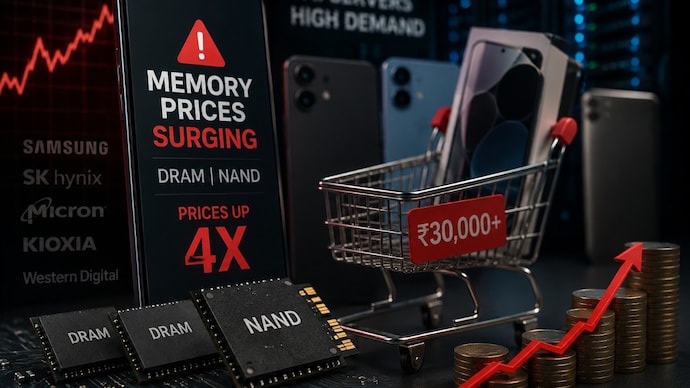
Pathak estimates that memory prices have already increased nearly 4x this year. He also expects the smartphone market to decline by 11 per cent in 2026, adding further strain on an already pressured segment.
"The shift has reduced the allocation of DRAM and NAND for smartphones, leading to a pronounced supply-demand imbalance that has driven memory prices upward and increased cost pressures for smartphone brands," he said in a statement to India Today Tech.
The most visible impact of the RAM crunch is being felt in the budget and mid-range segments, where brands are struggling to balance cost and specifications. Pathak noted that OEMs are now securing supply earlier, tightening inventory strategies, and becoming more conservative with product planning.
Akis explains it with a theoretical example. In a video that Nothing posted on Instagram, Akis noted that in a typical $400 smartphone, manufacturers aim for a bill of materials (BOM) of around $200. Earlier, memory alone would cost about $20. Today, that figure has crossed $100–$130 in some cases, according to Akis. "That leaves very little room to fit in camera, battery and other components, meaning manufacturers are increasingly left with no choice but to increase prices," he said.
RAM too expensive
Not just Akis, IDC's vice president Navkendar Singh also suggests the same. “Memory is I think the largest priced component in the bill of materials for a phone now. It used to be a display and the chipset. But, now, memory is almost the 30-35 per cent cost of a good smartphone. Of course, it impacts the product planning," Singh told India Today Tech.
At Nothing, the company had been working on a successor to its CMF phone lineup but decided against launching it this year, citing unsustainable memory costs. Of course, Nothing is not the only brand that has changed its product planning for the year. All brands, in one way or another, have done it. Although, unlike Nothing, they are not willing to be as upfront and honest with their users.
But a look at the smartphones that are available in the market shows a clear trend. Many of the popular phones are no longer available in the market. Similarly, most of the launches that we have seen this year seem iterative, and in some cases even a step back, compared to phones launched in the last two years. There is also a clear trend towards a price increase. A phone with 8GB or 12GB RAM with all things being equal, or somewhat equal, is slightly more expensive this year compared to 2025.
And not just new launches, prices have also been increased on the older models. In May 2026, several brands, including Nothing, OnePlus, Realme and Xiaomi, increased prices of multiple models. The revisions were confirmed through official listings on brand websites.
The RAM price is so stark that even Apple is feeling the pinch. Apple CEO Tim Cook recently acknowledged the pressure. In an interview with The Wall Street Journal, he said price increases across Apple products are becoming unavoidable due to rising memory and storage costs.
"Unfortunately, price increases are unavoidable," Cook said, adding that Apple has been trying to shield customers but the situation has become "unsustainable."
Cook specifically pointed to RAM constraints, noting that increasing allocation toward AI servers is tightening supply for consumer devices. "We definitely need memory pricing and supply to return to reasonable levels for consumer products. That’s the bottom line," he said.
But it is not going to happen anytime soon, at least that is what the signal is from RAM makers who are making hay while the sun shines. Micron CEO, Sanjay Mehrotra, has warned that memory supply shortages will take considerable time to ease. "Our customers are recognising that supply shortages in memory and storage will take considerable time to improve," he recently said during a call with analysts, adding that even by 2028, the industry would only see gradual improvements, with no clear timeline for full normalisation.
Update: In a statement given to India Today Tech, Apple said, “We have never seen a component price increase this much, this quickly. We have shielded our customers from these increases so far, but we have now reached a point where we need to begin raising prices on a number of products, including today's increases for iPad and Mac."
In an industry as competitive as smartphones, it takes a certain amount of courage and honesty to tell your fans that one of the most-awaited updates to a popular phone will no longer arrive this year. At least that is what Nothing recently told its fans, and there are many of them in India, that it will not be launching an update to the popular CMF Phone 2 Pro in 2026. Reason? The economics of such a phone don’t make sense anymore.
The smartphone industry is going through a difficult year. It is not the fault of brands like Nothing why they are facing headwinds this year. It is all due to AI, and companies like OpenAI, Google, Amazon and Anthropic, which are hogging the entire supply of components that would otherwise find their way to devices like phones and laptops. Yes, I am talking about RAM.
Nothing co-founder and India president, Akis Evangelidis, told India Today Tech that memory aka Random Access Memory (RAM) prices have risen by as much as 8x compared to early last year, fundamentally changing how smartphones are designed and priced. That makes the successor of the CMF Phone 2 Pro an unviable proposition in 2026.
"In some cases, the cost of high-end memory today exceeds what the entire cost of a smartphone should be to be able to launch below Rs 25,000 price segment; a segment that was over 60% of the market in 2025. This is one of the main reasons we've seen very few launches in this category and when products do launch, they often come with significant compromises," Akis told India Today Tech.
But Akis is not the only industry veteran to point at the broken economics of the smartphone market. And Nothing is not the only company facing challenges. Consumers expect the bestest phone at the lowest prices, but these expectations are no longer in sync with realities in the component market.
Across the smartphone industry, executives are now openly admitting what was once discussed quietly in supply chain meetings — RAM and storage are no longer background components. They are becoming the most difficult part of building a phone.
From entry-level devices to premium flagships, the pressure is showing up everywhere. For instance, features that were once common under Rs 20,000 are increasingly moving into the Rs 30,000 bracket. Phones in this range now more likely come with LCD panels, a single speaker, entry-level cameras, no basic protection ratings, and slower chipsets — specifications that earlier used to sit well below the Rs 20,000 price point.
At the same time, we are no longer seeing the upwards trend in the amount of RAM available in phones. Instead, in some cases there has been a trend downwards. The phones that were earlier available with 12GB RAM are now coming with 8GB. And only a few brands are daring to put 16GB in their phones and that too at the very top end of the price list.
AI boom is squeezing smartphone supply
Counterpoint Research’s Tarun Pathak told India Today Tech that the memory market has become "considerably more challenging compared to last year," largely due to aggressive demand from AI companies like Nvidia, Google and others that need top quality RAM for their expensive AI chips.
Suppliers, he noted, are prioritising high-growth segments such as AI servers and cloud data centres, reducing allocations for smartphones.
Pathak estimates that memory prices have already increased nearly 4x this year. He also expects the smartphone market to decline by 11 per cent in 2026, adding further strain on an already pressured segment.
"The shift has reduced the allocation of DRAM and NAND for smartphones, leading to a pronounced supply-demand imbalance that has driven memory prices upward and increased cost pressures for smartphone brands," he said in a statement to India Today Tech.
The most visible impact of the RAM crunch is being felt in the budget and mid-range segments, where brands are struggling to balance cost and specifications. Pathak noted that OEMs are now securing supply earlier, tightening inventory strategies, and becoming more conservative with product planning.
Akis explains it with a theoretical example. In a video that Nothing posted on Instagram, Akis noted that in a typical $400 smartphone, manufacturers aim for a bill of materials (BOM) of around $200. Earlier, memory alone would cost about $20. Today, that figure has crossed $100–$130 in some cases, according to Akis. "That leaves very little room to fit in camera, battery and other components, meaning manufacturers are increasingly left with no choice but to increase prices," he said.
RAM too expensive
Not just Akis, IDC's vice president Navkendar Singh also suggests the same. “Memory is I think the largest priced component in the bill of materials for a phone now. It used to be a display and the chipset. But, now, memory is almost the 30-35 per cent cost of a good smartphone. Of course, it impacts the product planning," Singh told India Today Tech.
At Nothing, the company had been working on a successor to its CMF phone lineup but decided against launching it this year, citing unsustainable memory costs. Of course, Nothing is not the only brand that has changed its product planning for the year. All brands, in one way or another, have done it. Although, unlike Nothing, they are not willing to be as upfront and honest with their users.
But a look at the smartphones that are available in the market shows a clear trend. Many of the popular phones are no longer available in the market. Similarly, most of the launches that we have seen this year seem iterative, and in some cases even a step back, compared to phones launched in the last two years. There is also a clear trend towards a price increase. A phone with 8GB or 12GB RAM with all things being equal, or somewhat equal, is slightly more expensive this year compared to 2025.
And not just new launches, prices have also been increased on the older models. In May 2026, several brands, including Nothing, OnePlus, Realme and Xiaomi, increased prices of multiple models. The revisions were confirmed through official listings on brand websites.
The RAM price is so stark that even Apple is feeling the pinch. Apple CEO Tim Cook recently acknowledged the pressure. In an interview with The Wall Street Journal, he said price increases across Apple products are becoming unavoidable due to rising memory and storage costs.
"Unfortunately, price increases are unavoidable," Cook said, adding that Apple has been trying to shield customers but the situation has become "unsustainable."
Cook specifically pointed to RAM constraints, noting that increasing allocation toward AI servers is tightening supply for consumer devices. "We definitely need memory pricing and supply to return to reasonable levels for consumer products. That’s the bottom line," he said.
But it is not going to happen anytime soon, at least that is what the signal is from RAM makers who are making hay while the sun shines. Micron CEO, Sanjay Mehrotra, has warned that memory supply shortages will take considerable time to ease. "Our customers are recognising that supply shortages in memory and storage will take considerable time to improve," he recently said during a call with analysts, adding that even by 2028, the industry would only see gradual improvements, with no clear timeline for full normalisation.
Update: In a statement given to India Today Tech, Apple said, “We have never seen a component price increase this much, this quickly. We have shielded our customers from these increases so far, but we have now reached a point where we need to begin raising prices on a number of products, including today's increases for iPad and Mac."

