Samsung Galaxy Z Fold 8 Ultra quick review: The ultimate foldable flex
The Samsung Galaxy Z Fold 8 Ultra has made a strong first impression with its slim build, less noticeable crease and useful Flex Mode. After using it for a few days, here is what India Today thinks of Samsung's latest foldable.
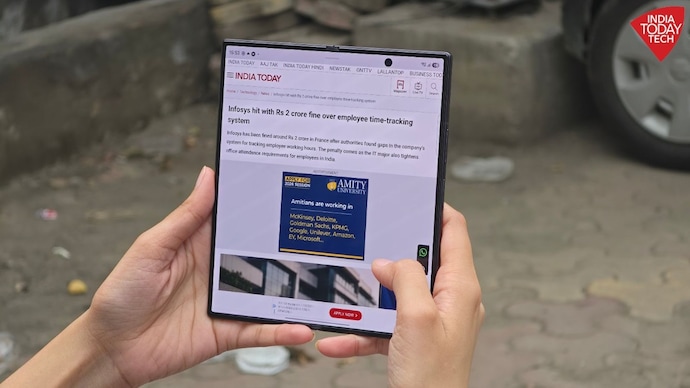
There is a funny thing that has happened almost every time I have taken the Samsung Galaxy Z Fold 8 Ultra out in public. People notice the foldable in my hand, but instead of asking about the phone I am actually using, they want to know if I have seen the new Galaxy Z Fold 8. More specifically, they want to see the smaller, passport-style foldable.
I can't really blame them. The new mini-book design has a certain novelty to it, and when Samsung puts two very different foldable designs side by side, the more unusual one is naturally going to attract attention. But after spending the last few days with the Galaxy Z Fold 8 Ultra, I have come to a slightly unpopular conclusion - I prefer this vertical form factor.
The reason is fairly simple. I have been using traditional smartphones for years, and the Fold 8 Ultra's tall, narrow shape is much closer to that familiar experience. More importantly, Samsung has managed to make this Fold so thin and light that, when it is closed, it doesn't really feel like I am holding a foldable at all. It feels remarkably close to using a regular smartphone.
That difference becomes obvious when you actually carry it around. The phone sits comfortably in my hand, slips into a jeans pocket without much fuss and doesn't have the heavy, bulky feeling that has long been associated with large foldables.
Then there is the other part of the equation - this is still a foldable. Open it up and you get an 8-inch display, giving you considerably more room for watching videos, multitasking, reading and simply getting things done.
Of course, all of this comes at a steep price. The Galaxy Z Fold 8 Ultra costs nearly Rs 2 lakh, which is a huge amount for a smartphone by any measure. But foldable technology is still expensive, component prices have gone up by a huge margin and Samsung has been steadily making these devices thinner and more refined.
I have only had the phone for a few days, so this is not my final verdict. I am still testing the camera, performance and battery life in greater detail. But there are already several things about the Fold 8 Ultra that I want to talk about in this quick review.
The crease is finally becoming something I don't think about
The crease has been one of the most persistent complaints about foldable phones. Samsung hasn't eliminated it completely, but with the Fold 8 Ultra, I find myself paying far less attention to it. You can run your finger across the entire inner display and barely feel a disruption where the panel folds. Look straight at the screen and the crease is difficult to notice. It becomes visible from an angle, but even then, Samsung appears to have made a meaningful improvement over the previous generation.
Samsung's new Flex Titanium display technology is part of the company's effort to make the panel thinner, flatter and more robust. But for me, the biggest benefit is simply that the foldable screen feels more seamless when I'm using it.
The inner display itself is also excellent. It measures 8 inches and has a 2504 x 2256 resolution, while the outer screen is a 6.5-inch panel with a 1080 x 2520 resolution.
The inner screen also gets an anti-reflective coating, which is particularly useful when watching darker content. Reflections are less distracting, and the screen gets bright enough to remain comfortable outdoors, with peak brightness reaching 3,000 nits.
Flex Mode is one of the best parts of this Fold
I didn't expect to use Flex Mode as much as I have. Partially fold the phone and you can place it on a table or bed to watch YouTube without needing anything else to prop it up. It is a small convenience, but once you start using it, it is difficult to go back.
Samsung has also made the lower half of the screen more useful in this mode. You get a dedicated set of controls for adjusting brightness and volume, taking screenshots, recording the screen, switching apps and accessing other functions. You can even turn the bottom half into a touchpad.
I didn't find the touchpad particularly useful in my own usage, but the rest of the controls are genuinely handy.
What I like more is the ability to open another app on the lower half of the screen without going back to the home screen. For example, if I'm watching something on YouTube and receive a WhatsApp message, I can open WhatsApp below, read and reply to it, and continue watching the video above. That I feel is a much better demonstration of why a foldable can be useful than simply saying that it has a bigger screen.
The Fold is slim, but I still want the S Pen
Samsung's push towards a slimmer Fold has made a huge difference to how I use it. The phone has a much better grip, it slides into a pocket more easily and its weight is low enough that I sometimes forget I am carrying a foldable. But there is one thing I haven't been able to forget and that is the S Pen.
I know Samsung didn't include S Pen support in the previous generation either, and I understand the reason. Removing the space required for the stylus helped the company make the phone slimmer. That trade-off makes sense from an engineering perspective.
I just don't think it makes as much sense from a usability perspective. An 8-inch display is arguably a better place for an S Pen than Samsung's regular Ultra phones. There is enough room to sketch, write notes, annotate documents or sign paperwork comfortably. These are things that genuinely benefit from having a large canvas.
Samsung could have continued supporting the S Pen through a case, as it did with the Galaxy Z Fold 6, allowing users who wanted the stylus to add it without making the phone thicker. For me, the S Pen is one of the few things that makes the Fold 8 Ultra feel like it is leaving some of its potential unused.
The cameras look good, but I need more time
I am not ready to give the Fold 8 Ultra's camera system a final verdict yet. I have only been using the phone for a few days, and a proper camera review requires much more testing. My initial experience, however, has been positive.
The portraits I have taken so far have natural skin tones, good separation between the subject and background, and plenty of detail. Daylight photos are also impressive, with colours that look natural rather than overly processed.
The ultrawide camera has received a significant upgrade this year. Samsung has moved from a 12-megapixel ultrawide on the previous generation to a 50-megapixel sensor on the Fold 8 Ultra, while the main camera continues to use a 200-megapixel sensor.
There is one early weakness I have noticed. Using the 3x zoom when there isn't enough light can result in images that look softer and noisier, with fine details becoming hazy.
I want to test this much more extensively before making a final call. For now, the early camera results are promising, but I wouldn't consider this a finished assessment.
The speakers could be louder
The audio experience is another area where I have a small complaint. The speakers don't always get as loud as I would like, particularly when listening to podcasts. But volume isn't everything, and the Fold 8 Ultra does a good job with sound quality.
The bass has some weight to it and the overall output sounds clean and fairly balanced. I have tested conventional phones that get much louder but don't necessarily sound as good. So while I would happily take a little more volume, I have no major complaints about the quality itself.
Performance should not be a concern
The Galaxy Z Fold 8 Ultra is powered by Qualcomm's Snapdragon 8 Elite Gen 5, featuring the company's third-generation Oryon CPU with clock speeds of up to 4.74GHz, an Adreno GPU and a next-generation Hexagon NPU designed for AI workloads.
Qualcomm says the platform delivers up to 20 per cent faster CPU performance and 23 per cent faster GPU performance than the Snapdragon 8 Elite.
The phone has been smooth during my initial use, but I don't want to make sweeping performance claims after only a few days. I still need to put it through demanding games, sustained multitasking and longer workloads before I can properly judge how it performs under pressure. That will be part of the full review.
Finally, Samsung has made the battery bigger
Samsung has also addressed one of the more persistent complaints about its Fold series - battery capacity. The Fold 8 Ultra gets a 5,000mAh battery, compared with the 4,400mAh cell in the previous generation. Samsung claims up to 27 hours of video playback.
I haven't used the phone long enough to verify that claim or give you a meaningful real-world battery estimate yet. But the move to a 5,000mAh battery is welcome, particularly when the phone has an 8-inch display that can be used extensively. This is another area where I will reserve judgement until I have completed proper testing.
Samsung Galaxy Z Fold 8 Ultra quick review: First impressions
The Galaxy Z Fold 8 Ultra isn't a dramatic reinvention of Samsung's foldable formula. In fact, I think its biggest achievement is that it makes the existing formula considerably easier to live with.
The slimmer and lighter body is the first thing you notice in everyday use. The phone is much easier to carry, and its vertical form factor means you don't have to completely change how you hold and use a smartphone. The crease is less distracting, the inner display is excellent, and Flex Mode has evolved into something I can genuinely see myself using regularly. The 5,000mAh battery is another welcome upgrade.
I still wish Samsung had found a way to retain S Pen support. With an 8-inch screen, there is a compelling argument for having a stylus available, even if it means using a case to carry it. The camera also needs much more testing, particularly the 3x zoom in challenging lighting. Performance and battery life are similarly areas where I need more time before reaching a conclusion.
But there is one thing I already know about the Fold 8 Ultra. Despite being a foldable, it doesn't constantly remind me that I am using one. When it is closed, the combination of its slim body and familiar vertical shape makes it feel remarkably close to a conventional smartphone. Open it, and suddenly I have an 8-inch screen when I need one for multitasking or binge watching. That is exactly the kind of foldable experience I prefer.
And while people around me may be more curious about Samsung's new mini-book-style foldable, I would still pick up the Fold 8 Ultra. You can stay tuned to India Today Tech if you are curious about the phone's gaming performance, whether it gets warm during long hours of gameplay, how long the phone can last with heavy usage, how good is the camera in tricky light situations, our detailed review will cover all this in the coming days.
There is a funny thing that has happened almost every time I have taken the Samsung Galaxy Z Fold 8 Ultra out in public. People notice the foldable in my hand, but instead of asking about the phone I am actually using, they want to know if I have seen the new Galaxy Z Fold 8. More specifically, they want to see the smaller, passport-style foldable.
I can't really blame them. The new mini-book design has a certain novelty to it, and when Samsung puts two very different foldable designs side by side, the more unusual one is naturally going to attract attention. But after spending the last few days with the Galaxy Z Fold 8 Ultra, I have come to a slightly unpopular conclusion - I prefer this vertical form factor.
The reason is fairly simple. I have been using traditional smartphones for years, and the Fold 8 Ultra's tall, narrow shape is much closer to that familiar experience. More importantly, Samsung has managed to make this Fold so thin and light that, when it is closed, it doesn't really feel like I am holding a foldable at all. It feels remarkably close to using a regular smartphone.
That difference becomes obvious when you actually carry it around. The phone sits comfortably in my hand, slips into a jeans pocket without much fuss and doesn't have the heavy, bulky feeling that has long been associated with large foldables.
Then there is the other part of the equation - this is still a foldable. Open it up and you get an 8-inch display, giving you considerably more room for watching videos, multitasking, reading and simply getting things done.
Of course, all of this comes at a steep price. The Galaxy Z Fold 8 Ultra costs nearly Rs 2 lakh, which is a huge amount for a smartphone by any measure. But foldable technology is still expensive, component prices have gone up by a huge margin and Samsung has been steadily making these devices thinner and more refined.
I have only had the phone for a few days, so this is not my final verdict. I am still testing the camera, performance and battery life in greater detail. But there are already several things about the Fold 8 Ultra that I want to talk about in this quick review.
The crease is finally becoming something I don't think about
The crease has been one of the most persistent complaints about foldable phones. Samsung hasn't eliminated it completely, but with the Fold 8 Ultra, I find myself paying far less attention to it. You can run your finger across the entire inner display and barely feel a disruption where the panel folds. Look straight at the screen and the crease is difficult to notice. It becomes visible from an angle, but even then, Samsung appears to have made a meaningful improvement over the previous generation.
Samsung's new Flex Titanium display technology is part of the company's effort to make the panel thinner, flatter and more robust. But for me, the biggest benefit is simply that the foldable screen feels more seamless when I'm using it.
The inner display itself is also excellent. It measures 8 inches and has a 2504 x 2256 resolution, while the outer screen is a 6.5-inch panel with a 1080 x 2520 resolution.
The inner screen also gets an anti-reflective coating, which is particularly useful when watching darker content. Reflections are less distracting, and the screen gets bright enough to remain comfortable outdoors, with peak brightness reaching 3,000 nits.
Flex Mode is one of the best parts of this Fold
I didn't expect to use Flex Mode as much as I have. Partially fold the phone and you can place it on a table or bed to watch YouTube without needing anything else to prop it up. It is a small convenience, but once you start using it, it is difficult to go back.
Samsung has also made the lower half of the screen more useful in this mode. You get a dedicated set of controls for adjusting brightness and volume, taking screenshots, recording the screen, switching apps and accessing other functions. You can even turn the bottom half into a touchpad.
I didn't find the touchpad particularly useful in my own usage, but the rest of the controls are genuinely handy.
What I like more is the ability to open another app on the lower half of the screen without going back to the home screen. For example, if I'm watching something on YouTube and receive a WhatsApp message, I can open WhatsApp below, read and reply to it, and continue watching the video above. That I feel is a much better demonstration of why a foldable can be useful than simply saying that it has a bigger screen.
The Fold is slim, but I still want the S Pen
Samsung's push towards a slimmer Fold has made a huge difference to how I use it. The phone has a much better grip, it slides into a pocket more easily and its weight is low enough that I sometimes forget I am carrying a foldable. But there is one thing I haven't been able to forget and that is the S Pen.
I know Samsung didn't include S Pen support in the previous generation either, and I understand the reason. Removing the space required for the stylus helped the company make the phone slimmer. That trade-off makes sense from an engineering perspective.
I just don't think it makes as much sense from a usability perspective. An 8-inch display is arguably a better place for an S Pen than Samsung's regular Ultra phones. There is enough room to sketch, write notes, annotate documents or sign paperwork comfortably. These are things that genuinely benefit from having a large canvas.
Samsung could have continued supporting the S Pen through a case, as it did with the Galaxy Z Fold 6, allowing users who wanted the stylus to add it without making the phone thicker. For me, the S Pen is one of the few things that makes the Fold 8 Ultra feel like it is leaving some of its potential unused.
The cameras look good, but I need more time
I am not ready to give the Fold 8 Ultra's camera system a final verdict yet. I have only been using the phone for a few days, and a proper camera review requires much more testing. My initial experience, however, has been positive.
The portraits I have taken so far have natural skin tones, good separation between the subject and background, and plenty of detail. Daylight photos are also impressive, with colours that look natural rather than overly processed.
The ultrawide camera has received a significant upgrade this year. Samsung has moved from a 12-megapixel ultrawide on the previous generation to a 50-megapixel sensor on the Fold 8 Ultra, while the main camera continues to use a 200-megapixel sensor.
There is one early weakness I have noticed. Using the 3x zoom when there isn't enough light can result in images that look softer and noisier, with fine details becoming hazy.
I want to test this much more extensively before making a final call. For now, the early camera results are promising, but I wouldn't consider this a finished assessment.
The speakers could be louder
The audio experience is another area where I have a small complaint. The speakers don't always get as loud as I would like, particularly when listening to podcasts. But volume isn't everything, and the Fold 8 Ultra does a good job with sound quality.
The bass has some weight to it and the overall output sounds clean and fairly balanced. I have tested conventional phones that get much louder but don't necessarily sound as good. So while I would happily take a little more volume, I have no major complaints about the quality itself.
Performance should not be a concern
The Galaxy Z Fold 8 Ultra is powered by Qualcomm's Snapdragon 8 Elite Gen 5, featuring the company's third-generation Oryon CPU with clock speeds of up to 4.74GHz, an Adreno GPU and a next-generation Hexagon NPU designed for AI workloads.
Qualcomm says the platform delivers up to 20 per cent faster CPU performance and 23 per cent faster GPU performance than the Snapdragon 8 Elite.
The phone has been smooth during my initial use, but I don't want to make sweeping performance claims after only a few days. I still need to put it through demanding games, sustained multitasking and longer workloads before I can properly judge how it performs under pressure. That will be part of the full review.
Finally, Samsung has made the battery bigger
Samsung has also addressed one of the more persistent complaints about its Fold series - battery capacity. The Fold 8 Ultra gets a 5,000mAh battery, compared with the 4,400mAh cell in the previous generation. Samsung claims up to 27 hours of video playback.
I haven't used the phone long enough to verify that claim or give you a meaningful real-world battery estimate yet. But the move to a 5,000mAh battery is welcome, particularly when the phone has an 8-inch display that can be used extensively. This is another area where I will reserve judgement until I have completed proper testing.
Samsung Galaxy Z Fold 8 Ultra quick review: First impressions
The Galaxy Z Fold 8 Ultra isn't a dramatic reinvention of Samsung's foldable formula. In fact, I think its biggest achievement is that it makes the existing formula considerably easier to live with.
The slimmer and lighter body is the first thing you notice in everyday use. The phone is much easier to carry, and its vertical form factor means you don't have to completely change how you hold and use a smartphone. The crease is less distracting, the inner display is excellent, and Flex Mode has evolved into something I can genuinely see myself using regularly. The 5,000mAh battery is another welcome upgrade.
I still wish Samsung had found a way to retain S Pen support. With an 8-inch screen, there is a compelling argument for having a stylus available, even if it means using a case to carry it. The camera also needs much more testing, particularly the 3x zoom in challenging lighting. Performance and battery life are similarly areas where I need more time before reaching a conclusion.
But there is one thing I already know about the Fold 8 Ultra. Despite being a foldable, it doesn't constantly remind me that I am using one. When it is closed, the combination of its slim body and familiar vertical shape makes it feel remarkably close to a conventional smartphone. Open it, and suddenly I have an 8-inch screen when I need one for multitasking or binge watching. That is exactly the kind of foldable experience I prefer.
And while people around me may be more curious about Samsung's new mini-book-style foldable, I would still pick up the Fold 8 Ultra. You can stay tuned to India Today Tech if you are curious about the phone's gaming performance, whether it gets warm during long hours of gameplay, how long the phone can last with heavy usage, how good is the camera in tricky light situations, our detailed review will cover all this in the coming days.
There is a funny thing that has happened almost every time I have taken the Samsung Galaxy Z Fold 8 Ultra out in public. People notice the foldable in my hand, but instead of asking about the phone I am actually using, they want to know if I have seen the new Galaxy Z Fold 8. More specifically, they want to see the smaller, passport-style foldable.
I can't really blame them. The new mini-book design has a certain novelty to it, and when Samsung puts two very different foldable designs side by side, the more unusual one is naturally going to attract attention. But after spending the last few days with the Galaxy Z Fold 8 Ultra, I have come to a slightly unpopular conclusion - I prefer this vertical form factor.
The reason is fairly simple. I have been using traditional smartphones for years, and the Fold 8 Ultra's tall, narrow shape is much closer to that familiar experience. More importantly, Samsung has managed to make this Fold so thin and light that, when it is closed, it doesn't really feel like I am holding a foldable at all. It feels remarkably close to using a regular smartphone.
That difference becomes obvious when you actually carry it around. The phone sits comfortably in my hand, slips into a jeans pocket without much fuss and doesn't have the heavy, bulky feeling that has long been associated with large foldables.
Then there is the other part of the equation - this is still a foldable. Open it up and you get an 8-inch display, giving you considerably more room for watching videos, multitasking, reading and simply getting things done.
Of course, all of this comes at a steep price. The Galaxy Z Fold 8 Ultra costs nearly Rs 2 lakh, which is a huge amount for a smartphone by any measure. But foldable technology is still expensive, component prices have gone up by a huge margin and Samsung has been steadily making these devices thinner and more refined.
I have only had the phone for a few days, so this is not my final verdict. I am still testing the camera, performance and battery life in greater detail. But there are already several things about the Fold 8 Ultra that I want to talk about in this quick review.
The crease is finally becoming something I don't think about
The crease has been one of the most persistent complaints about foldable phones. Samsung hasn't eliminated it completely, but with the Fold 8 Ultra, I find myself paying far less attention to it. You can run your finger across the entire inner display and barely feel a disruption where the panel folds. Look straight at the screen and the crease is difficult to notice. It becomes visible from an angle, but even then, Samsung appears to have made a meaningful improvement over the previous generation.
Samsung's new Flex Titanium display technology is part of the company's effort to make the panel thinner, flatter and more robust. But for me, the biggest benefit is simply that the foldable screen feels more seamless when I'm using it.
The inner display itself is also excellent. It measures 8 inches and has a 2504 x 2256 resolution, while the outer screen is a 6.5-inch panel with a 1080 x 2520 resolution.
The inner screen also gets an anti-reflective coating, which is particularly useful when watching darker content. Reflections are less distracting, and the screen gets bright enough to remain comfortable outdoors, with peak brightness reaching 3,000 nits.
Flex Mode is one of the best parts of this Fold
I didn't expect to use Flex Mode as much as I have. Partially fold the phone and you can place it on a table or bed to watch YouTube without needing anything else to prop it up. It is a small convenience, but once you start using it, it is difficult to go back.
Samsung has also made the lower half of the screen more useful in this mode. You get a dedicated set of controls for adjusting brightness and volume, taking screenshots, recording the screen, switching apps and accessing other functions. You can even turn the bottom half into a touchpad.
I didn't find the touchpad particularly useful in my own usage, but the rest of the controls are genuinely handy.
What I like more is the ability to open another app on the lower half of the screen without going back to the home screen. For example, if I'm watching something on YouTube and receive a WhatsApp message, I can open WhatsApp below, read and reply to it, and continue watching the video above. That I feel is a much better demonstration of why a foldable can be useful than simply saying that it has a bigger screen.
The Fold is slim, but I still want the S Pen
Samsung's push towards a slimmer Fold has made a huge difference to how I use it. The phone has a much better grip, it slides into a pocket more easily and its weight is low enough that I sometimes forget I am carrying a foldable. But there is one thing I haven't been able to forget and that is the S Pen.
I know Samsung didn't include S Pen support in the previous generation either, and I understand the reason. Removing the space required for the stylus helped the company make the phone slimmer. That trade-off makes sense from an engineering perspective.
I just don't think it makes as much sense from a usability perspective. An 8-inch display is arguably a better place for an S Pen than Samsung's regular Ultra phones. There is enough room to sketch, write notes, annotate documents or sign paperwork comfortably. These are things that genuinely benefit from having a large canvas.
Samsung could have continued supporting the S Pen through a case, as it did with the Galaxy Z Fold 6, allowing users who wanted the stylus to add it without making the phone thicker. For me, the S Pen is one of the few things that makes the Fold 8 Ultra feel like it is leaving some of its potential unused.
The cameras look good, but I need more time
I am not ready to give the Fold 8 Ultra's camera system a final verdict yet. I have only been using the phone for a few days, and a proper camera review requires much more testing. My initial experience, however, has been positive.
The portraits I have taken so far have natural skin tones, good separation between the subject and background, and plenty of detail. Daylight photos are also impressive, with colours that look natural rather than overly processed.
The ultrawide camera has received a significant upgrade this year. Samsung has moved from a 12-megapixel ultrawide on the previous generation to a 50-megapixel sensor on the Fold 8 Ultra, while the main camera continues to use a 200-megapixel sensor.
There is one early weakness I have noticed. Using the 3x zoom when there isn't enough light can result in images that look softer and noisier, with fine details becoming hazy.
I want to test this much more extensively before making a final call. For now, the early camera results are promising, but I wouldn't consider this a finished assessment.
The speakers could be louder
The audio experience is another area where I have a small complaint. The speakers don't always get as loud as I would like, particularly when listening to podcasts. But volume isn't everything, and the Fold 8 Ultra does a good job with sound quality.
The bass has some weight to it and the overall output sounds clean and fairly balanced. I have tested conventional phones that get much louder but don't necessarily sound as good. So while I would happily take a little more volume, I have no major complaints about the quality itself.
Performance should not be a concern
The Galaxy Z Fold 8 Ultra is powered by Qualcomm's Snapdragon 8 Elite Gen 5, featuring the company's third-generation Oryon CPU with clock speeds of up to 4.74GHz, an Adreno GPU and a next-generation Hexagon NPU designed for AI workloads.
Qualcomm says the platform delivers up to 20 per cent faster CPU performance and 23 per cent faster GPU performance than the Snapdragon 8 Elite.
The phone has been smooth during my initial use, but I don't want to make sweeping performance claims after only a few days. I still need to put it through demanding games, sustained multitasking and longer workloads before I can properly judge how it performs under pressure. That will be part of the full review.
Finally, Samsung has made the battery bigger
Samsung has also addressed one of the more persistent complaints about its Fold series - battery capacity. The Fold 8 Ultra gets a 5,000mAh battery, compared with the 4,400mAh cell in the previous generation. Samsung claims up to 27 hours of video playback.
I haven't used the phone long enough to verify that claim or give you a meaningful real-world battery estimate yet. But the move to a 5,000mAh battery is welcome, particularly when the phone has an 8-inch display that can be used extensively. This is another area where I will reserve judgement until I have completed proper testing.
Samsung Galaxy Z Fold 8 Ultra quick review: First impressions
The Galaxy Z Fold 8 Ultra isn't a dramatic reinvention of Samsung's foldable formula. In fact, I think its biggest achievement is that it makes the existing formula considerably easier to live with.
The slimmer and lighter body is the first thing you notice in everyday use. The phone is much easier to carry, and its vertical form factor means you don't have to completely change how you hold and use a smartphone. The crease is less distracting, the inner display is excellent, and Flex Mode has evolved into something I can genuinely see myself using regularly. The 5,000mAh battery is another welcome upgrade.
I still wish Samsung had found a way to retain S Pen support. With an 8-inch screen, there is a compelling argument for having a stylus available, even if it means using a case to carry it. The camera also needs much more testing, particularly the 3x zoom in challenging lighting. Performance and battery life are similarly areas where I need more time before reaching a conclusion.
But there is one thing I already know about the Fold 8 Ultra. Despite being a foldable, it doesn't constantly remind me that I am using one. When it is closed, the combination of its slim body and familiar vertical shape makes it feel remarkably close to a conventional smartphone. Open it, and suddenly I have an 8-inch screen when I need one for multitasking or binge watching. That is exactly the kind of foldable experience I prefer.
And while people around me may be more curious about Samsung's new mini-book-style foldable, I would still pick up the Fold 8 Ultra. You can stay tuned to India Today Tech if you are curious about the phone's gaming performance, whether it gets warm during long hours of gameplay, how long the phone can last with heavy usage, how good is the camera in tricky light situations, our detailed review will cover all this in the coming days.

