Anthropic says AGI possible by 2028, US must not let China lead AI race
Anthropic says AGI could arrive by 2028. Ahead of the imminent arrival of AGI, the company has warned that the US must tighten chip controls and policies to stop China from overtaking the West in the global AI race. The warning comes even as US President Donald Trump visited Beijing this week for the first time in nearly a decade.
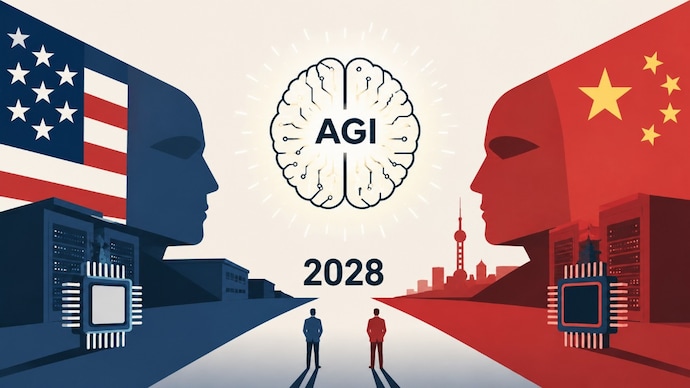
As US President Donald Trump wraps up his 2-day visit to Beijing, his first in nearly a decade, Anthropic has published a new research and policy paper arguing that the world could achieve AGI (AI with human-level intelligence) by 2028, and by no means, the US can let China lead in this race.
According to Anthropic, the world could see transformative AI systems emerge within the next few years. In its new paper, titled “2028: Two Scenarios for Global AI Leadership”, the company says AI models are improving at a pace that could soon make them capable of performing complex intellectual tasks across science, cybersecurity, engineering and research at levels comparable to, or even beyond, human experts.
The company describes this future as a “country of geniuses in a data centre”, where AI systems are not just answering questions but actively accelerating scientific discovery, software development and even AI research itself. Anthropic argues that whoever controls these systems will hold enormous economic, political and military influence.
“It’s essential that the US and its allies stay ahead of authoritarian governments like the Chinese Communist Party, or CCP,” reads the paper. “AI will soon become powerful enough to be used to repress citizens at unprecedented scale, and even to alter the balance of power among nations.”
Leader in AI will lead the world
Anthropic argues that the US needs to stay ahead in advanced AI development because the country leading AI will also shape the global rules, norms and economic power surrounding the technology.
The company says the US currently holds a meaningful lead in advanced AI development because they dominate compute, the high-end chips and infrastructure needed to train frontier AI models. However, Anthropic warns that this advantage could narrow rapidly if loopholes around chip exports, overseas data centres and model access are not addressed.
It also argues that the political systems building the most advanced AI models will ultimately shape how those systems are deployed across the world.
Anthropic calls for control over compute
Anthropic describes compute as the single most important ingredient in developing frontier AI. The company credits export controls introduced by successive US administrations for helping preserve America’s edge over China. According to Anthropic, Chinese AI firms have allegedly remained competitive by exploiting loopholes in export controls, using overseas compute access and relying on what the company calls “large-scale distillation attacks”, where outputs from leading US AI models are seemingly used to recreate similar capabilities at lower cost.
Now as companies and countries are moving into the future making more advanced AI models, and possibilities of AGI, in the report, Anthropic outlines two possible outcomes for 2028.
In the first scenario, the US and its allies successfully tighten controls on advanced chips, prevent smuggling and accelerate domestic AI adoption. Anthropic says this could allow democracies to maintain a commanding lead, with American AI systems remaining 12 to 24 months ahead of Chinese rivals in intelligence and capability.
In the second scenario, Anthropic argues that China remains close to the frontier because of weak enforcement, continued access to overseas compute infrastructure and ongoing use of American AI systems for research and development. Anthropic warns that such an outcome could allow China to shape the global AI ecosystem and expand the use of AI for surveillance, cyber operations and military applications.
The paper also calls for tightened restrictions on smuggled chips, offshore compute access and semiconductor manufacturing equipment while also protecting US AI models from distillation attacks. At the same time, Anthropic says it supports dialogue with Chinese AI researchers on safety issues but adds that such engagement works best when US maintain a clear technological lead.
As US President Donald Trump wraps up his 2-day visit to Beijing, his first in nearly a decade, Anthropic has published a new research and policy paper arguing that the world could achieve AGI (AI with human-level intelligence) by 2028, and by no means, the US can let China lead in this race.
According to Anthropic, the world could see transformative AI systems emerge within the next few years. In its new paper, titled “2028: Two Scenarios for Global AI Leadership”, the company says AI models are improving at a pace that could soon make them capable of performing complex intellectual tasks across science, cybersecurity, engineering and research at levels comparable to, or even beyond, human experts.
The company describes this future as a “country of geniuses in a data centre”, where AI systems are not just answering questions but actively accelerating scientific discovery, software development and even AI research itself. Anthropic argues that whoever controls these systems will hold enormous economic, political and military influence.
“It’s essential that the US and its allies stay ahead of authoritarian governments like the Chinese Communist Party, or CCP,” reads the paper. “AI will soon become powerful enough to be used to repress citizens at unprecedented scale, and even to alter the balance of power among nations.”
Leader in AI will lead the world
Anthropic argues that the US needs to stay ahead in advanced AI development because the country leading AI will also shape the global rules, norms and economic power surrounding the technology.
The company says the US currently holds a meaningful lead in advanced AI development because they dominate compute, the high-end chips and infrastructure needed to train frontier AI models. However, Anthropic warns that this advantage could narrow rapidly if loopholes around chip exports, overseas data centres and model access are not addressed.
It also argues that the political systems building the most advanced AI models will ultimately shape how those systems are deployed across the world.
Anthropic calls for control over compute
Anthropic describes compute as the single most important ingredient in developing frontier AI. The company credits export controls introduced by successive US administrations for helping preserve America’s edge over China. According to Anthropic, Chinese AI firms have allegedly remained competitive by exploiting loopholes in export controls, using overseas compute access and relying on what the company calls “large-scale distillation attacks”, where outputs from leading US AI models are seemingly used to recreate similar capabilities at lower cost.
Now as companies and countries are moving into the future making more advanced AI models, and possibilities of AGI, in the report, Anthropic outlines two possible outcomes for 2028.
In the first scenario, the US and its allies successfully tighten controls on advanced chips, prevent smuggling and accelerate domestic AI adoption. Anthropic says this could allow democracies to maintain a commanding lead, with American AI systems remaining 12 to 24 months ahead of Chinese rivals in intelligence and capability.
In the second scenario, Anthropic argues that China remains close to the frontier because of weak enforcement, continued access to overseas compute infrastructure and ongoing use of American AI systems for research and development. Anthropic warns that such an outcome could allow China to shape the global AI ecosystem and expand the use of AI for surveillance, cyber operations and military applications.
The paper also calls for tightened restrictions on smuggled chips, offshore compute access and semiconductor manufacturing equipment while also protecting US AI models from distillation attacks. At the same time, Anthropic says it supports dialogue with Chinese AI researchers on safety issues but adds that such engagement works best when US maintain a clear technological lead.

