Google may turn to Samsung for its next big AI chip
Google is reportedly looking beyond TSMC for future capacity. A new report suggests Samsung could play a key role in building one of Google's most advanced AI processors yet.
Google has some big artificial intelligence chip projects in the pipeline and, if reports are to be believed, the Gemini creator may bring Samsung on board to help build them. According to a report by The Information, Alphabet-owned Google is in talks with Samsung Electronics to manufacture part of its next-generation AI processor, codenamed "Icefish".
The chip is still reportedly under development, but if the plans move forward, Samsung could help build a key component of the processor while Taiwan Semiconductor Manufacturing Co. (TSMC) produces the main computing engine.
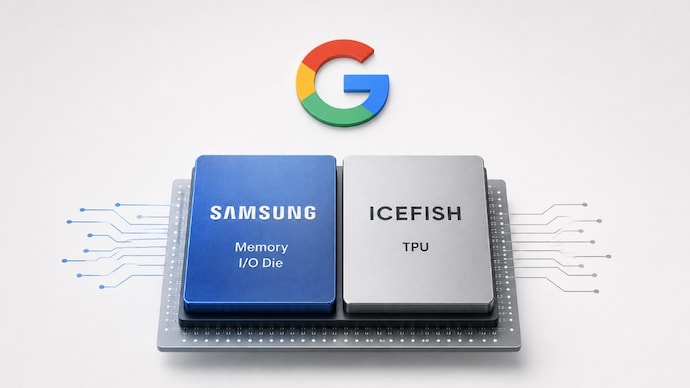
According to the report Google plans to split production of the chip between multiple partners. TSMC would manufacture the primary processing component of the tensor processing unit (TPU), while Samsung could be responsible for a separate piece that helps connect the processor to memory using its advanced 2-nanometre manufacturing technology.
The whispers around Google's plans with Samsung comes at a time when major technology companies are increasingly looking to diversify their chip supply chains as demand for AI hardware continues to surge. Icefish is reportedly expected to enter mass production as early as 2028. Google is also said to be working with chip designer MediaTek on the project.
How will Samsung help?
According to reports, the Samsung-produced component would play an important role in linking the processor to memory. It is said to be a memory input-output die that connects the processor with high-bandwidth memory, which is critical for handling large AI workloads efficiently.
Do note that neither company has confirmed the report.
The talks come at a time when Google appears to be exploring additional manufacturing partners beyond TSMC. Earlier this week, The Information reported that Google was also in discussions with Intel about producing more than three million TPUs in 2028. This shows how Google is preparing for a future in which demand for AI chips may far exceed available manufacturing capacity.
But why? Well the reason is fairly straightforward. Demand for AI chips is rising so quickly that even the world's largest chipmakers are struggling to keep up. TSMC, which manufactures advanced chips for companies including Nvidia, Apple and AMD, has become the backbone of the AI industry. However, the company has been facing mounting pressure as customers race to secure production capacity. Earlier this month, TSMC chief executive C.C. Wei reportedly warned that chip supply would remain tight for years as AI adoption continues to accelerate.
For Google, securing enough chip production capacity has become increasingly important. The company has spent years developing its own TPUs as an alternative to Nvidia's highly sought-after graphics processing units (GPUs). These custom chips power many of Google's AI services and have become a key part of its cloud business.
In April alone, Google unveiled two new AI-focused chips designed for training AI models and running AI applications. The company is investing heavily in its AI infrastructure as it competes with rivals such as Microsoft, Amazon and Meta.
Meanwhile, for Samsung, winning a role in the Icefish project would be a major boost for its foundry business. The company's 2-nanometre process is designed to deliver higher performance and improved power efficiency, making it attractive for next-generation AI hardware. If the talks progress, Samsung could become an important part of Google's future TPU manufacturing network, joining TSMC and potentially Intel.
Google has some big artificial intelligence chip projects in the pipeline and, if reports are to be believed, the Gemini creator may bring Samsung on board to help build them. According to a report by The Information, Alphabet-owned Google is in talks with Samsung Electronics to manufacture part of its next-generation AI processor, codenamed "Icefish".
The chip is still reportedly under development, but if the plans move forward, Samsung could help build a key component of the processor while Taiwan Semiconductor Manufacturing Co. (TSMC) produces the main computing engine.
According to the report Google plans to split production of the chip between multiple partners. TSMC would manufacture the primary processing component of the tensor processing unit (TPU), while Samsung could be responsible for a separate piece that helps connect the processor to memory using its advanced 2-nanometre manufacturing technology.
The whispers around Google's plans with Samsung comes at a time when major technology companies are increasingly looking to diversify their chip supply chains as demand for AI hardware continues to surge. Icefish is reportedly expected to enter mass production as early as 2028. Google is also said to be working with chip designer MediaTek on the project.
How will Samsung help?
According to reports, the Samsung-produced component would play an important role in linking the processor to memory. It is said to be a memory input-output die that connects the processor with high-bandwidth memory, which is critical for handling large AI workloads efficiently.
Do note that neither company has confirmed the report.
The talks come at a time when Google appears to be exploring additional manufacturing partners beyond TSMC. Earlier this week, The Information reported that Google was also in discussions with Intel about producing more than three million TPUs in 2028. This shows how Google is preparing for a future in which demand for AI chips may far exceed available manufacturing capacity.
But why? Well the reason is fairly straightforward. Demand for AI chips is rising so quickly that even the world's largest chipmakers are struggling to keep up. TSMC, which manufactures advanced chips for companies including Nvidia, Apple and AMD, has become the backbone of the AI industry. However, the company has been facing mounting pressure as customers race to secure production capacity. Earlier this month, TSMC chief executive C.C. Wei reportedly warned that chip supply would remain tight for years as AI adoption continues to accelerate.
For Google, securing enough chip production capacity has become increasingly important. The company has spent years developing its own TPUs as an alternative to Nvidia's highly sought-after graphics processing units (GPUs). These custom chips power many of Google's AI services and have become a key part of its cloud business.
In April alone, Google unveiled two new AI-focused chips designed for training AI models and running AI applications. The company is investing heavily in its AI infrastructure as it competes with rivals such as Microsoft, Amazon and Meta.
Meanwhile, for Samsung, winning a role in the Icefish project would be a major boost for its foundry business. The company's 2-nanometre process is designed to deliver higher performance and improved power efficiency, making it attractive for next-generation AI hardware. If the talks progress, Samsung could become an important part of Google's future TPU manufacturing network, joining TSMC and potentially Intel.

