Robots will soon replace 7 lakh delivery workers, JD.com founder says
JD.com founder Richard Liu says the company's 7 lakh delivery workers could eventually be replaced by robots as automation advances. The warning comes as major companies across the world rapidly expand the use of robots in warehouses, logistics and other operations.
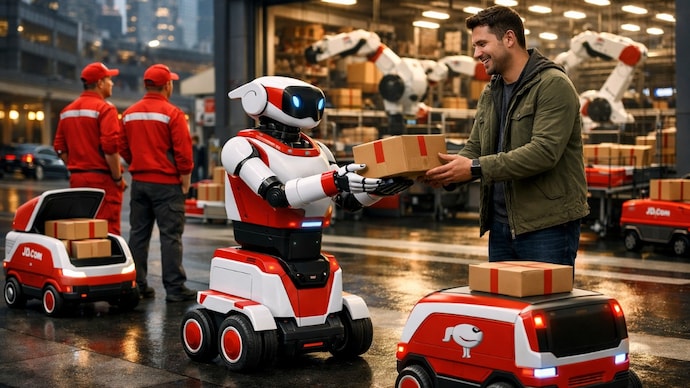
For months, concerns about AI taking away jobs have dominated discussions around the future of work. More recently, several technology leaders like Sam Altman have argued that the impact may not be as dramatic as many initially feared. But while AI's effect on employment remains a topic of debate, another technology is advancing rapidly - robots. And according to one of China's biggest e-commerce entrepreneurs, delivery workers will eventually be replaced by robots.
Richard Liu, founder and chairman of Chinese e-commerce giant JD.com, has warned that the company's army of around 700,000 delivery workers could one day be replaced by robots. Speaking at the Asia-Pacific Economic Cooperation (APEC) CEO forum in Beijing, Liu said automated deliveries are not a distant possibility but an eventual reality, Financial Times reports.
"In the future, when robots are delivering parcels, sooner or later, there will be a day when couriers are basically no longer needed," Liu said. "It will definitely be robots delivering parcels. But I really do not want our 700,000 brothers to go without meals, without jobs."
JD.com is one of China's largest online retailers and competes with e-commerce giants such as Alibaba and Meituan. While Liu did not provide a timeline for when robot deliveries could become mainstream, the company is already preparing for that future. According to him, JD.com has partnered with around 120 schools to help retrain delivery workers for new roles that may emerge as automation expands.
One of the jobs Liu believes will become increasingly important is robot maintenance. "Because robots are machinery ... they will always, at some point, have faults," he said, suggesting that workers displaced by automation could be trained to repair and manage robotic systems.
China's 5-year plan to put robots everywhere
His comments come at a time when China is aggressively investing in robotics and automation. The country's recent five-year plan places robotics among its priority technologies, with policymakers viewing robots as a key driver of future economic growth. Several pilot projects are already being tested across China, including robots that deliver food to airport passengers and others that travel on commuter rail networks to restock convenience stores.
The remarks have also reignited concerns about employment. China's gig economy has expanded rapidly over the past few years. Research estimates suggest the number of gig workers in the country could reach 320 million this year, up from around 200 million five years ago. Delivery workers, ride-hailing drivers and temporary factory workers make up a large part of this workforce.
Liu insisted that technology should improve people's lives rather than remove their ability to earn a living. "Technology should make human life become better" and work "more interesting", rather than "take away human beings' right to work", he said.
Amazon, Figure AI show automation trend is almost here
JD.com's plans are not happening in isolation. Across the technology industry, companies are increasingly looking at robots and automation to improve efficiency and reduce costs.
Amazon, for example, revealed in June 2026 that it has deployed more than one million robots across its operations network since 2012. The company uses robotic systems for tasks such as inventory sorting and packaging. A recent report from Business Insider has also suggested that Amazon is testing technologies that automatically manage worker assignments inside warehouses based on changing workloads throughout the day. In October 2025, the New York Times reported that "Amazon plans to replace more than half a million jobs with robots, which is huge. It is currently unknown whether the same could happen in countries like India. The report stated that the current plan is for the United States.
The trend extends beyond e-commerce giants. Robotics startup Figure AI recently claimed that robots now outnumber human employees within its own company. Figure AI founder Brett Adcock announced that the company has more robots than people on its payroll, with robot deployments rising sharply as manufacturing scales up.
For months, concerns about AI taking away jobs have dominated discussions around the future of work. More recently, several technology leaders like Sam Altman have argued that the impact may not be as dramatic as many initially feared. But while AI's effect on employment remains a topic of debate, another technology is advancing rapidly - robots. And according to one of China's biggest e-commerce entrepreneurs, delivery workers will eventually be replaced by robots.
Richard Liu, founder and chairman of Chinese e-commerce giant JD.com, has warned that the company's army of around 700,000 delivery workers could one day be replaced by robots. Speaking at the Asia-Pacific Economic Cooperation (APEC) CEO forum in Beijing, Liu said automated deliveries are not a distant possibility but an eventual reality, Financial Times reports.
"In the future, when robots are delivering parcels, sooner or later, there will be a day when couriers are basically no longer needed," Liu said. "It will definitely be robots delivering parcels. But I really do not want our 700,000 brothers to go without meals, without jobs."
JD.com is one of China's largest online retailers and competes with e-commerce giants such as Alibaba and Meituan. While Liu did not provide a timeline for when robot deliveries could become mainstream, the company is already preparing for that future. According to him, JD.com has partnered with around 120 schools to help retrain delivery workers for new roles that may emerge as automation expands.
One of the jobs Liu believes will become increasingly important is robot maintenance. "Because robots are machinery ... they will always, at some point, have faults," he said, suggesting that workers displaced by automation could be trained to repair and manage robotic systems.
China's 5-year plan to put robots everywhere
His comments come at a time when China is aggressively investing in robotics and automation. The country's recent five-year plan places robotics among its priority technologies, with policymakers viewing robots as a key driver of future economic growth. Several pilot projects are already being tested across China, including robots that deliver food to airport passengers and others that travel on commuter rail networks to restock convenience stores.
The remarks have also reignited concerns about employment. China's gig economy has expanded rapidly over the past few years. Research estimates suggest the number of gig workers in the country could reach 320 million this year, up from around 200 million five years ago. Delivery workers, ride-hailing drivers and temporary factory workers make up a large part of this workforce.
Liu insisted that technology should improve people's lives rather than remove their ability to earn a living. "Technology should make human life become better" and work "more interesting", rather than "take away human beings' right to work", he said.
Amazon, Figure AI show automation trend is almost here
JD.com's plans are not happening in isolation. Across the technology industry, companies are increasingly looking at robots and automation to improve efficiency and reduce costs.
Amazon, for example, revealed in June 2026 that it has deployed more than one million robots across its operations network since 2012. The company uses robotic systems for tasks such as inventory sorting and packaging. A recent report from Business Insider has also suggested that Amazon is testing technologies that automatically manage worker assignments inside warehouses based on changing workloads throughout the day. In October 2025, the New York Times reported that "Amazon plans to replace more than half a million jobs with robots, which is huge. It is currently unknown whether the same could happen in countries like India. The report stated that the current plan is for the United States.
The trend extends beyond e-commerce giants. Robotics startup Figure AI recently claimed that robots now outnumber human employees within its own company. Figure AI founder Brett Adcock announced that the company has more robots than people on its payroll, with robot deployments rising sharply as manufacturing scales up.

