Tata beats Foxconn to become largest contract manufacturer in India for Apple with 75,000 employees
Tata Electronics has overtaken Foxconn to become Apple's largest contract manufacturer in India by headcount, rapidly scaling its workforce to around 75,000 from just 15,000 in two years.
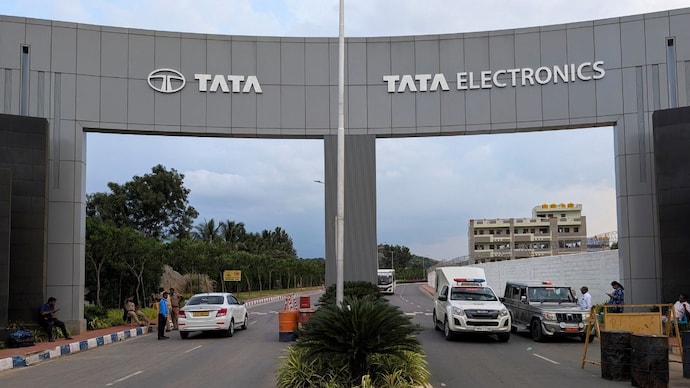
Tata Electronics has now become Apple’s largest contract manufacturing partner in India by headcount. According to the latest report by The Economic Times, the company has expanded its workforce to around 75,000 employees, overtaking Taiwanese giant Foxconn in terms of total headcount. What makes this milestone for Tata particularly notable is the pace of its expansion. Just two years ago, when it signed the deal with Apple, the company had around 15,000 employees. Its workforce has since grown nearly fourfold.
According to the report, much of this growth has been driven by Tata Electronics’ sprawling facility in Hosur, Tamil Nadu, along with its acquisitions of Wistron and Pegatron’s India operations.
The report suggests that the company has been aggressively pushing hiring. The expansion has been deliberate, aimed at building the scale required to operate within Apple’s tightly controlled global supply chain, while also developing the capabilities needed for large-scale iPhone manufacturing.
The report also notes that Tata Electronics’ workforce is now spread across multiple facilities. However, while it has taken the lead over Foxconn for now, that position may not last long.
Foxconn is expected to ramp up its upcoming plant in Devanahalli later this year, which could see it reclaim the top spot. Even so, the speed at which Tata Electronics has scaled up stands out, especially in a sector long dominated by established players from Taiwan, China and South Korea.
At present, the primary manufacturers of Apple products in India are Tata Electronics and Foxconn (Hon Hai Precision Industry Co), supported by a growing component ecosystem. Meanwhile, Tata Electronics runs Apple-related operations acquired from Wistron and Pegatron, and now manages significant iPhone assembly in Tamil Nadu and Karnataka.
What makes Tata’s growth particularly notable is that the company only began operations in 2020. In a short span, it has built capabilities that allow it to compete with global contract manufacturing veterans. According to the report, the company has reached a critical mass, improving its process discipline, supplier management and ramp-up capabilities, all of which are said to be essential for handling high-volume, precision manufacturing like iPhones.
However, the growth is still seen as being in its early stages. Analysts suggest that Tata Electronics now needs to move beyond assembly and deepen its role in the value chain. This includes focusing on localisation, improving yields and quality, and building resilience across multiple manufacturing sites. The company also aims to expand into semiconductor fabrication and advanced packaging as part of its next growth phase.
Meanwhile, India is said to be steadily emerging as a key hub for global electronics manufacturing, supported by a growing skilled workforce, policy incentives and increasing localisation. According to reports Apple’s expanding presence has been central to this shift, with iPhones becoming India’s largest export in 2025, at around $23 billion, mostly to the US.
Tata Electronics has now become Apple’s largest contract manufacturing partner in India by headcount. According to the latest report by The Economic Times, the company has expanded its workforce to around 75,000 employees, overtaking Taiwanese giant Foxconn in terms of total headcount. What makes this milestone for Tata particularly notable is the pace of its expansion. Just two years ago, when it signed the deal with Apple, the company had around 15,000 employees. Its workforce has since grown nearly fourfold.
According to the report, much of this growth has been driven by Tata Electronics’ sprawling facility in Hosur, Tamil Nadu, along with its acquisitions of Wistron and Pegatron’s India operations.
The report suggests that the company has been aggressively pushing hiring. The expansion has been deliberate, aimed at building the scale required to operate within Apple’s tightly controlled global supply chain, while also developing the capabilities needed for large-scale iPhone manufacturing.
The report also notes that Tata Electronics’ workforce is now spread across multiple facilities. However, while it has taken the lead over Foxconn for now, that position may not last long.
Foxconn is expected to ramp up its upcoming plant in Devanahalli later this year, which could see it reclaim the top spot. Even so, the speed at which Tata Electronics has scaled up stands out, especially in a sector long dominated by established players from Taiwan, China and South Korea.
At present, the primary manufacturers of Apple products in India are Tata Electronics and Foxconn (Hon Hai Precision Industry Co), supported by a growing component ecosystem. Meanwhile, Tata Electronics runs Apple-related operations acquired from Wistron and Pegatron, and now manages significant iPhone assembly in Tamil Nadu and Karnataka.
What makes Tata’s growth particularly notable is that the company only began operations in 2020. In a short span, it has built capabilities that allow it to compete with global contract manufacturing veterans. According to the report, the company has reached a critical mass, improving its process discipline, supplier management and ramp-up capabilities, all of which are said to be essential for handling high-volume, precision manufacturing like iPhones.
However, the growth is still seen as being in its early stages. Analysts suggest that Tata Electronics now needs to move beyond assembly and deepen its role in the value chain. This includes focusing on localisation, improving yields and quality, and building resilience across multiple manufacturing sites. The company also aims to expand into semiconductor fabrication and advanced packaging as part of its next growth phase.
Meanwhile, India is said to be steadily emerging as a key hub for global electronics manufacturing, supported by a growing skilled workforce, policy incentives and increasing localisation. According to reports Apple’s expanding presence has been central to this shift, with iPhones becoming India’s largest export in 2025, at around $23 billion, mostly to the US.

