IFS officer shares rare first-ever photographic record of Eurasian lynx in Sikkim
An X post by IFS officer Parveen Kaswan shared a camera-trap image of a Eurasian lynx from North Sikkim for the first time.
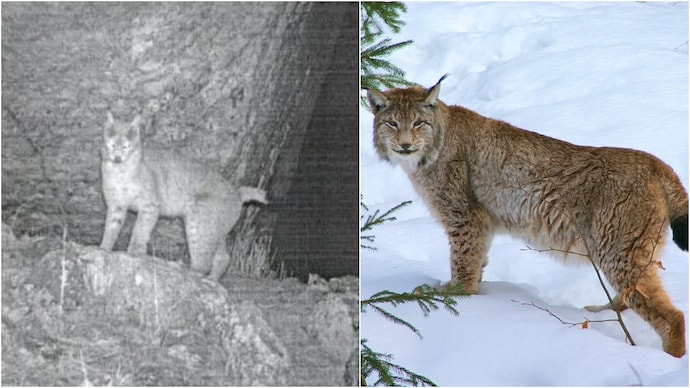
A rare camera trap image of a Eurasian lynx captured in the high-altitude landscapes of North Sikkim has excited wildlife enthusiasts and conservationists alike.
Shared by Indian Forest Service (IFS) officer Parveen Kaswan on X, the sighting marks the first-ever photographic record of the elusive wild cat in Sikkim, making it a significant milestone for wildlife conservation in India.
Sharing the image, Kaswan wrote, "Ghosts of the mountains do exist."
He added, "The first-ever photographic record of the elusive Eurasian Lynx in Sikkim is a significant moment for India's wildlife conservation story. Every such discovery reminds us how much nature still has to reveal."
According to Kaswan, the image was captured by a camera trap installed as part of the long-term Snow Leopard and Rangeland Monitoring Programme, jointly conducted by the Sikkim Forest and Environment Department and WWF-India. The camera recorded the lynx on the Tso Lhamo Plateau in North Sikkim at an altitude of around 5,250 metres.
See the post:
The Eurasian lynx (Lynx lynx) is the largest of the four lynx species found across Europe and Asia. Known for its tufted ears, thick spotted coat, broad paws and short tail, the solitary predator inhabits remote forests, alpine meadows and rugged mountain landscapes. It is an exceptionally elusive animal, making confirmed sightings extremely rare.
In India, the Eurasian lynx is found only in a few high-altitude regions of the Himalayas, including parts of Ladakh, Himachal Pradesh and now Sikkim.
Because of its secretive nature and the harsh terrain it inhabits, researchers rely heavily on camera traps to monitor its presence and understand its distribution.
The post quickly drew admiration on social media, with users celebrating the rare documentation of the species and applauding the efforts of forest officials and conservationists. Many described the image as a reminder of the hidden wildlife that still thrives in India's remote mountain ecosystems and the importance of continued conservation and scientific monitoring to protect these fragile habitats.
A rare camera trap image of a Eurasian lynx captured in the high-altitude landscapes of North Sikkim has excited wildlife enthusiasts and conservationists alike.
Shared by Indian Forest Service (IFS) officer Parveen Kaswan on X, the sighting marks the first-ever photographic record of the elusive wild cat in Sikkim, making it a significant milestone for wildlife conservation in India.
Sharing the image, Kaswan wrote, "Ghosts of the mountains do exist."
He added, "The first-ever photographic record of the elusive Eurasian Lynx in Sikkim is a significant moment for India's wildlife conservation story. Every such discovery reminds us how much nature still has to reveal."
According to Kaswan, the image was captured by a camera trap installed as part of the long-term Snow Leopard and Rangeland Monitoring Programme, jointly conducted by the Sikkim Forest and Environment Department and WWF-India. The camera recorded the lynx on the Tso Lhamo Plateau in North Sikkim at an altitude of around 5,250 metres.
See the post:
The Eurasian lynx (Lynx lynx) is the largest of the four lynx species found across Europe and Asia. Known for its tufted ears, thick spotted coat, broad paws and short tail, the solitary predator inhabits remote forests, alpine meadows and rugged mountain landscapes. It is an exceptionally elusive animal, making confirmed sightings extremely rare.
In India, the Eurasian lynx is found only in a few high-altitude regions of the Himalayas, including parts of Ladakh, Himachal Pradesh and now Sikkim.
Because of its secretive nature and the harsh terrain it inhabits, researchers rely heavily on camera traps to monitor its presence and understand its distribution.
The post quickly drew admiration on social media, with users celebrating the rare documentation of the species and applauding the efforts of forest officials and conservationists. Many described the image as a reminder of the hidden wildlife that still thrives in India's remote mountain ecosystems and the importance of continued conservation and scientific monitoring to protect these fragile habitats.

