Welcome to Indian homes, where these 5 traditions happen without a second thought
Nobody teaches them, nobody questions them, yet everyone follows them. Here are 5 habits that just make sense in Indian homes.
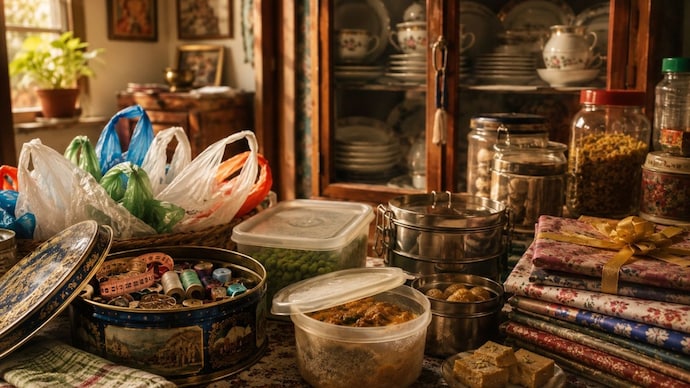
Nobody gives you a crash course on how to live in an Indian household.
There is no handbook explaining why the expensive crockery is reserved for guests who visit three times a year but not for the people who use the kitchen every single day. Nobody sits you down and teaches you that returning an empty dabba is somehow socially unacceptable. And nobody warns you that an ice cream container in the freezer should never be trusted to contain ice cream.
Yet somehow, most Indians grow up knowing all of this.
At some point during childhood, we all accepted certain facts without asking too many questions. The good plates weren't for us. Biscuit tins could not be trusted. Plastic bags remained inside other plastic bags. Wrapping paper deserved a second life. And if guests were visiting, eating snacks without offering them around first was a risky decision.
The strange part is that nobody remembers learning these rules.
There was no family seminar. No PowerPoint presentation titled ‘Introduction to Indian Household Behaviour.’ No elder gathering the children and explaining the correct protocol for storing leftover rajma inside a repurposed ice cream tub.
The knowledge simply appeared.
One day you were confused about why your grandmother kept empty sweet boxes. The next day you were keeping them too.
That's probably why social media loves these habits. Every few months somebody posts a picture of a Danish cookie tin full of sewing supplies or complains about finding frozen peas inside an ice cream container, and thousands of Indians react as though they've just discovered a long-lost sibling.
"Wait. Your family does that too?"
Apparently, all our families do.
Here’s a list of things that almost every Indian family has been swearing by without knowing why:
The Good Crockery Was Never Really Ours
Every Indian household had two sets of utensils.
The first set was for everyday use. Steel plates, cups, bowls that had survived years of service and the occasional dish with a chip that nobody considered serious enough to replace. These were the utensils that were used daily and carried the weight of countless breakfasts, lunches and dinners.
Then, there was the other dinner set.
The fancy set. The guest set. The set that often spent more time inside a glass cabinet than on a dining table.
These crockery sets would usually peek through glass-front cabinets in upper middle-class households, preserved as dinnerware and more as symbols of aspiration. Children could look at them, admire them, even dust them occasionally. But to be able to actually use them was another matter altogether.
The moment a child reached for one, somebody would appear from another room with remarkable speed.
“Arre woh mat nikalo, mehmaanon ke liye hai (Don’t take this out, it is for guests).”
“Roz roz istemaal karoge toh kharab ho jayega (If you use this every day, it’ll get ruined).”
“Guests aayenge toh kya nikaalenge phir (What will we use when the guests come home)?”
Or the ultimate dismissal: “Tumhare liye steel ki plate hi theek hai (You can use the steel plates instead).”
Some families protected those dinner sets so carefully that they remained in near-perfect condition for decades. Ironically, the people who owned them often used steel plates every day while waiting for guests worthy of the premium collection.
Nobody questioned the arrangement because it somehow made perfect sense to them. In Indian homes, hospitality has always been less about convenience and more about giving visitors the best things available, even if the family itself rarely gets to enjoy them.
The Dabba Must Never Return Empty
Nobody knows who created this rule. Nobody knows when it started. Yet every Indian household follows it with the dedication of a constitutional law.
A neighbour sends kheer. An aunt drops off biryani. Someone arrives with homemade sweets during Diwali. The food gets eaten, the container gets washed and eventually it has to be returned.
But not empty. Never empty.
Returning an empty dabba feels wrong in the same way wearing shoes inside a temple feels wrong. Technically, you can do it. Emotionally, something stops you. So, before the container goes back, something finds its way inside. A few fruits. Some namkeen. Leftover sabzi. Homemade snacks. The contents are almost secondary.
The real purpose is to keep the exchange going.
The dabba is less a container and more a messenger travelling between households carrying food, goodwill and the unspoken understanding that kindness should never make a one-way trip.
Nothing Was Ever Really Discarded
Indian households have never been particularly good at throwing things away.
In many homes, before an object could be discarded, it had to survive a lengthy review process involving at least one parent asking, "But can't we use this for something else?" More often than not, the answer was yes.
The greatest example of this philosophy is the ice cream container.
To the untrained eye, spotting an ice cream tub in the freezer suggests one thing: ice cream. Anyone raised in an Indian household knows better. An ice cream container is not a container. It is a gamble.
Maybe, it's vanilla.
Maybe, it's butterscotch.
Maybe, today is your lucky day.
Then, you open the lid and discover frozen peas.
Or chopped coriander.
Or leftover rajma.
Or a mystery sabzi that has been frozen for so long nobody remembers when it was originally cooked.
Every Indian child has experienced this disappointment. Every Indian child has learned absolutely nothing from it and fallen for the same trick again a few weeks later.
The Danish cookie tin enjoyed a similarly dramatic career change. Once the biscuits were gone, the tin quietly transformed into a sewing kit. Children who opened it expecting snacks were instead greeted by needles, thread reels, safety pins, measuring tape and enough spare buttons to outfit an entire village.
The same principle applied throughout the house. Glass jars became spice containers. Sweet boxes became storage organisers. Old sarees found second careers as curtains, cushion covers or cleaning cloths. Plastic takeaway containers earned permanent residency in kitchen cupboards, stacked inside one another in towers that threatened to collapse whenever somebody opened the door.
Today, people might call this sustainability. Indian households simply called it common sense.
The Plastic Bag Collection Everyone Pretends Is Temporary
Almost every Indian household has a plastic bag filled with other plastic bags. Nobody remembers starting the collection. Nobody remembers adding to it. Yet somehow, it exists. One day there are two or three spare carry bags lying around, and the next thing you know, there's an entire bag dedicated to storing other bags.
The collection usually lives in a drawer, hangs behind a kitchen door or occupies a mysterious corner in a cupboard. It seems to operate under its own laws of physics. No matter how many bags are used, the total number never really goes down. Need one for vegetables? There's a bag. Need one for leftovers? Plenty. Need one for a completely random errand you didn't see coming? The bag collection is ready for it.
To outsiders, it might look like clutter. To an Indian household, it's an emergency resource. Because the minute you decide to throw them all away is the minute someone walks in asking, "Do we have any spare bags?" And somehow, everybody knows the answer should always be yes.
The Secret Life of a Wrapping Paper
For most children, opening a gift marks the end of the wrapping paper's journey. But for Indian parents, it marks the beginning.
After you receive a gift, somebody starts carefully removing the tape. The wrapping paper is unfolded. Creases are smoothened out. And then, it goes under the mattress for reuse, of course. Ribbons are kept aside too. Decorative gift bags are also folded and stored away for future use.
Watching this process as a child was often confusing. Why save wrapping paper? Why save gift bags? Why save ribbons?
The answer usually arrived years later, when the same wrapping paper suddenly reappeared wrapped around somebody else's birthday present.
Indian households have always had a healthy respect for anything that remains useful. If the paper can wrap another gift, why throw it away? If the ribbon still looks good, why buy a new one?
The wrapping paper may have changed owners, but its career was far from over.
Every Indian Child Has Attempted a Snack Heist
Every Indian child has participated in some version of the same mission. Guests are sitting in the living room, the snacks are in the kitchen and, unfortunately, you are hungry.
The objective seems simple: acquire snacks without attracting attention. In reality, it requires the planning and precision of a military operation. Chips disappear secretly, biscuit packets are tucked under shirts and children attempt suspiciously casual walks through areas that suddenly feel heavily monitored. For a few glorious seconds, it feels like the plan might actually work.
It rarely does.
Indian parents possess an almost supernatural ability to detect unauthorised snacking. The moment you're spotted, the interrogation begins.
"Sabko poocha (Did you ask everyone)?"
"Guests ko diye (Did you offer this to the guests)?"
"Bas khud hi khaoge (Will you eat all this by yourself)?"
Within seconds, what started as an attempt to eat a biscuit reserved for guests turns into a lesson on manners, sharing and hospitality. Most children never truly win this battle. They just spend years refining their technique and hoping the next snack heist will finally be the one that succeeds.
The Lessons Nobody Realise They Learnt
Ask people where these habits came from and most won't have an answer.
Nobody remembers receiving a lecture on dabba etiquette. Nobody attended a workshop explaining why sewing supplies belong inside biscuit tins. Nobody completed a certification course in plastic bag preservation.
The lessons arrived quietly. Children watched parents save wrapping paper. They watched grandparents reuse containers. They watched neighbours exchange food and guests receive the best treatment. They watched ordinary objects take on entirely new lives rather than being thrown away.
And then, somewhere along the way, they started doing the same things themselves.
That is probably why these habits continue to resonate so strongly online. They feel intensely personal because they happened inside our homes, among our families and around objects we saw every day. Yet, they are also remarkably universal. Millions of Indians grew up believing their family was the only one storing peas inside ice cream containers or hiding sewing supplies inside biscuit tins.
But, turns out, almost everybody was.
Nobody taught us these rules. Nobody wrote them down. There are no manuals, no ceremonies and no official guardians preserving them. Yet somehow, they continue to survive, passed on from one generation to the next through observation, repetition and the occasional warning not to touch the fancy dinner set.
And honestly, that might be the most Indian thing about them.
Nobody gives you a crash course on how to live in an Indian household.
There is no handbook explaining why the expensive crockery is reserved for guests who visit three times a year but not for the people who use the kitchen every single day. Nobody sits you down and teaches you that returning an empty dabba is somehow socially unacceptable. And nobody warns you that an ice cream container in the freezer should never be trusted to contain ice cream.
Yet somehow, most Indians grow up knowing all of this.
At some point during childhood, we all accepted certain facts without asking too many questions. The good plates weren't for us. Biscuit tins could not be trusted. Plastic bags remained inside other plastic bags. Wrapping paper deserved a second life. And if guests were visiting, eating snacks without offering them around first was a risky decision.
The strange part is that nobody remembers learning these rules.
There was no family seminar. No PowerPoint presentation titled ‘Introduction to Indian Household Behaviour.’ No elder gathering the children and explaining the correct protocol for storing leftover rajma inside a repurposed ice cream tub.
The knowledge simply appeared.
One day you were confused about why your grandmother kept empty sweet boxes. The next day you were keeping them too.
That's probably why social media loves these habits. Every few months somebody posts a picture of a Danish cookie tin full of sewing supplies or complains about finding frozen peas inside an ice cream container, and thousands of Indians react as though they've just discovered a long-lost sibling.
"Wait. Your family does that too?"
Apparently, all our families do.
Here’s a list of things that almost every Indian family has been swearing by without knowing why:
The Good Crockery Was Never Really Ours
Every Indian household had two sets of utensils.
The first set was for everyday use. Steel plates, cups, bowls that had survived years of service and the occasional dish with a chip that nobody considered serious enough to replace. These were the utensils that were used daily and carried the weight of countless breakfasts, lunches and dinners.
Then, there was the other dinner set.
The fancy set. The guest set. The set that often spent more time inside a glass cabinet than on a dining table.
These crockery sets would usually peek through glass-front cabinets in upper middle-class households, preserved as dinnerware and more as symbols of aspiration. Children could look at them, admire them, even dust them occasionally. But to be able to actually use them was another matter altogether.
The moment a child reached for one, somebody would appear from another room with remarkable speed.
“Arre woh mat nikalo, mehmaanon ke liye hai (Don’t take this out, it is for guests).”
“Roz roz istemaal karoge toh kharab ho jayega (If you use this every day, it’ll get ruined).”
“Guests aayenge toh kya nikaalenge phir (What will we use when the guests come home)?”
Or the ultimate dismissal: “Tumhare liye steel ki plate hi theek hai (You can use the steel plates instead).”
Some families protected those dinner sets so carefully that they remained in near-perfect condition for decades. Ironically, the people who owned them often used steel plates every day while waiting for guests worthy of the premium collection.
Nobody questioned the arrangement because it somehow made perfect sense to them. In Indian homes, hospitality has always been less about convenience and more about giving visitors the best things available, even if the family itself rarely gets to enjoy them.
The Dabba Must Never Return Empty
Nobody knows who created this rule. Nobody knows when it started. Yet every Indian household follows it with the dedication of a constitutional law.
A neighbour sends kheer. An aunt drops off biryani. Someone arrives with homemade sweets during Diwali. The food gets eaten, the container gets washed and eventually it has to be returned.
But not empty. Never empty.
Returning an empty dabba feels wrong in the same way wearing shoes inside a temple feels wrong. Technically, you can do it. Emotionally, something stops you. So, before the container goes back, something finds its way inside. A few fruits. Some namkeen. Leftover sabzi. Homemade snacks. The contents are almost secondary.
The real purpose is to keep the exchange going.
The dabba is less a container and more a messenger travelling between households carrying food, goodwill and the unspoken understanding that kindness should never make a one-way trip.
Nothing Was Ever Really Discarded
Indian households have never been particularly good at throwing things away.
In many homes, before an object could be discarded, it had to survive a lengthy review process involving at least one parent asking, "But can't we use this for something else?" More often than not, the answer was yes.
The greatest example of this philosophy is the ice cream container.
To the untrained eye, spotting an ice cream tub in the freezer suggests one thing: ice cream. Anyone raised in an Indian household knows better. An ice cream container is not a container. It is a gamble.
Maybe, it's vanilla.
Maybe, it's butterscotch.
Maybe, today is your lucky day.
Then, you open the lid and discover frozen peas.
Or chopped coriander.
Or leftover rajma.
Or a mystery sabzi that has been frozen for so long nobody remembers when it was originally cooked.
Every Indian child has experienced this disappointment. Every Indian child has learned absolutely nothing from it and fallen for the same trick again a few weeks later.
The Danish cookie tin enjoyed a similarly dramatic career change. Once the biscuits were gone, the tin quietly transformed into a sewing kit. Children who opened it expecting snacks were instead greeted by needles, thread reels, safety pins, measuring tape and enough spare buttons to outfit an entire village.
The same principle applied throughout the house. Glass jars became spice containers. Sweet boxes became storage organisers. Old sarees found second careers as curtains, cushion covers or cleaning cloths. Plastic takeaway containers earned permanent residency in kitchen cupboards, stacked inside one another in towers that threatened to collapse whenever somebody opened the door.
Today, people might call this sustainability. Indian households simply called it common sense.
The Plastic Bag Collection Everyone Pretends Is Temporary
Almost every Indian household has a plastic bag filled with other plastic bags. Nobody remembers starting the collection. Nobody remembers adding to it. Yet somehow, it exists. One day there are two or three spare carry bags lying around, and the next thing you know, there's an entire bag dedicated to storing other bags.
The collection usually lives in a drawer, hangs behind a kitchen door or occupies a mysterious corner in a cupboard. It seems to operate under its own laws of physics. No matter how many bags are used, the total number never really goes down. Need one for vegetables? There's a bag. Need one for leftovers? Plenty. Need one for a completely random errand you didn't see coming? The bag collection is ready for it.
To outsiders, it might look like clutter. To an Indian household, it's an emergency resource. Because the minute you decide to throw them all away is the minute someone walks in asking, "Do we have any spare bags?" And somehow, everybody knows the answer should always be yes.
The Secret Life of a Wrapping Paper
For most children, opening a gift marks the end of the wrapping paper's journey. But for Indian parents, it marks the beginning.
After you receive a gift, somebody starts carefully removing the tape. The wrapping paper is unfolded. Creases are smoothened out. And then, it goes under the mattress for reuse, of course. Ribbons are kept aside too. Decorative gift bags are also folded and stored away for future use.
Watching this process as a child was often confusing. Why save wrapping paper? Why save gift bags? Why save ribbons?
The answer usually arrived years later, when the same wrapping paper suddenly reappeared wrapped around somebody else's birthday present.
Indian households have always had a healthy respect for anything that remains useful. If the paper can wrap another gift, why throw it away? If the ribbon still looks good, why buy a new one?
The wrapping paper may have changed owners, but its career was far from over.
Every Indian Child Has Attempted a Snack Heist
Every Indian child has participated in some version of the same mission. Guests are sitting in the living room, the snacks are in the kitchen and, unfortunately, you are hungry.
The objective seems simple: acquire snacks without attracting attention. In reality, it requires the planning and precision of a military operation. Chips disappear secretly, biscuit packets are tucked under shirts and children attempt suspiciously casual walks through areas that suddenly feel heavily monitored. For a few glorious seconds, it feels like the plan might actually work.
It rarely does.
Indian parents possess an almost supernatural ability to detect unauthorised snacking. The moment you're spotted, the interrogation begins.
"Sabko poocha (Did you ask everyone)?"
"Guests ko diye (Did you offer this to the guests)?"
"Bas khud hi khaoge (Will you eat all this by yourself)?"
Within seconds, what started as an attempt to eat a biscuit reserved for guests turns into a lesson on manners, sharing and hospitality. Most children never truly win this battle. They just spend years refining their technique and hoping the next snack heist will finally be the one that succeeds.
The Lessons Nobody Realise They Learnt
Ask people where these habits came from and most won't have an answer.
Nobody remembers receiving a lecture on dabba etiquette. Nobody attended a workshop explaining why sewing supplies belong inside biscuit tins. Nobody completed a certification course in plastic bag preservation.
The lessons arrived quietly. Children watched parents save wrapping paper. They watched grandparents reuse containers. They watched neighbours exchange food and guests receive the best treatment. They watched ordinary objects take on entirely new lives rather than being thrown away.
And then, somewhere along the way, they started doing the same things themselves.
That is probably why these habits continue to resonate so strongly online. They feel intensely personal because they happened inside our homes, among our families and around objects we saw every day. Yet, they are also remarkably universal. Millions of Indians grew up believing their family was the only one storing peas inside ice cream containers or hiding sewing supplies inside biscuit tins.
But, turns out, almost everybody was.
Nobody taught us these rules. Nobody wrote them down. There are no manuals, no ceremonies and no official guardians preserving them. Yet somehow, they continue to survive, passed on from one generation to the next through observation, repetition and the occasional warning not to touch the fancy dinner set.
And honestly, that might be the most Indian thing about them.

