What Aloka the peace dog means to the people who chose indies over pedigrees
For India's growing community of Indie dog parents, those who chose the street dog over the showroom, the rescued over the purchased, Aloka the peace dog's journey means something more specific, and more urgent.
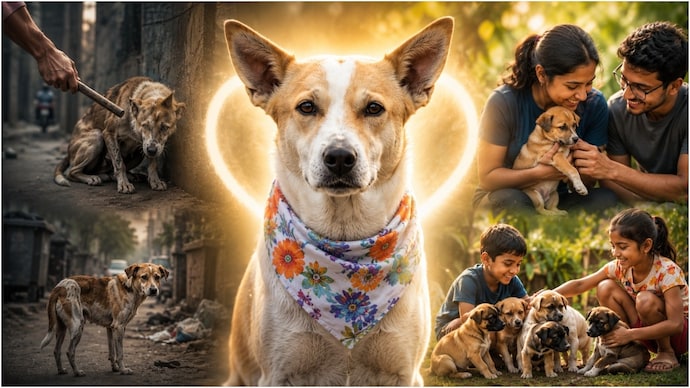
Every day in India, street dogs are chased off pavements, relocated from neighbourhoods, and often treated as a problem to be managed rather than animals to be protected.
Aloka was one of the lucky ones. Then he became something else entirely.
He had no collar, no name, and no reason to trust anyone. In 2022, somewhere on the roads of Kolkata, a stray dog made a quiet, unremarkable decision: he fell into step behind a group of Buddhist monks and simply kept walking. He survived being hit by a car. He pushed through severe illness. And still, he walked.
The monks named him Aloka, which means ‘light’ in Pali, and together, they crossed 2,300 miles of American terrain, from coast to capital. By the time Aloka trotted into Washington, DC, millions had fallen for the dog with the heart-shaped marking on his forehead. He had become, improbably, a symbol of peace, resilience, and coexistence.
But to India's growing community of Indie dog parents, those who chose the street dog over the showroom, the rescued over the purchased, Aloka's journey means something more specific, and more urgent. He is not just a travelling dog. He is a mirror held up to a country that has spent decades looking past its most abundant, most resilient, and most overlooked animal.
The dog at the door we never opened
India has millions of street dogs. They sleep on footpaths, scavenge at dumpsters, navigate traffic with a kind of weary expertise, and are, more often than not, chased, feared, or ignored. The narrative around them has long been one of nuisance or threat, an inconvenience of urban life to be managed, relocated, or forgotten.
And yet, a quiet counter-movement has been building. Across Indian cities, a generation of pet parents is choosing to adopt Indies, the colloquial term for Indian street dogs, or INDog, over purchasing pedigree breeds. Rescue shelters report growing waitlists.
Social media communities dedicated to Indies now attract hundreds of thousands of followers. And somewhere in the middle of all this, Aloka arrived, not as a campaign or a cause, but as a dog who simply kept going.
"I think it's much bigger than just one dog," says Susmita Pakrasi, a PR professional and Indie parent. "Aloka has become a familiar face, but what people are really connecting with is the idea that Indie dogs deserve the same love and recognition as any other breed. It feels like more people are beginning to see them for who they are, not just where they come from."
What Aloka carries that no pedigree could
There is something specifically powerful about the fact that Aloka is an Indie. Had he been a Labrador or a Golden Retriever, his story would have been heartwarming. As an Indian street dog, one of the millions that go unnamed and uncounted every year, his story becomes something else entirely: a rebuttal.
Richa, an editor and parent to an Indie named Dora, puts it plainly. "A dog is a dog. They love unconditionally, ask for attention with no remorse, and are there for you no matter what. And Aloka, by staying on course with the monks, has shown that they are just as loyal, tough, and brilliant as any other breed.
If Aloka represents possibility, Dora represents proof.
Dora's own story carries that same thread. Rescued from the streets of North Delhi after her entire family was run over by a car, she survived only because she had wandered off to explore. Her foster parent named her Dora for exactly that reason.
"She has a very strong survival instinct and is very independent," says Richa. "She doesn't let any fear stop her from experiencing things. Nothing. And I think that is most Indies, they are so used to the harsh life that they are just emotionally and mentally very strong."
It is this quality, a resilience born not of breeding, but of survival, that Indie parents return to again and again when describing their dogs. Susmita calls it emotional intelligence. "Indie dogs are incredibly observant and intuitive. They form deep bonds, understand routines, and are remarkably resilient despite everything they've been through. I wish more people realised that community dogs aren't 'less than', they're just as loving, loyal, and capable of becoming wonderful companions."
The misconception that costs lives
Ask any Indie parent what myth they most want dismantled, and the answers converge quickly. The deepest, most damaging misconception is not that Indies are dangerous, it is that they are somehow not meant to belong.
"That they are not meant to be around humans, or meant to be a part of your family," says Richa. It is a belief so entrenched that it shapes adoption rates, policy decisions, and the everyday attitude of people who pass street dogs without a second glance.
Tiasa Bhowal, a journalist, adds another layer to this. For her, the conversation about Indies cannot be separated from a broader reckoning with how Indians relate to animals at all. "We have to learn how to coexist with animals," she says. "The perception that dogs will adapt to how humans live is the biggest misconception. We should try to understand how they behave and why."
She is particularly pointed about the violence narrative that dominates coverage of street dogs. Every incident of a dog bite or a mauling makes headlines. The trigger — a stone thrown, a dog cornered, a territory threatened — rarely does. "We always miss the point," she says. "What triggered that? Did that little boy try to throw a stone? Was the dog scared? Nobody asks that. Just like we consider why humans behave in a certain way, we have to analyse how animals in our surroundings behave the way they do."
The status problem
Beneath the surface of India's relationship with dogs runs a current that Tiasa identifies with particular clarity: status.
"The biggest thing is that today, people have dogs because they want to show people that they own a dog which costs thirty thousand rupees," she says. "The market value of everything has come down to status." The result is a paradox in which families shell out significant sums for imported or pedigree breeds while puppies die on the street outside their gates: underfed, uncounted, unnamed.
"We don't want to adopt them," she says, with the plainness of someone who has watched this play out too many times. "Let's just go out and buy something, like we're shopping for clothes. We have so many puppies dying every day, getting crushed, not getting food. But we are ready to shell out money rather than walk outside and save one."
The practical case for Indies, she argues, is also overwhelming. "If you talk to a lot of pet parents who have an Indie dog, they will tell you they are the most hassle-free pets to have. They will eat whatever you give them. They stay in any condition — they survive on Indian streets, sometimes going days without food or water. They are not like a husky that needs air conditioning twenty-four hours a day because they are not meant for the Indian climate."
It is an argument that cuts through the romanticism and arrives at something grounded: the Indie dog is, in almost every practical sense, the dog that was made for this country. And yet it remains the dog this country has been slowest to welcome home.
If every Indie were Aloka
The question that lingers, after Aloka's story has been told and retold, is the one about possibility. What would shift, in India, if the street dog were met not with fear or indifference, but with the same patience and care that transformed a nameless stray into a symbol of peace?
Susmita's answer is, perhaps, the most hopeful. "I think we'd see a complete change in perspective. When dogs are healthy, safe, and cared for, their true personalities shine through. More people would recognise Indies as intelligent, gentle, adaptable companions instead of seeing them through the lens of fear or stereotypes. Over time, kindness would become the norm, and adoption, responsible care, and peaceful coexistence would feel like the obvious choice rather than the exception."
Richa believes the stakes are even higher than that. "I think our society would truly heal if we just take the plunge and accept our Indies. Dogs literally bring people together, I feel that strongly. And if we give our Indies a chance, we would be left amazed at just how innately intelligent and sharp they are."
Walking towards the light
Aloka did not set out to be a symbol. He set out, in the way that dogs do, because something ahead of him felt worth following. A group of monks on a peace walk. A direction that made sense in the moment. And then, step by step, something larger.
In India, where his kind is still far more likely to be chased than celebrated, his story arrives as both inspiration and indictment. It asks something of the people watching from the footpath, not to simply admire a dog who made it, but to look down at the ones still waiting.
Millions of Alokas are out there. They have survived car accidents and hunger and indifference. They have the same heart-shaped markings, invisible to those not looking. They have been walking toward us, in their quiet way, for a long time.
All they need is for us to be kind.
Every day in India, street dogs are chased off pavements, relocated from neighbourhoods, and often treated as a problem to be managed rather than animals to be protected.
Aloka was one of the lucky ones. Then he became something else entirely.
He had no collar, no name, and no reason to trust anyone. In 2022, somewhere on the roads of Kolkata, a stray dog made a quiet, unremarkable decision: he fell into step behind a group of Buddhist monks and simply kept walking. He survived being hit by a car. He pushed through severe illness. And still, he walked.
The monks named him Aloka, which means ‘light’ in Pali, and together, they crossed 2,300 miles of American terrain, from coast to capital. By the time Aloka trotted into Washington, DC, millions had fallen for the dog with the heart-shaped marking on his forehead. He had become, improbably, a symbol of peace, resilience, and coexistence.
But to India's growing community of Indie dog parents, those who chose the street dog over the showroom, the rescued over the purchased, Aloka's journey means something more specific, and more urgent. He is not just a travelling dog. He is a mirror held up to a country that has spent decades looking past its most abundant, most resilient, and most overlooked animal.
The dog at the door we never opened
India has millions of street dogs. They sleep on footpaths, scavenge at dumpsters, navigate traffic with a kind of weary expertise, and are, more often than not, chased, feared, or ignored. The narrative around them has long been one of nuisance or threat, an inconvenience of urban life to be managed, relocated, or forgotten.
And yet, a quiet counter-movement has been building. Across Indian cities, a generation of pet parents is choosing to adopt Indies, the colloquial term for Indian street dogs, or INDog, over purchasing pedigree breeds. Rescue shelters report growing waitlists.
Social media communities dedicated to Indies now attract hundreds of thousands of followers. And somewhere in the middle of all this, Aloka arrived, not as a campaign or a cause, but as a dog who simply kept going.
"I think it's much bigger than just one dog," says Susmita Pakrasi, a PR professional and Indie parent. "Aloka has become a familiar face, but what people are really connecting with is the idea that Indie dogs deserve the same love and recognition as any other breed. It feels like more people are beginning to see them for who they are, not just where they come from."
What Aloka carries that no pedigree could
There is something specifically powerful about the fact that Aloka is an Indie. Had he been a Labrador or a Golden Retriever, his story would have been heartwarming. As an Indian street dog, one of the millions that go unnamed and uncounted every year, his story becomes something else entirely: a rebuttal.
Richa, an editor and parent to an Indie named Dora, puts it plainly. "A dog is a dog. They love unconditionally, ask for attention with no remorse, and are there for you no matter what. And Aloka, by staying on course with the monks, has shown that they are just as loyal, tough, and brilliant as any other breed.
If Aloka represents possibility, Dora represents proof.
Dora's own story carries that same thread. Rescued from the streets of North Delhi after her entire family was run over by a car, she survived only because she had wandered off to explore. Her foster parent named her Dora for exactly that reason.
"She has a very strong survival instinct and is very independent," says Richa. "She doesn't let any fear stop her from experiencing things. Nothing. And I think that is most Indies, they are so used to the harsh life that they are just emotionally and mentally very strong."
It is this quality, a resilience born not of breeding, but of survival, that Indie parents return to again and again when describing their dogs. Susmita calls it emotional intelligence. "Indie dogs are incredibly observant and intuitive. They form deep bonds, understand routines, and are remarkably resilient despite everything they've been through. I wish more people realised that community dogs aren't 'less than', they're just as loving, loyal, and capable of becoming wonderful companions."
The misconception that costs lives
Ask any Indie parent what myth they most want dismantled, and the answers converge quickly. The deepest, most damaging misconception is not that Indies are dangerous, it is that they are somehow not meant to belong.
"That they are not meant to be around humans, or meant to be a part of your family," says Richa. It is a belief so entrenched that it shapes adoption rates, policy decisions, and the everyday attitude of people who pass street dogs without a second glance.
Tiasa Bhowal, a journalist, adds another layer to this. For her, the conversation about Indies cannot be separated from a broader reckoning with how Indians relate to animals at all. "We have to learn how to coexist with animals," she says. "The perception that dogs will adapt to how humans live is the biggest misconception. We should try to understand how they behave and why."
She is particularly pointed about the violence narrative that dominates coverage of street dogs. Every incident of a dog bite or a mauling makes headlines. The trigger — a stone thrown, a dog cornered, a territory threatened — rarely does. "We always miss the point," she says. "What triggered that? Did that little boy try to throw a stone? Was the dog scared? Nobody asks that. Just like we consider why humans behave in a certain way, we have to analyse how animals in our surroundings behave the way they do."
The status problem
Beneath the surface of India's relationship with dogs runs a current that Tiasa identifies with particular clarity: status.
"The biggest thing is that today, people have dogs because they want to show people that they own a dog which costs thirty thousand rupees," she says. "The market value of everything has come down to status." The result is a paradox in which families shell out significant sums for imported or pedigree breeds while puppies die on the street outside their gates: underfed, uncounted, unnamed.
"We don't want to adopt them," she says, with the plainness of someone who has watched this play out too many times. "Let's just go out and buy something, like we're shopping for clothes. We have so many puppies dying every day, getting crushed, not getting food. But we are ready to shell out money rather than walk outside and save one."
The practical case for Indies, she argues, is also overwhelming. "If you talk to a lot of pet parents who have an Indie dog, they will tell you they are the most hassle-free pets to have. They will eat whatever you give them. They stay in any condition — they survive on Indian streets, sometimes going days without food or water. They are not like a husky that needs air conditioning twenty-four hours a day because they are not meant for the Indian climate."
It is an argument that cuts through the romanticism and arrives at something grounded: the Indie dog is, in almost every practical sense, the dog that was made for this country. And yet it remains the dog this country has been slowest to welcome home.
If every Indie were Aloka
The question that lingers, after Aloka's story has been told and retold, is the one about possibility. What would shift, in India, if the street dog were met not with fear or indifference, but with the same patience and care that transformed a nameless stray into a symbol of peace?
Susmita's answer is, perhaps, the most hopeful. "I think we'd see a complete change in perspective. When dogs are healthy, safe, and cared for, their true personalities shine through. More people would recognise Indies as intelligent, gentle, adaptable companions instead of seeing them through the lens of fear or stereotypes. Over time, kindness would become the norm, and adoption, responsible care, and peaceful coexistence would feel like the obvious choice rather than the exception."
Richa believes the stakes are even higher than that. "I think our society would truly heal if we just take the plunge and accept our Indies. Dogs literally bring people together, I feel that strongly. And if we give our Indies a chance, we would be left amazed at just how innately intelligent and sharp they are."
Walking towards the light
Aloka did not set out to be a symbol. He set out, in the way that dogs do, because something ahead of him felt worth following. A group of monks on a peace walk. A direction that made sense in the moment. And then, step by step, something larger.
In India, where his kind is still far more likely to be chased than celebrated, his story arrives as both inspiration and indictment. It asks something of the people watching from the footpath, not to simply admire a dog who made it, but to look down at the ones still waiting.
Millions of Alokas are out there. They have survived car accidents and hunger and indifference. They have the same heart-shaped markings, invisible to those not looking. They have been walking toward us, in their quiet way, for a long time.
All they need is for us to be kind.

