Who decides who is a terrorist? From Gandhi to Barghouti, the label has always been political
When activists carried a statue of Marwan Barghouti through the streets of London and tried to place it in Parliament Square, they provoked one of the oldest and most uncomfortable questions in modern history, a question that reaches from Churchill's India to Trump's Syria and beyond.
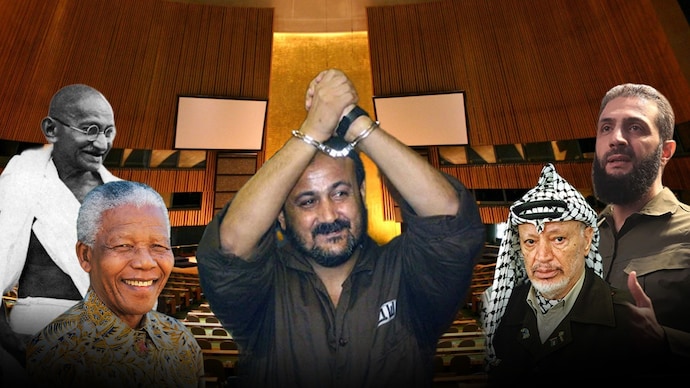
Earlier this month, activists carrying a bronze statue made their way through central London with a singular aim. The statue was of Marwan Barghouti, a senior Palestinian political figure who has spent more than 24 years in an Israeli prison cell, and the destination was Parliament Square, where it was intended to stand alongside the likenesses of Nelson Mandela, Mahatma Gandhi, Benjamin Disraeli and Oliver Cromwell. British police intervened before the statue could be installed. Officers remained on site until the campaign's bronze figure was removed.
The "Free Marwan Now" campaign, which organised the demonstration in collaboration with climate activist Greta Thunberg and actors Mark Ruffalo and Liam Cunningham, declared on social media that "Marwan will take his rightful place alongside other civil rights leaders." Green Party leader Zack Polanski had already caused controversy by wearing a "Free Marwan" T-shirt at a party event, comparing Barghouti to Mandela and arguing that he had been denied a fair trial. The campaign itself was explicit about the parallel it was drawing: "Nelson Mandela was once politically isolated and labeled a terrorist before being recognized as a global symbol of freedom and justice," it stated. "Marwan Barghouti faces a similar fate."
That comparison is, depending on your perspective, either one of the most apt in contemporary political life or one of the most grotesque. But before reaching for either verdict, it is worth pausing on what history actually tells us about the terrorist label because the record is considerably more troubling, and more instructive, than most people in positions of power would care to admit.
Churchill and Gandhi
The story does not begin with the contemporary West Asia. It begins, as so many modern questions about colonialism and resistance do, in British India.
In February 1931, Winston Churchill addressed the West Essex Unionist Association and described Mahatma Gandhi in terms that would become infamous. The man now celebrated across the world as the father of nonviolent resistance, the man whose face appears on Indian currency, whose statues stand in London's Parliament Square itself, and whose methods inspired civil rights movements from Alabama to Johannesburg, was described by Churchill as follows: "It is alarming and also nauseating to see Mr. Gandhi, a seditious Middle Temple lawyer, now posing as a fakir of a type well known in the East, striding half-naked up the steps of the Vice-regal palace, to parley on equal terms with the representative of the King-Emperor."
Churchill's bitterness deepened throughout the 1930s. He called Gandhi "seditious in aim," accused him of unleashing "evil genius" against the British Empire, called him a "Hindu Mussolini" and alleged that he was fomenting racial war. The label, in retrospect, describes nothing about Gandhi. It describes, with uncomfortable precision, the anxiety of an imperial power confronting the most effective challenge to its authority it had ever encountered. Gandhi was dangerous not because he was violent, his entire political method was premised on the rejection of violence, but because he was succeeding. The label was a weapon. It was also wrong.
Mandela and the Cold War
If the Gandhi case illustrates how the terrorist label can be deployed against nonviolent resistance, the case of Nelson Mandela illustrates something perhaps even more damning, that the label can persist long after the political inconvenience that generated it has dissolved.
In a 1986 speech, then U.S. President Ronald Reagan warned of what he called "calculated terror by elements of the African National Congress," citing "the mining of roads, the bombings of public places, designed to bring about further repression." The Reagan administration followed the apartheid South African government's own designation of the ANC as a terrorist organisation. In January 1989, the then United States Department of Defense included the ANC in an official publication titled "Terrorist Group Profiles," prefaced by President-elect George H.W. Bush, which listed the ANC among 52 of what it called the "world's more notorious terrorist groups." Mandela, who had spent more than a quarter of a century in prison by that point, was named as part of the organisation's leadership.
The reason was not primarily about what the ANC had done, but about what Washington feared it might represent. The ANC had ties to communist movements, and South Africa's apartheid regime was a Cold War ally. As historian Robert Trent Vinson has argued, Washington regarded Mandela as "a person on the wrong side of the Cold War." The designation was geopolitical convenience dressed in moral language.
What followed remains astonishing in its absurdity. Mandela was released from prison in 1990. He won the Nobel Peace Prize in 1993. He became president of South Africa in 1994 and left office in 1999 after serving a single term, a gesture of democratic restraint that earned him universal admiration. And yet, Nelson Mandela remained on the United States terrorism watch list until 2008. He was 90 years old when the designation was finally removed.
The embarrassment was acknowledged from within the American government itself. In April 2008, Secretary of State Condoleezza Rice appeared before a Senate committee and told lawmakers that her department was still having to issue waivers for ANC members to visit the United States. "This is a country with which we now have excellent relations, South Africa," she said, "but it's frankly a rather embarrassing matter that I still have to waive in my own counterpart, the foreign minister of South Africa, not to mention the great leader Nelson Mandela." President George W. Bush signed legislation removing Mandela from all terror lists later that summer, fourteen years after he had been elected president, and nine years after he had left office.
The lesson here is not simply that the Americans were wrong about Mandela, though they were. It is that their designation of him as a terrorist had never really been about his actions in the first place. It was about Cold War alliance structures. When those structures no longer mattered, the designation became, in Rice's own word, embarrassing.
Arafat and the Diplomatic Moment
The case of Yasser Arafat introduces a different dynamic, not the persistence of a wrong label, but the speed with which it can be discarded when political usefulness demands it.
The Palestine Liberation Organisation was designated a terrorist organisation by the United States in 1987. For years, Washington and Tel Aviv refused official contact with it. Arafat had addressed the United Nations General Assembly in 1974, but he remained a political pariah in American eyes. Then, in September 1993, two days after the PLO formally recognised Israel's right to exist and renounced violence, President Clinton removed the PLO from the State Department's list of terrorist organisations. Two days after that, Arafat was welcomed to the White House lawn for the signing of the Oslo Accords, where he shook hands with Israeli Prime Minister Yitzhak Rabin in one of the most photographed moments of the late twentieth century. The following year, Arafat shared the Nobel Peace Prize with Rabin and Shimon Peres.
Arafat had not changed. His history had not changed. What changed was American strategic interest. The Oslo peace process required a Palestinian interlocutor, and Arafat was the only figure with sufficient authority to fill that role. The terrorism designation came off because it had become inconvenient to keep it on. What had previously been a moral judgement revealed itself, under examination, to have been a diplomatic position and diplomatic positions change.
Al-Sharaa and the Rebrand
Perhaps the most striking contemporary illustration of the pattern, however, is the case of Ahmed al-Sharaa, the man who now governs Syria.
The United States formally designated al-Sharaa's group, Hayat Tahrir al-Sham, as a Foreign Terrorist Organisation. HTS had emerged from al-Nusra Front, once al-Qaeda's official branch in Syria. Al-Sharaa himself, operating under the nom de guerre Mohammed al-Jolani, was subject to a United Nations asset freeze and travel ban. In December 2024, however, the forces he led overthrew the Assad government in what Al Jazeera described as a "lightning offensive," and al-Sharaa became Syria's president.
What followed moves with the kind of speed that makes a mockery of the language of fixed moral categories. In May 2025, President Trump met al-Sharaa in Riyadh. In July 2025, the Unites States announced the revocation of HTS's Foreign Terrorist Organisation designation, stating that "this FTO revocation is an important step in fulfilling President Trump's vision of a stable, unified, and peaceful Syria." The United Kingdom removed the group from its list of proscribed terrorist organisations in October 2025. In February 2026, the United Nations Security Council Committee removed HTS from its own sanctions list.
The former leader of an al-Qaeda offshoot is now an internationally recognised head of state, received by Washington and courted by Paris. The United Nations, which had maintained terror-related sanctions against him since 2014, lifted them. The transformation was not gradual. It was almost instantaneous, because what changed was not al-Sharaa, but the calculation of Western interests in Syria.
The Question of Barghouti
Against this backdrop arrives the most contested comparison of the present moment. Barghouti is a senior member of Fatah and, according to consistent polling, one of the few Palestinian figures capable of uniting Palestinians across factional lines. He has been imprisoned by Israel since 2002. In 2004, an Israeli court convicted him on five counts of murder for involvement in attacks during the Second Intifada. He refused to recognise the court's jurisdiction, rejecting the legitimacy of a judicial process conducted by what he characterised as an occupying power. His trial drew substantial criticism from human rights organisations and legal observers internationally.
His supporters draw the Mandela parallel explicitly: that Mandela was also convicted under the laws of a government whose legitimacy he refused to accept, that armed resistance to occupation is consistently criminalised by the power doing the occupying, and that the West's current refusal to treat Barghouti as a political figure rather than a criminal reflects the same pattern of geopolitical convenience that kept Mandela on a terrorism watch list until he was 90. His critics argue, with equal force, that he was convicted of specific murders of civilians, and that invoking Mandela's name elides those deaths and the people who suffered them.
This debate is not one that admits of easy resolution. The killings for which Barghouti was convicted were real, and the victims were real. The question of whether an Israeli court has legitimate jurisdiction over a member of the Palestinian legislature is not a simple one, but it does not dissolve the fact of the deaths. Those who argue that Barghouti deserves the Mandela comparison and those who argue that it dishonours Mandela's memory are both engaging in genuine moral reasoning about questions that resist tidy answers.
What the Pattern Tells Us
What the historical record does tell us, however, is this: the terrorist label has repeatedly been presented as a moral verdict when it was, in practice, a political instrument. Gandhi threatened an empire, so he was called seditious. Mandela threatened apartheid, so he was kept on a terrorism watch list for nine years after leaving power. Arafat became useful to a peace process, so he became a statesman within 48 hours. Ahmed al-Sharaa became useful to Western strategy in Syria, so his al-Qaeda origins became, in the diplomatic formulation, historical context rather than present reality.
The consistency is not in who gets the label. It is in who applies it, and what purpose it serves at the moment of application. If yesterday's foreign terrorist organisation designation can be revoked on the basis of a meeting in Riyadh, then the designation was never quite the timeless moral statement it was presented to be. If Nelson Mandela can remain on a terrorism watch list for 14 years after becoming a democratically elected president, then the watch list was not really about terrorism.
None of this answers the question of Marwan Barghouti. His case involves specific alleged acts of violence that go beyond the category of resistance leader convicted under contested laws. The comparison with Mandela is not automatic, and those who resist it are not simply defenders of an unjust status quo. But the pattern of history does establish, with uncomfortable clarity, that the question of who receives the terrorist label and who receives the statue in Parliament Square is never settled by principle alone. It is settled by power and the power to apply the label has always been exercised by those with the greatest interest in the outcome.
The statue was carried back from Parliament Square. But the question it raised is not so easily removed.
With inputs from Jyoti Shukla.
Earlier this month, activists carrying a bronze statue made their way through central London with a singular aim. The statue was of Marwan Barghouti, a senior Palestinian political figure who has spent more than 24 years in an Israeli prison cell, and the destination was Parliament Square, where it was intended to stand alongside the likenesses of Nelson Mandela, Mahatma Gandhi, Benjamin Disraeli and Oliver Cromwell. British police intervened before the statue could be installed. Officers remained on site until the campaign's bronze figure was removed.
The "Free Marwan Now" campaign, which organised the demonstration in collaboration with climate activist Greta Thunberg and actors Mark Ruffalo and Liam Cunningham, declared on social media that "Marwan will take his rightful place alongside other civil rights leaders." Green Party leader Zack Polanski had already caused controversy by wearing a "Free Marwan" T-shirt at a party event, comparing Barghouti to Mandela and arguing that he had been denied a fair trial. The campaign itself was explicit about the parallel it was drawing: "Nelson Mandela was once politically isolated and labeled a terrorist before being recognized as a global symbol of freedom and justice," it stated. "Marwan Barghouti faces a similar fate."
That comparison is, depending on your perspective, either one of the most apt in contemporary political life or one of the most grotesque. But before reaching for either verdict, it is worth pausing on what history actually tells us about the terrorist label because the record is considerably more troubling, and more instructive, than most people in positions of power would care to admit.
Churchill and Gandhi
The story does not begin with the contemporary West Asia. It begins, as so many modern questions about colonialism and resistance do, in British India.
In February 1931, Winston Churchill addressed the West Essex Unionist Association and described Mahatma Gandhi in terms that would become infamous. The man now celebrated across the world as the father of nonviolent resistance, the man whose face appears on Indian currency, whose statues stand in London's Parliament Square itself, and whose methods inspired civil rights movements from Alabama to Johannesburg, was described by Churchill as follows: "It is alarming and also nauseating to see Mr. Gandhi, a seditious Middle Temple lawyer, now posing as a fakir of a type well known in the East, striding half-naked up the steps of the Vice-regal palace, to parley on equal terms with the representative of the King-Emperor."
Churchill's bitterness deepened throughout the 1930s. He called Gandhi "seditious in aim," accused him of unleashing "evil genius" against the British Empire, called him a "Hindu Mussolini" and alleged that he was fomenting racial war. The label, in retrospect, describes nothing about Gandhi. It describes, with uncomfortable precision, the anxiety of an imperial power confronting the most effective challenge to its authority it had ever encountered. Gandhi was dangerous not because he was violent, his entire political method was premised on the rejection of violence, but because he was succeeding. The label was a weapon. It was also wrong.
Mandela and the Cold War
If the Gandhi case illustrates how the terrorist label can be deployed against nonviolent resistance, the case of Nelson Mandela illustrates something perhaps even more damning, that the label can persist long after the political inconvenience that generated it has dissolved.
In a 1986 speech, then U.S. President Ronald Reagan warned of what he called "calculated terror by elements of the African National Congress," citing "the mining of roads, the bombings of public places, designed to bring about further repression." The Reagan administration followed the apartheid South African government's own designation of the ANC as a terrorist organisation. In January 1989, the then United States Department of Defense included the ANC in an official publication titled "Terrorist Group Profiles," prefaced by President-elect George H.W. Bush, which listed the ANC among 52 of what it called the "world's more notorious terrorist groups." Mandela, who had spent more than a quarter of a century in prison by that point, was named as part of the organisation's leadership.
The reason was not primarily about what the ANC had done, but about what Washington feared it might represent. The ANC had ties to communist movements, and South Africa's apartheid regime was a Cold War ally. As historian Robert Trent Vinson has argued, Washington regarded Mandela as "a person on the wrong side of the Cold War." The designation was geopolitical convenience dressed in moral language.
What followed remains astonishing in its absurdity. Mandela was released from prison in 1990. He won the Nobel Peace Prize in 1993. He became president of South Africa in 1994 and left office in 1999 after serving a single term, a gesture of democratic restraint that earned him universal admiration. And yet, Nelson Mandela remained on the United States terrorism watch list until 2008. He was 90 years old when the designation was finally removed.
The embarrassment was acknowledged from within the American government itself. In April 2008, Secretary of State Condoleezza Rice appeared before a Senate committee and told lawmakers that her department was still having to issue waivers for ANC members to visit the United States. "This is a country with which we now have excellent relations, South Africa," she said, "but it's frankly a rather embarrassing matter that I still have to waive in my own counterpart, the foreign minister of South Africa, not to mention the great leader Nelson Mandela." President George W. Bush signed legislation removing Mandela from all terror lists later that summer, fourteen years after he had been elected president, and nine years after he had left office.
The lesson here is not simply that the Americans were wrong about Mandela, though they were. It is that their designation of him as a terrorist had never really been about his actions in the first place. It was about Cold War alliance structures. When those structures no longer mattered, the designation became, in Rice's own word, embarrassing.
Arafat and the Diplomatic Moment
The case of Yasser Arafat introduces a different dynamic, not the persistence of a wrong label, but the speed with which it can be discarded when political usefulness demands it.
The Palestine Liberation Organisation was designated a terrorist organisation by the United States in 1987. For years, Washington and Tel Aviv refused official contact with it. Arafat had addressed the United Nations General Assembly in 1974, but he remained a political pariah in American eyes. Then, in September 1993, two days after the PLO formally recognised Israel's right to exist and renounced violence, President Clinton removed the PLO from the State Department's list of terrorist organisations. Two days after that, Arafat was welcomed to the White House lawn for the signing of the Oslo Accords, where he shook hands with Israeli Prime Minister Yitzhak Rabin in one of the most photographed moments of the late twentieth century. The following year, Arafat shared the Nobel Peace Prize with Rabin and Shimon Peres.
Arafat had not changed. His history had not changed. What changed was American strategic interest. The Oslo peace process required a Palestinian interlocutor, and Arafat was the only figure with sufficient authority to fill that role. The terrorism designation came off because it had become inconvenient to keep it on. What had previously been a moral judgement revealed itself, under examination, to have been a diplomatic position and diplomatic positions change.
Al-Sharaa and the Rebrand
Perhaps the most striking contemporary illustration of the pattern, however, is the case of Ahmed al-Sharaa, the man who now governs Syria.
The United States formally designated al-Sharaa's group, Hayat Tahrir al-Sham, as a Foreign Terrorist Organisation. HTS had emerged from al-Nusra Front, once al-Qaeda's official branch in Syria. Al-Sharaa himself, operating under the nom de guerre Mohammed al-Jolani, was subject to a United Nations asset freeze and travel ban. In December 2024, however, the forces he led overthrew the Assad government in what Al Jazeera described as a "lightning offensive," and al-Sharaa became Syria's president.
What followed moves with the kind of speed that makes a mockery of the language of fixed moral categories. In May 2025, President Trump met al-Sharaa in Riyadh. In July 2025, the Unites States announced the revocation of HTS's Foreign Terrorist Organisation designation, stating that "this FTO revocation is an important step in fulfilling President Trump's vision of a stable, unified, and peaceful Syria." The United Kingdom removed the group from its list of proscribed terrorist organisations in October 2025. In February 2026, the United Nations Security Council Committee removed HTS from its own sanctions list.
The former leader of an al-Qaeda offshoot is now an internationally recognised head of state, received by Washington and courted by Paris. The United Nations, which had maintained terror-related sanctions against him since 2014, lifted them. The transformation was not gradual. It was almost instantaneous, because what changed was not al-Sharaa, but the calculation of Western interests in Syria.
The Question of Barghouti
Against this backdrop arrives the most contested comparison of the present moment. Barghouti is a senior member of Fatah and, according to consistent polling, one of the few Palestinian figures capable of uniting Palestinians across factional lines. He has been imprisoned by Israel since 2002. In 2004, an Israeli court convicted him on five counts of murder for involvement in attacks during the Second Intifada. He refused to recognise the court's jurisdiction, rejecting the legitimacy of a judicial process conducted by what he characterised as an occupying power. His trial drew substantial criticism from human rights organisations and legal observers internationally.
His supporters draw the Mandela parallel explicitly: that Mandela was also convicted under the laws of a government whose legitimacy he refused to accept, that armed resistance to occupation is consistently criminalised by the power doing the occupying, and that the West's current refusal to treat Barghouti as a political figure rather than a criminal reflects the same pattern of geopolitical convenience that kept Mandela on a terrorism watch list until he was 90. His critics argue, with equal force, that he was convicted of specific murders of civilians, and that invoking Mandela's name elides those deaths and the people who suffered them.
This debate is not one that admits of easy resolution. The killings for which Barghouti was convicted were real, and the victims were real. The question of whether an Israeli court has legitimate jurisdiction over a member of the Palestinian legislature is not a simple one, but it does not dissolve the fact of the deaths. Those who argue that Barghouti deserves the Mandela comparison and those who argue that it dishonours Mandela's memory are both engaging in genuine moral reasoning about questions that resist tidy answers.
What the Pattern Tells Us
What the historical record does tell us, however, is this: the terrorist label has repeatedly been presented as a moral verdict when it was, in practice, a political instrument. Gandhi threatened an empire, so he was called seditious. Mandela threatened apartheid, so he was kept on a terrorism watch list for nine years after leaving power. Arafat became useful to a peace process, so he became a statesman within 48 hours. Ahmed al-Sharaa became useful to Western strategy in Syria, so his al-Qaeda origins became, in the diplomatic formulation, historical context rather than present reality.
The consistency is not in who gets the label. It is in who applies it, and what purpose it serves at the moment of application. If yesterday's foreign terrorist organisation designation can be revoked on the basis of a meeting in Riyadh, then the designation was never quite the timeless moral statement it was presented to be. If Nelson Mandela can remain on a terrorism watch list for 14 years after becoming a democratically elected president, then the watch list was not really about terrorism.
None of this answers the question of Marwan Barghouti. His case involves specific alleged acts of violence that go beyond the category of resistance leader convicted under contested laws. The comparison with Mandela is not automatic, and those who resist it are not simply defenders of an unjust status quo. But the pattern of history does establish, with uncomfortable clarity, that the question of who receives the terrorist label and who receives the statue in Parliament Square is never settled by principle alone. It is settled by power and the power to apply the label has always been exercised by those with the greatest interest in the outcome.
The statue was carried back from Parliament Square. But the question it raised is not so easily removed.
With inputs from Jyoti Shukla.

