Pak warns world over Indus Waters Treaty at global conference
Pakistan organised an international conference on Indus Waters and warned that if the treaty failed no world order that was on paper would remain secure. India put the Indus Waters Treaty in abeyance after the terror attack in Pahalgam. Pakistan has since been desperate.
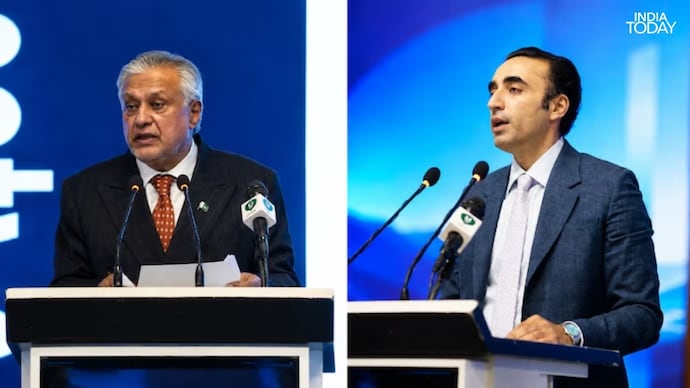
A desperate Pakistan on Tuesday hosted an "international conference" and warned that no world order that is on paper would remain secure if the Indus Waters Treaty (IWT) failed. India has kept the IWT in abeyance after the Pakistan-sponsored terror attack in Pahalgam in April 2025.
Pakistan's agrarian economy and power generation depend on the waters of the Indus River System. The suspension of the IWT, signed in 1960, by India has also left Pakistan blindsided on the volume of water in its rivers, as it doesn't have hydrological information for timely action.
India has time and again made it clear that "blood and water cannot flow together".
Pakistan's Deputy Prime Minister and Foreign Minister Ishaq Dar, who addressed the conference, described the IWT as "not merely a water-sharing arrangement but a vital instrument of regional peace, stability, and cooperation".
Pakistani Peoples Party chief and MP Bilawal Bhutto Zardari said the IWT was "never a favour to Pakistan".
The civilian-military hybrid regime of Pakistan has been highlighting the suspension of the IWT at the global fora. Pakistan, which was founded on the basis of the communal Two-Nation Theory, has been suddenly showcasing its pre-Islamic heritage. Its sudden embrace of the Indus Valley Civilisation, too, has to do with its clamour for the waters of the Indus Rivers System.
At Tuesday's conference, Pakistan brought together local and international experts on water and international law as it "seeks to reinforce its case against India's suspension of the decades-old water-sharing agreement", reported the Arab News.
"This is a first-of-its-kind international seminar," the Arab News quoted Pakistan's Information Minister Attaullah Tarar of saying one the conference, titled 'Indus Waters Treaty as an Enduring Legal and Institutional Framework'.
"The Indus Waters Treaty has witnessed three wars between the two nuclear powers. If this treaty doesn't hold, no world order that is on paper post World War II will remain secure," Pakistani senator Musadik Malik said at the conference.
Calling the IWT one of the strongest international agreements ever negotiated, Malik argued that international law is tested by how it protects weaker parties rather than stronger ones.
"When a law needs to be tested, it must be done at the weakest point and not the strongest point. The Indus Waters Treaty is the strongest pact the world has ever seen," he said.
Without naming India, Malik further questioned the credibility of international treaties if a "powerful country" could unilaterally suspend them.
"What is the value of the treaties if one powerful country wakes up one day and says the treaty doesn't apply to me and I unilaterally suspend or put it in abeyance?" Malik said, adding that such attitudes in history had led to genocide.
DON'T WEAPONISE SHARED WATER, WARNS ISHAQ DAR
Echoing the same position, Ishaq Dar, in a post on X, said he had addressed the seminar on the Indus Waters Treaty alongside experts from Pakistan and abroad.
"Shared waters must never be weaponised. They must remain a bridge between nations, guided by cooperation, dialogue, and respect for international law," Dar wrote.
He also warned that any attempt to deprive Pakistan of its rights under the treaty would have "profound consequences" for regional peace and security, affecting the shared interests of nearly two billion people in South Asia.
WHAT IS THE INDUS WATERS TREATY AND WHY WAS IT SUSPENDED?
The Indus Waters Treaty (IWT) is a water-sharing agreement between India and Pakistan, signed on 19 September 1960 in Karachi. The treaty was brokered by the World Bank, and it governs the sharing and management of the waters of the Indus River system, which is one of the world's largest transboundary river basins.
The agreement was signed by India's first Prime Minister Jawaharlal Nehru and Pakistani President Ayub Khan. The treaty allocates the six rivers of the Indus basin between the two countries.
In April 2025, following the Pahalgam terror attack in Jammu and Kashmir, in which 26 civilians were killed, India announced that it was placing the IWT in abeyance. The Indian government stated that the treaty could not remain insulated from cross-border terrorism and linked future water cooperation to Pakistan taking credible and irreversible action against terrorism emanating from its territory.
Prime Minister Narendra Modi also said that "Blood and water cannot flow together" and warned Pakistan to end its support to terrorism.
Following this decision, India accelerated work on hydropower and water infrastructure projects on the western rivers and indicated that it would maximise the utilisation of waters available under its control, reducing flows that would otherwise reach Pakistan wherever legally and technically feasible.
India currently maintains that the treaty will remain in abeyance until Pakistan credibly ends support for cross-border terrorism.
A desperate Pakistan on Tuesday hosted an "international conference" and warned that no world order that is on paper would remain secure if the Indus Waters Treaty (IWT) failed. India has kept the IWT in abeyance after the Pakistan-sponsored terror attack in Pahalgam in April 2025.
Pakistan's agrarian economy and power generation depend on the waters of the Indus River System. The suspension of the IWT, signed in 1960, by India has also left Pakistan blindsided on the volume of water in its rivers, as it doesn't have hydrological information for timely action.
India has time and again made it clear that "blood and water cannot flow together".
Pakistan's Deputy Prime Minister and Foreign Minister Ishaq Dar, who addressed the conference, described the IWT as "not merely a water-sharing arrangement but a vital instrument of regional peace, stability, and cooperation".
Pakistani Peoples Party chief and MP Bilawal Bhutto Zardari said the IWT was "never a favour to Pakistan".
The civilian-military hybrid regime of Pakistan has been highlighting the suspension of the IWT at the global fora. Pakistan, which was founded on the basis of the communal Two-Nation Theory, has been suddenly showcasing its pre-Islamic heritage. Its sudden embrace of the Indus Valley Civilisation, too, has to do with its clamour for the waters of the Indus Rivers System.
At Tuesday's conference, Pakistan brought together local and international experts on water and international law as it "seeks to reinforce its case against India's suspension of the decades-old water-sharing agreement", reported the Arab News.
"This is a first-of-its-kind international seminar," the Arab News quoted Pakistan's Information Minister Attaullah Tarar of saying one the conference, titled 'Indus Waters Treaty as an Enduring Legal and Institutional Framework'.
"The Indus Waters Treaty has witnessed three wars between the two nuclear powers. If this treaty doesn't hold, no world order that is on paper post World War II will remain secure," Pakistani senator Musadik Malik said at the conference.
Calling the IWT one of the strongest international agreements ever negotiated, Malik argued that international law is tested by how it protects weaker parties rather than stronger ones.
"When a law needs to be tested, it must be done at the weakest point and not the strongest point. The Indus Waters Treaty is the strongest pact the world has ever seen," he said.
Without naming India, Malik further questioned the credibility of international treaties if a "powerful country" could unilaterally suspend them.
"What is the value of the treaties if one powerful country wakes up one day and says the treaty doesn't apply to me and I unilaterally suspend or put it in abeyance?" Malik said, adding that such attitudes in history had led to genocide.
DON'T WEAPONISE SHARED WATER, WARNS ISHAQ DAR
Echoing the same position, Ishaq Dar, in a post on X, said he had addressed the seminar on the Indus Waters Treaty alongside experts from Pakistan and abroad.
"Shared waters must never be weaponised. They must remain a bridge between nations, guided by cooperation, dialogue, and respect for international law," Dar wrote.
He also warned that any attempt to deprive Pakistan of its rights under the treaty would have "profound consequences" for regional peace and security, affecting the shared interests of nearly two billion people in South Asia.
WHAT IS THE INDUS WATERS TREATY AND WHY WAS IT SUSPENDED?
The Indus Waters Treaty (IWT) is a water-sharing agreement between India and Pakistan, signed on 19 September 1960 in Karachi. The treaty was brokered by the World Bank, and it governs the sharing and management of the waters of the Indus River system, which is one of the world's largest transboundary river basins.
The agreement was signed by India's first Prime Minister Jawaharlal Nehru and Pakistani President Ayub Khan. The treaty allocates the six rivers of the Indus basin between the two countries.
In April 2025, following the Pahalgam terror attack in Jammu and Kashmir, in which 26 civilians were killed, India announced that it was placing the IWT in abeyance. The Indian government stated that the treaty could not remain insulated from cross-border terrorism and linked future water cooperation to Pakistan taking credible and irreversible action against terrorism emanating from its territory.
Prime Minister Narendra Modi also said that "Blood and water cannot flow together" and warned Pakistan to end its support to terrorism.
Following this decision, India accelerated work on hydropower and water infrastructure projects on the western rivers and indicated that it would maximise the utilisation of waters available under its control, reducing flows that would otherwise reach Pakistan wherever legally and technically feasible.
India currently maintains that the treaty will remain in abeyance until Pakistan credibly ends support for cross-border terrorism.

