Trump's World Cup stat line: 0 goals, 0 caps, 1 assist
The 2026 World Cup has delivered goals, dramas and VAR controversies. It has also produced an entirely new route for challenging a red card: a direct line to the Oval Office.
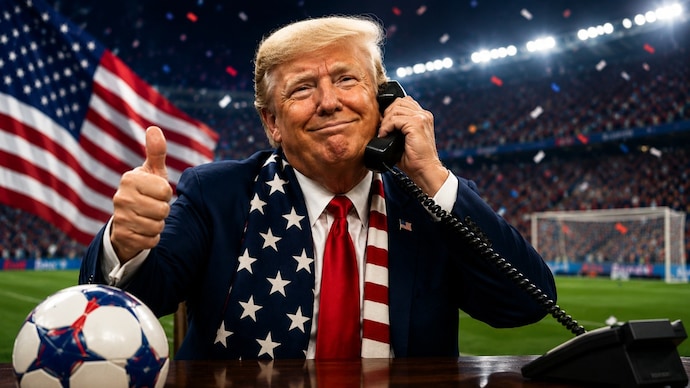
In most World Cups, players appeal red cards.
In the 2026 World Cup, hosted by America, FIFA got a call from America. When the host nation didn't like a red card, it skipped straight to customer service.
It all began when US striker Folarin Balogun received a red card against Bosnia and Herzegovina. FIFA said he was out for the next match. The referee stood by his decision. The rulebook stood by the referee. Millions of fans argued on social media.
Then came the most powerful force in modern football: a presidential phone call.
Donald Trump watched the incident, concluded that "it wasn't a foul," admitted he wasn't entirely sure what a red card meant, and proceeded to call FIFA president Gianni Infantino anyway.
Traditionalists might argue that FIFA disciplinary matters should be decided by referees, committees and regulations. But why spend hours studying the laws of the game when you can simply ask the President of the United States whether it looked fair on television?
To be fair, Trump insists he merely requested a review.
The football world, however, is now learning that there are several stages to modern justice:
- Referee decision
- VAR review
- FIFA disciplinary process
- Presidential vibe check
Remarkably, Balogun's suspension was then suspended.
Coincidence? FIFA says independent committees make independent decisions.
Skeptics note that if Belgium wanted Kevin De Bruyne's suspension overturned, it would probably have to submit paperwork rather than ring the White House (FYI, US will face Belgium in the Round of 16).
Trump, naturally, declared FIFA's reversal a "brilliant decision." This created the rare situation where the same governing body was apparently both wrong and brilliant within a span of four days.
The referee, meanwhile, has been promoted from match official to geopolitical talking point.
The episode has also opened exciting possibilities for the remainder of the tournament.
If a striker misses a penalty, perhaps the Treasury Secretary can file an appeal. If extra time looks inconvenient, maybe Congress can vote to skip it. And if the US reaches the final, don't be surprised if VAR checks are conducted in the Oval Office.
For now, Trump maintains he had nothing to do with the outcome. He only watched the incident, decided the referee was wrong, called FIFA's president, sought a review, saw the ban disappear and then praised the decision.
In football, they call that an assist.
In most World Cups, players appeal red cards.
In the 2026 World Cup, hosted by America, FIFA got a call from America. When the host nation didn't like a red card, it skipped straight to customer service.
It all began when US striker Folarin Balogun received a red card against Bosnia and Herzegovina. FIFA said he was out for the next match. The referee stood by his decision. The rulebook stood by the referee. Millions of fans argued on social media.
Then came the most powerful force in modern football: a presidential phone call.
Donald Trump watched the incident, concluded that "it wasn't a foul," admitted he wasn't entirely sure what a red card meant, and proceeded to call FIFA president Gianni Infantino anyway.
Traditionalists might argue that FIFA disciplinary matters should be decided by referees, committees and regulations. But why spend hours studying the laws of the game when you can simply ask the President of the United States whether it looked fair on television?
To be fair, Trump insists he merely requested a review.
The football world, however, is now learning that there are several stages to modern justice:
- Referee decision
- VAR review
- FIFA disciplinary process
- Presidential vibe check
Remarkably, Balogun's suspension was then suspended.
Coincidence? FIFA says independent committees make independent decisions.
Skeptics note that if Belgium wanted Kevin De Bruyne's suspension overturned, it would probably have to submit paperwork rather than ring the White House (FYI, US will face Belgium in the Round of 16).
Trump, naturally, declared FIFA's reversal a "brilliant decision." This created the rare situation where the same governing body was apparently both wrong and brilliant within a span of four days.
The referee, meanwhile, has been promoted from match official to geopolitical talking point.
The episode has also opened exciting possibilities for the remainder of the tournament.
If a striker misses a penalty, perhaps the Treasury Secretary can file an appeal. If extra time looks inconvenient, maybe Congress can vote to skip it. And if the US reaches the final, don't be surprised if VAR checks are conducted in the Oval Office.
For now, Trump maintains he had nothing to do with the outcome. He only watched the incident, decided the referee was wrong, called FIFA's president, sought a review, saw the ban disappear and then praised the decision.
In football, they call that an assist.

