Largest economies meeting, not one woman at table: Trump-Xi meet draws criticism
Donald Trump and Xi Jinping met in Beijing as images showed an all-male bilateral table. The optics triggered criticism and renewed debate over who gets represented in top-level diplomacy and the exclusion of women.
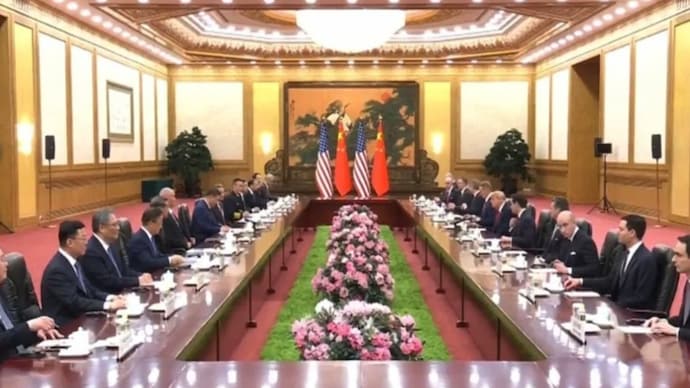
The high-profile meeting between US President Donald Trump and Chinese President Xi Jinping in Beijing on Thursday has sparked criticism after observers noted the complete absence of women at the bilateral meeting table.
The summit at Beijing’s Great Hall of the People featured elaborate ceremony and symbolism, including a display of Chinese soldiers, children waving American and Chinese flags, and the presence of senior officials and top US business executives. However, images from the meeting quickly drew attention online for another reason: the all-male delegations seated at the negotiating table.
Among the most widely shared reactions was a post by Harvard University economics professor Gita Gopinath, who described the scene as “a painting of the end of meritocracy”. In a social media post that garnered more than 22,000 likes overnight, Gopinath wrote: “A meeting of the two largest economies and not one woman at the table.”
Speaking to The Guardian, Gopinath said the image reflected a growing emphasis on networks and power structures over capability and merit.
“We have somehow gravitated back to this idea that what matters is your network and not your capabilities – and that matters in terms of whether or not you get a seat at the table,” she said, adding that it was “inexplicable” for such a high-level meeting to exclude women despite the large number of qualified female leaders globally.
Halima Kazem, associate director of Stanford University’s program in feminist, gender and sexuality studies, also criticised the optics of the summit, comparing it to US-China meetings held during former US President Barack Obama’s administration.
“We’ve gone backward,” Kazem said, noting that previous bilateral meetings had included prominent women such as former Chinese Vice Premier Liu Yandong, former US National Security Adviser Susan Rice and former Secretary of State Hillary Clinton.
Kazem argued that the absence of women was not due to a lack of qualified candidates but reflected a deliberate projection of power, the Guardian said.
“This was a choice about what kind of authority to project: masculine, militarised and exclusionary,” she said. “When both superpowers perform power this way, they’re jointly defining what ‘serious’ diplomacy looks like and who gets excluded from it.”
Despite the absence of women at the main bilateral table, a handful of women accompanied Trump during his two-day visit to Beijing, including Lara Trump, Citigroup CEO Jane Fraser and Meta president Dina Powell McCormick.
The high-profile meeting between US President Donald Trump and Chinese President Xi Jinping in Beijing on Thursday has sparked criticism after observers noted the complete absence of women at the bilateral meeting table.
The summit at Beijing’s Great Hall of the People featured elaborate ceremony and symbolism, including a display of Chinese soldiers, children waving American and Chinese flags, and the presence of senior officials and top US business executives. However, images from the meeting quickly drew attention online for another reason: the all-male delegations seated at the negotiating table.
Among the most widely shared reactions was a post by Harvard University economics professor Gita Gopinath, who described the scene as “a painting of the end of meritocracy”. In a social media post that garnered more than 22,000 likes overnight, Gopinath wrote: “A meeting of the two largest economies and not one woman at the table.”
Speaking to The Guardian, Gopinath said the image reflected a growing emphasis on networks and power structures over capability and merit.
“We have somehow gravitated back to this idea that what matters is your network and not your capabilities – and that matters in terms of whether or not you get a seat at the table,” she said, adding that it was “inexplicable” for such a high-level meeting to exclude women despite the large number of qualified female leaders globally.
Halima Kazem, associate director of Stanford University’s program in feminist, gender and sexuality studies, also criticised the optics of the summit, comparing it to US-China meetings held during former US President Barack Obama’s administration.
“We’ve gone backward,” Kazem said, noting that previous bilateral meetings had included prominent women such as former Chinese Vice Premier Liu Yandong, former US National Security Adviser Susan Rice and former Secretary of State Hillary Clinton.
Kazem argued that the absence of women was not due to a lack of qualified candidates but reflected a deliberate projection of power, the Guardian said.
“This was a choice about what kind of authority to project: masculine, militarised and exclusionary,” she said. “When both superpowers perform power this way, they’re jointly defining what ‘serious’ diplomacy looks like and who gets excluded from it.”
Despite the absence of women at the main bilateral table, a handful of women accompanied Trump during his two-day visit to Beijing, including Lara Trump, Citigroup CEO Jane Fraser and Meta president Dina Powell McCormick.

