US Navy Seahawk makes emergency landing in Arabian Sea; 1 crew member missing
US Naval Forces Central Command said there was no indication the aircraft had been brought down by hostile action, even as US forces remain on heightened alert in the Middle East.
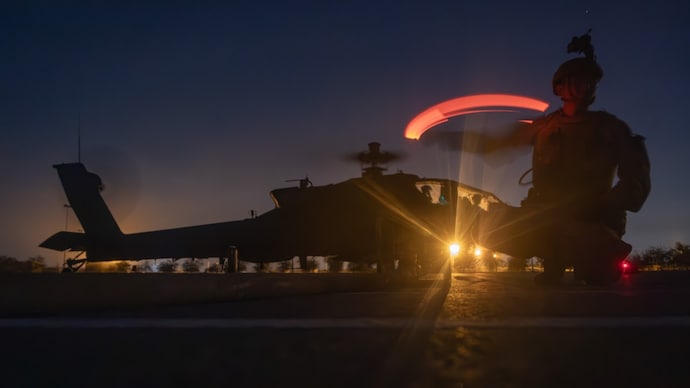
A US Navy search operation is underway in the Arabian Sea after an MH-60S Seahawk helicopter made an emergency water landing on Wednesday, leaving one crew member missing and three others rescued. The helicopter, assigned to the USS George HW Bush aircraft carrier, went down at around 3:30 AM Eastern Time (about 1:00 PM local time), according to US Naval Forces Central Command.
Military officials said there was no indication the aircraft had been brought down by hostile action, even as US forces remain on heightened alert in the Middle East.
THREE CREW MEMBERS RESCUED
Rescue teams quickly recovered three of the helicopter's four crew members from the sea. All three were taken aboard the USS George HW Bush and are reported to be in stable condition.
"Three of the helicopter's four crew members have been recovered and are in stable condition aboard George H. W. Bush," US Naval Forces Central Command said.
"US Navy assets in the region are currently searching for (the) other aircrewman still missing."
The search for the fourth crew member was continuing as of Tuesday.
NO SIGNS OF HOSTILE ACTION
The Navy stressed that there was currently no evidence suggesting the helicopter was shot down. The cause of the emergency water landing has not yet been determined, and an investigation is expected to establish what forced the aircraft into the sea.
The incident comes during a period of heightened military activity across the region following recent fighting between the United States and Iran. Although a ceasefire remains in place, sporadic flare-ups have kept American forces on high alert.
Emergency water landings are among the most challenging situations helicopter crews can face. Unlike fixed-wing aircraft, helicopters are more likely to overturn after hitting the water because of their top-heavy design, making escape and rescue operations especially dangerous.
Military crews regularly train for such emergencies, but survival often depends on sea conditions and how quickly rescue teams can respond.
USS GEORGE HW BUSH REMAINS IN THE REGION
The helicopter was operating from the USS George HW Bush, one of two US aircraft carriers currently deployed in the Middle East.
The carrier has been stationed in the region since late April as part of Washington's expanded military presence during the recent conflict with Iran.
Although Washington has lifted its blockade on commercial vessels travelling through the Strait of Hormuz, it continues to maintain a significant naval presence to safeguard shipping lanes and support regional security operations.
The latest incident comes after several aviation losses involving US forces during the ongoing regional conflict. According to the most recent update provided to Congress in mid-May, the US military had lost 42 fixed-wing and rotary aircraft during Operation Epic Fury.
That figure does not include an Apache helicopter that was shot down by an Iranian drone in early June.
Both crew members in that incident survived after being rescued, but the attack prompted the United States to launch what it described as "self-defense strikes" against Iran.
A US Navy search operation is underway in the Arabian Sea after an MH-60S Seahawk helicopter made an emergency water landing on Wednesday, leaving one crew member missing and three others rescued. The helicopter, assigned to the USS George HW Bush aircraft carrier, went down at around 3:30 AM Eastern Time (about 1:00 PM local time), according to US Naval Forces Central Command.
Military officials said there was no indication the aircraft had been brought down by hostile action, even as US forces remain on heightened alert in the Middle East.
THREE CREW MEMBERS RESCUED
Rescue teams quickly recovered three of the helicopter's four crew members from the sea. All three were taken aboard the USS George HW Bush and are reported to be in stable condition.
"Three of the helicopter's four crew members have been recovered and are in stable condition aboard George H. W. Bush," US Naval Forces Central Command said.
"US Navy assets in the region are currently searching for (the) other aircrewman still missing."
The search for the fourth crew member was continuing as of Tuesday.
NO SIGNS OF HOSTILE ACTION
The Navy stressed that there was currently no evidence suggesting the helicopter was shot down. The cause of the emergency water landing has not yet been determined, and an investigation is expected to establish what forced the aircraft into the sea.
The incident comes during a period of heightened military activity across the region following recent fighting between the United States and Iran. Although a ceasefire remains in place, sporadic flare-ups have kept American forces on high alert.
Emergency water landings are among the most challenging situations helicopter crews can face. Unlike fixed-wing aircraft, helicopters are more likely to overturn after hitting the water because of their top-heavy design, making escape and rescue operations especially dangerous.
Military crews regularly train for such emergencies, but survival often depends on sea conditions and how quickly rescue teams can respond.
USS GEORGE HW BUSH REMAINS IN THE REGION
The helicopter was operating from the USS George HW Bush, one of two US aircraft carriers currently deployed in the Middle East.
The carrier has been stationed in the region since late April as part of Washington's expanded military presence during the recent conflict with Iran.
Although Washington has lifted its blockade on commercial vessels travelling through the Strait of Hormuz, it continues to maintain a significant naval presence to safeguard shipping lanes and support regional security operations.
The latest incident comes after several aviation losses involving US forces during the ongoing regional conflict. According to the most recent update provided to Congress in mid-May, the US military had lost 42 fixed-wing and rotary aircraft during Operation Epic Fury.
That figure does not include an Apache helicopter that was shot down by an Iranian drone in early June.
Both crew members in that incident survived after being rescued, but the attack prompted the United States to launch what it described as "self-defense strikes" against Iran.

