US drops 'Indo' from US military command name. What it means for India
The Trump administration has restored the US Pacific Command name, reversing the 2018 move to call it US Indo-Pacific Command. Does the renaming reveal a change in strategy for the US in the Indian Ocean Region (IOR)? Is the US giving up its IOR plans after ditching its allies in the Middle East?
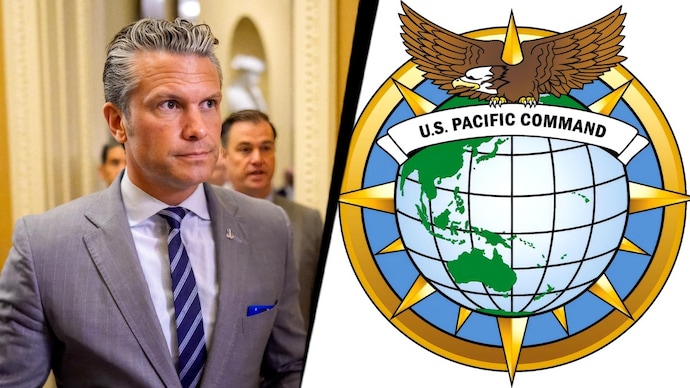
Names matter in geopolitics because they communicate a strategic intent. Take for example the Trump administration's decision to rename the Department of Defense the Department of War. So, when the Trump administration decided to restore the US Pacific Command's (USPACOM) official name, reversing it from the US Indo-Pacific Command, it sent ripples across defence circles. It has also sparked a number of questions, the primary one being — Is the US giving up on its plans in the Indian Ocean Region (IOR) to counter a more assertive China? The question comes at a time that the US has been seen as deserting its decades-old allies in the Middle East, and putting the Quad on the back burner.
The move to revert to "US Pacific Command" effectively reverses the 2018 renaming of the command as "US Indo-Pacific Command". The 2018 change to US Indo-Pacific Command was specifically aimed at emphasising the strategic linkage between the Indian and Pacific Oceans and to underscore India's growing importance in US foreign policy.
The US Department of War, which is itself a result of changed nomenclature, has maintained that the change is limited to nomenclature. In its announcement restoring the USPACOM designation, the department said the command's area of responsibility "remains exactly the same" and that its "fundamental mission" and commitment to regional partners are unchanged.
But the restoration of the name USPACOM, is way more than just a bureaucratic change.
Just six months ago, the Donald Trump administration's National Security Strategy 2025 painted a very different picture.
The document repeatedly highlighted the Indo-Pacific as the central arena of global competition, identified China as the United States' principal strategic challenger, and explicitly described India and the Quad as critical pillars in Washington's approach to maintaining regional balance. The security document mentioned the "Indo-Pacific" seven times in a 29-page document.
Now, with "Indo" removed from the name of the command responsible for the region, analysts are debating whether the change is merely cosmetic or reflects a broader shift in American strategic messaging.
For India, the development is less about the name itself and more about what it says regarding Washington's evolving priorities.
Announcing the decision on X, US Secretary of War, Pete Hegseth, seemingly had a triumphant tone. "US Pacific Command...is back," he wrote on his X account.
The announcement follows on the heels of Hegseth's address at the Shangri-La Dialogue in Singapore on May 30, 2026. In the speech, Hegseth laid out a vision stressing greater allied self-reliance and a more focused US posture.
National security analyst Nitin Gokhale, saw Hegseth's May announcement as a precursor to the command's renaming.
"RIP Indo-Pacific," Gokhale noted on X after the nomenclature.
THE INDO-PACIFIC IN AMERICA'S NATIONAL SECURITY STRATEGY
The contrast from America's policy document is difficult to ignore.
In December, the National Security Strategy devoted considerable attention to the Indo-Pacific. The document, released on December 4, 2025, stated that the US must improve commercial and strategic relations with India and encourage New Delhi's contribution to regional security in the Indo-Pacific region through continued cooperation in the Quad, a strategic forum which consists of India, Australia, Japan, and the US.
It presented India as a major strategic partner in balancing China's growing influence and described the Indo-Pacific as the key geopolitical battleground of the 21st century.
The language reflected a continuation of a trend that began during President Donald Trump's first term, when then Defence Secretary James Mattis redesignated the US Pacific Command as the US Indo-Pacific Command in 2018.
At the time, Mattis described the move as recognition of the growing connectivity between the Indian and Pacific Oceans and of India's increasing importance in American strategic thinking. The renaming was widely interpreted as a signal that Washington no longer viewed Asian security solely through an East Asian lens but increasingly through a broader maritime framework extending to the Indian Ocean.
Now, the reversal has inevitably raised questions about whether that emphasis is being diluted.
'FROM BOLLYWOOD TO HOLLYWOOD': WHY THE 2018 RENAMING MATTERED
According to reports by American defence publications and contemporary coverage of the ceremony in Hawaii, the 2018 event was designed to showcase a coalition of partners that included India, Japan, Australia and several Southeast Asian nations. "In recognition of the increasing connectivity between the Indian and Pacific oceans, today we rename the US Pacific Command to the US Indo-Pacific Command," then US Secretary of Defense, James N Mattis, said in 2018, according to US Department of War.
The command stretches "from Bollywood to Hollywood, and from penguins to polar bears", Mattis said, adding, "it plays an important part in America's National Defense Strategy," according to the 2018 statement by the Department of Defense (now the Department of War).
It was intended to communicate that the US viewed security in the Indian and Pacific Oceans as interconnected.
No one might have budgeted for a return to the original name within a span of some years.
Politico's defence reporter, Connor O'Brien, said, "The Pentagon has changed US Indo-Pacific Command back to US Pacific Command. Undoes a name change that occurred during the first Trump administration to emphasize the importance of the Indian Ocean area in the command's mission," he wrote on X.
The timing of the reversal matters, because in the Trump administration's 2026 National Defense Strategy, publicly released January 23 this year, a core priority is for allies to "shoulder their fair share of the burden of our collective defense", noting that the US will no longer tolerate decades of subsidising partners' security.
Trump has been rebuking America's Nato allies, asking them to foot more of the military alliance's defence budget.
Against this backdrop, despite Pentagon assurances that the command's mission remains unchanged, even a symbolic move such as restoring the Pacific Command designation is likely to be interpreted from a wider lens.
WHAT AMERICAN OFFICIALS ARE SAYING ABOUT US PACIFIC COMMAND NAME CHANGE
Officially, Washington's position remains straightforward.
The Department of War has stressed that the command's operational responsibilities remain unchanged. The area of responsibility still stretches from the US West Coast to India's western boundary.
The official focussed on history rather than strategy. The administration argues that restoring the USPACOM designation honours the command's legacy dating back to 1947 and reflects institutional continuity.
There has been no accompanying announcement on military cooperation, no indication of changes to Quad engagements, and no other suggestions.
But strategic signalling often extends beyond official explanations.
But not everyone is convinced that the change is merely symbolic.
Strategic affairs analyst Brahma Chellaney argued on X that the move should be viewed alongside broader shifts in US policy. "The Pentagon's decision to drop 'Indo' and revert to US Pacific Command, coupled with the recent US National Security Strategy (NSS) barely mentioning India, has understandably raised questions about India's standing in Washington," he wrote.
Chellaney argued that the relationship is increasingly being shaped by transactional considerations rather than a shared strategic vision, particularly as the Trump administration seeks to recalibrate ties with China and reassess Pakistan's role in the region.
THE SYMBOLISM OF USINDOPACOM NAME CHANGE TO USPACOM
Several analysts have argued that the symbolism cannot be dismissed entirely.
Christopher Clary, Associate Professor of Political Science at the University at Albany and a Nonresident Fellow at the Stimson Center, questioned the rationale behind the move. Writing on X, he remarked: "Maybe it was a silly idea to rename the Combatant Command to add 'Indo-' but once you made that decision you've really got to stick with it unless there is a very good policy reason (which there isn't)."
His observation reflects a broader concern among strategic observers that consistency in signalling matters. Once governments invest political capital in a concept, reversing course inevitably invites speculation.
Viewed through that lens, the latest decision appears less significant operationally than diplomatically.
Former General Officer Commanding of Chinar Corps, Lt General DP Pandey (Retd) offered one such interpretation. Writing on X, he argued that many in India's strategic community might initially feel apprehensive about the move but suggested it could instead reflect the limits of American power.
"India has to step up and be responsible for the seas and oceans around without US," he wrote, calling for greater investment in regional security and stronger development of strategic island territories such as the Andaman and Nicobar Islands and Lakshadweep.
His argument aligns with a trend increasingly visible across global geopolitics. Whether in Europe or West Asia, Washington has been encouraging partners to assume greater responsibility for their own security environments. Notably, the Trump administration has already pressed Nato members to increase defence spending and assume more responsibility for their own security.
Meanwhile, former Indian Army officer and defence analyst, Pravin Sawhney, offered one of the most critical interpretations. "This is extremely significant. India left with no strategic role - simply put, America has no geopolitical use for India in the Asia Pacific region." Sawhney wrote on X.
Though that assessment is not reflected in any official US policy statement, it matches with the scenario in the Middle East.
HOW TRUMP HAS DESERTED AMERICAN ALLIES IN THE MIDDLE EAST
The US has reached an understanding with Iran to end the over three-month-long war, according to Trump. The war began after joint American and Israeli airstrikes in Iran on February 28. With the US out of its range, Iran started targeting American allies in the Middle East.
Over 400 ballistic missiles and nearly 1,000 drones targeting US and allied assets flew from Iran, across all six GCC states — Bahrain, Kuwait, Qatar, Saudi Arabia, Oman, and the UAE. Strikes slammed into urban areas, energy facilities, airports, and civilian infrastructure.
American weapon systems like THAAD, Patriot PAC-3 upgrades, missiles, and armed drones that the Gulf countries spent hundreds of billions on ended up being duds. And not just that, Trump didn't do anything much to deter Iran from striking the American allies.
The Iranian strikes on energy assets caused significant economic setbacks for the countries, especially the UAE. However, a clause reportedly in Trump's peace deal is that the GCC states would pay Iran $300 billion as a reconstruction fund. While it was the US and Israel that flattened Iran, it is the Gulf allies that will pay Iran. Nothing better explains the backstabbing of allies than this.
THE QUAD QUESTION AFTER US COMMAND RENAMING
That is a reason why the renaming of the US Indo-Pacific command is being seen as a change in DC's plans in the Indian Ocean Region. The Trump administration has been accused of giving low priority to the Quad, an informal grouping of the US, India, Japan and Australia, especially focusing on the IOR.
Congress MP Shashi Tharoor reacted with a pointed question on X after the change in nomenclature. "One more nail in the coffin of the Quad?" he asked.
The concern stems from the fact that the Indo-Pacific concept and the Quad evolved together over the past two decades. Both emerged as mechanisms through which like-minded democracies sought to coordinate responses to strategic challenges in the region.
There is currently little evidence that the Quad itself is being sidelined, as Tharoor suggested, but the question has sprung up regardless. The last Quad meeting was the 11th Quad Foreign Ministers' Meeting held on May 26 in New Delhi. However, Trump hasn't given any signal to show America's focus on the Quad.
For now, the bigger story is that just six months ago, America's National Security Strategy projected confidence in an American-led Indo-Pacific framework. The restoration of the Pacific Command name comes amid a more complex geopolitical environment marked by simultaneous crises in Europe, West Asia and Asia.
India's strategic importance in the Indo-Pacific doesn't get diminished with merely a name change. What might be changing, however, is the expectation that regional powers themselves will carry a greater share of responsibility, and their reach.
It could very well signify that the US might be recalibrating its IOR strategy even as it deserts its allies in the Middle East.
As for the US Indo-Pacific Command, the name has changed. US strategy might change, but the logic underpinning India's importance has not.
Names matter in geopolitics because they communicate a strategic intent. Take for example the Trump administration's decision to rename the Department of Defense the Department of War. So, when the Trump administration decided to restore the US Pacific Command's (USPACOM) official name, reversing it from the US Indo-Pacific Command, it sent ripples across defence circles. It has also sparked a number of questions, the primary one being — Is the US giving up on its plans in the Indian Ocean Region (IOR) to counter a more assertive China? The question comes at a time that the US has been seen as deserting its decades-old allies in the Middle East, and putting the Quad on the back burner.
The move to revert to "US Pacific Command" effectively reverses the 2018 renaming of the command as "US Indo-Pacific Command". The 2018 change to US Indo-Pacific Command was specifically aimed at emphasising the strategic linkage between the Indian and Pacific Oceans and to underscore India's growing importance in US foreign policy.
The US Department of War, which is itself a result of changed nomenclature, has maintained that the change is limited to nomenclature. In its announcement restoring the USPACOM designation, the department said the command's area of responsibility "remains exactly the same" and that its "fundamental mission" and commitment to regional partners are unchanged.
But the restoration of the name USPACOM, is way more than just a bureaucratic change.
Just six months ago, the Donald Trump administration's National Security Strategy 2025 painted a very different picture.
The document repeatedly highlighted the Indo-Pacific as the central arena of global competition, identified China as the United States' principal strategic challenger, and explicitly described India and the Quad as critical pillars in Washington's approach to maintaining regional balance. The security document mentioned the "Indo-Pacific" seven times in a 29-page document.
Now, with "Indo" removed from the name of the command responsible for the region, analysts are debating whether the change is merely cosmetic or reflects a broader shift in American strategic messaging.
For India, the development is less about the name itself and more about what it says regarding Washington's evolving priorities.
Announcing the decision on X, US Secretary of War, Pete Hegseth, seemingly had a triumphant tone. "US Pacific Command...is back," he wrote on his X account.
The announcement follows on the heels of Hegseth's address at the Shangri-La Dialogue in Singapore on May 30, 2026. In the speech, Hegseth laid out a vision stressing greater allied self-reliance and a more focused US posture.
National security analyst Nitin Gokhale, saw Hegseth's May announcement as a precursor to the command's renaming.
"RIP Indo-Pacific," Gokhale noted on X after the nomenclature.
THE INDO-PACIFIC IN AMERICA'S NATIONAL SECURITY STRATEGY
The contrast from America's policy document is difficult to ignore.
In December, the National Security Strategy devoted considerable attention to the Indo-Pacific. The document, released on December 4, 2025, stated that the US must improve commercial and strategic relations with India and encourage New Delhi's contribution to regional security in the Indo-Pacific region through continued cooperation in the Quad, a strategic forum which consists of India, Australia, Japan, and the US.
It presented India as a major strategic partner in balancing China's growing influence and described the Indo-Pacific as the key geopolitical battleground of the 21st century.
The language reflected a continuation of a trend that began during President Donald Trump's first term, when then Defence Secretary James Mattis redesignated the US Pacific Command as the US Indo-Pacific Command in 2018.
At the time, Mattis described the move as recognition of the growing connectivity between the Indian and Pacific Oceans and of India's increasing importance in American strategic thinking. The renaming was widely interpreted as a signal that Washington no longer viewed Asian security solely through an East Asian lens but increasingly through a broader maritime framework extending to the Indian Ocean.
Now, the reversal has inevitably raised questions about whether that emphasis is being diluted.
'FROM BOLLYWOOD TO HOLLYWOOD': WHY THE 2018 RENAMING MATTERED
According to reports by American defence publications and contemporary coverage of the ceremony in Hawaii, the 2018 event was designed to showcase a coalition of partners that included India, Japan, Australia and several Southeast Asian nations. "In recognition of the increasing connectivity between the Indian and Pacific oceans, today we rename the US Pacific Command to the US Indo-Pacific Command," then US Secretary of Defense, James N Mattis, said in 2018, according to US Department of War.
The command stretches "from Bollywood to Hollywood, and from penguins to polar bears", Mattis said, adding, "it plays an important part in America's National Defense Strategy," according to the 2018 statement by the Department of Defense (now the Department of War).
It was intended to communicate that the US viewed security in the Indian and Pacific Oceans as interconnected.
No one might have budgeted for a return to the original name within a span of some years.
Politico's defence reporter, Connor O'Brien, said, "The Pentagon has changed US Indo-Pacific Command back to US Pacific Command. Undoes a name change that occurred during the first Trump administration to emphasize the importance of the Indian Ocean area in the command's mission," he wrote on X.
The timing of the reversal matters, because in the Trump administration's 2026 National Defense Strategy, publicly released January 23 this year, a core priority is for allies to "shoulder their fair share of the burden of our collective defense", noting that the US will no longer tolerate decades of subsidising partners' security.
Trump has been rebuking America's Nato allies, asking them to foot more of the military alliance's defence budget.
Against this backdrop, despite Pentagon assurances that the command's mission remains unchanged, even a symbolic move such as restoring the Pacific Command designation is likely to be interpreted from a wider lens.
WHAT AMERICAN OFFICIALS ARE SAYING ABOUT US PACIFIC COMMAND NAME CHANGE
Officially, Washington's position remains straightforward.
The Department of War has stressed that the command's operational responsibilities remain unchanged. The area of responsibility still stretches from the US West Coast to India's western boundary.
The official focussed on history rather than strategy. The administration argues that restoring the USPACOM designation honours the command's legacy dating back to 1947 and reflects institutional continuity.
There has been no accompanying announcement on military cooperation, no indication of changes to Quad engagements, and no other suggestions.
But strategic signalling often extends beyond official explanations.
But not everyone is convinced that the change is merely symbolic.
Strategic affairs analyst Brahma Chellaney argued on X that the move should be viewed alongside broader shifts in US policy. "The Pentagon's decision to drop 'Indo' and revert to US Pacific Command, coupled with the recent US National Security Strategy (NSS) barely mentioning India, has understandably raised questions about India's standing in Washington," he wrote.
Chellaney argued that the relationship is increasingly being shaped by transactional considerations rather than a shared strategic vision, particularly as the Trump administration seeks to recalibrate ties with China and reassess Pakistan's role in the region.
THE SYMBOLISM OF USINDOPACOM NAME CHANGE TO USPACOM
Several analysts have argued that the symbolism cannot be dismissed entirely.
Christopher Clary, Associate Professor of Political Science at the University at Albany and a Nonresident Fellow at the Stimson Center, questioned the rationale behind the move. Writing on X, he remarked: "Maybe it was a silly idea to rename the Combatant Command to add 'Indo-' but once you made that decision you've really got to stick with it unless there is a very good policy reason (which there isn't)."
His observation reflects a broader concern among strategic observers that consistency in signalling matters. Once governments invest political capital in a concept, reversing course inevitably invites speculation.
Viewed through that lens, the latest decision appears less significant operationally than diplomatically.
Former General Officer Commanding of Chinar Corps, Lt General DP Pandey (Retd) offered one such interpretation. Writing on X, he argued that many in India's strategic community might initially feel apprehensive about the move but suggested it could instead reflect the limits of American power.
"India has to step up and be responsible for the seas and oceans around without US," he wrote, calling for greater investment in regional security and stronger development of strategic island territories such as the Andaman and Nicobar Islands and Lakshadweep.
His argument aligns with a trend increasingly visible across global geopolitics. Whether in Europe or West Asia, Washington has been encouraging partners to assume greater responsibility for their own security environments. Notably, the Trump administration has already pressed Nato members to increase defence spending and assume more responsibility for their own security.
Meanwhile, former Indian Army officer and defence analyst, Pravin Sawhney, offered one of the most critical interpretations. "This is extremely significant. India left with no strategic role - simply put, America has no geopolitical use for India in the Asia Pacific region." Sawhney wrote on X.
Though that assessment is not reflected in any official US policy statement, it matches with the scenario in the Middle East.
HOW TRUMP HAS DESERTED AMERICAN ALLIES IN THE MIDDLE EAST
The US has reached an understanding with Iran to end the over three-month-long war, according to Trump. The war began after joint American and Israeli airstrikes in Iran on February 28. With the US out of its range, Iran started targeting American allies in the Middle East.
Over 400 ballistic missiles and nearly 1,000 drones targeting US and allied assets flew from Iran, across all six GCC states — Bahrain, Kuwait, Qatar, Saudi Arabia, Oman, and the UAE. Strikes slammed into urban areas, energy facilities, airports, and civilian infrastructure.
American weapon systems like THAAD, Patriot PAC-3 upgrades, missiles, and armed drones that the Gulf countries spent hundreds of billions on ended up being duds. And not just that, Trump didn't do anything much to deter Iran from striking the American allies.
The Iranian strikes on energy assets caused significant economic setbacks for the countries, especially the UAE. However, a clause reportedly in Trump's peace deal is that the GCC states would pay Iran $300 billion as a reconstruction fund. While it was the US and Israel that flattened Iran, it is the Gulf allies that will pay Iran. Nothing better explains the backstabbing of allies than this.
THE QUAD QUESTION AFTER US COMMAND RENAMING
That is a reason why the renaming of the US Indo-Pacific command is being seen as a change in DC's plans in the Indian Ocean Region. The Trump administration has been accused of giving low priority to the Quad, an informal grouping of the US, India, Japan and Australia, especially focusing on the IOR.
Congress MP Shashi Tharoor reacted with a pointed question on X after the change in nomenclature. "One more nail in the coffin of the Quad?" he asked.
The concern stems from the fact that the Indo-Pacific concept and the Quad evolved together over the past two decades. Both emerged as mechanisms through which like-minded democracies sought to coordinate responses to strategic challenges in the region.
There is currently little evidence that the Quad itself is being sidelined, as Tharoor suggested, but the question has sprung up regardless. The last Quad meeting was the 11th Quad Foreign Ministers' Meeting held on May 26 in New Delhi. However, Trump hasn't given any signal to show America's focus on the Quad.
For now, the bigger story is that just six months ago, America's National Security Strategy projected confidence in an American-led Indo-Pacific framework. The restoration of the Pacific Command name comes amid a more complex geopolitical environment marked by simultaneous crises in Europe, West Asia and Asia.
India's strategic importance in the Indo-Pacific doesn't get diminished with merely a name change. What might be changing, however, is the expectation that regional powers themselves will carry a greater share of responsibility, and their reach.
It could very well signify that the US might be recalibrating its IOR strategy even as it deserts its allies in the Middle East.
As for the US Indo-Pacific Command, the name has changed. US strategy might change, but the logic underpinning India's importance has not.

