US releases footage of Tomahawk missiles launched at Iran overnight
The missile launches come amid one of the most serious US-Iran confrontations in years, with both sides trading strikes and warnings.
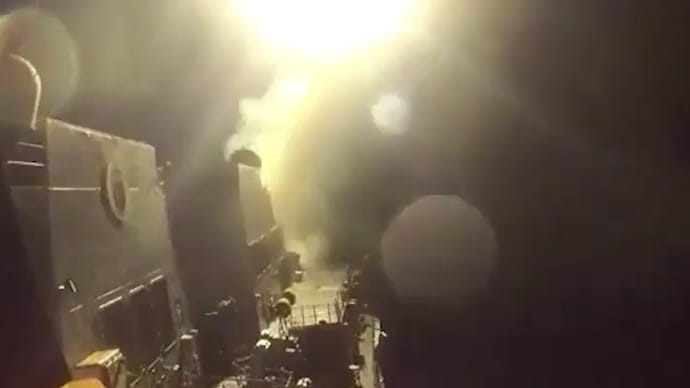
After US President Donald Trump claimed that 49 Tomahawk missiles were used to strike targets deep inside Iranian territory, the US Central Command (CENTCOM) released a video showing the cruise missiles being launched under the cover of darkness.
According to the US military, the missiles were launched at multiple targets beginning at 3:45 am IST.
Describing the operation as "additional self-defence strikes", CENTCOM said in a post on X, "The strikes are in response to Iran's unwarranted and continued aggression."
Local media reports said the latest strikes hit western Tehran, Fars province, Bandar Abbas, Qeshm Island, Kish, Minab and parts of central Isfahan.
The escalation widened as Iran’s Islamic Revolutionary Guard Corps, or IRGC, said its aerospace force and navy had launched a two-wave operational strike on US forces in the region, targeting 18 key installations at bases hosting American troops.
The IRGC also said it had closed the Strait of Hormuz to “all vessels”, including oil tankers and commercial ships, but CENTCOM disputed that claim and said commercial traffic was continuing through the waterway.
According to the IRGC statement cited by CNN, “Effective immediately, due to insecurity in the region, the Strait of Hormuz is declared closed to all vessels, including oil tankers and commercial ships.” CENTCOM then publicly rejected that claim, saying, “Commercial ships are continuing to transit in and out of the Strait of Hormuz tonight” despite the fresh hostilities.
Speaking to Fox News, Trump said "49 Tomahawk missiles were used to strike targets inside Iran, with some as close as 40 miles (64 km) from Tehran. He also said US fighter jets were operating over Iran and were taking out radar and air defence systems in the south-western part of the country, close to the Persian Gulf.
Fox also reported that Trump said top Iranian officials had called him and asked the US to stop the bombing. He further said that if Tehran did not sign the peace deal proposed by US negotiators, American forces would bomb again “tomorrow night”, reportedly using an expletive while making the threat.
Iranian officials challenged parts of the US account. IRGC Aerospace Force commander Brigadier General Majid Mousavi said Iran would respond across the region if the Strait of Hormuz was destabilised.
“We will bring the region into hell for you from across Iran if you make the sacred Strait of Hormuz unsafe,” he said. Iranian media, citing senior officials, also said Trump’s claim that he had directly spoken by phone with senior Iranian officials was false and that there had been no such communication between the two sides.
The latest exchange brought together fresh US strikes inside Iran, Iran’s claim of retaliatory attacks on American bases in the region, a contested announcement on the Strait of Hormuz, and conflicting statements from Washington and Tehran over both military action and possible contact between their officials.
After US President Donald Trump claimed that 49 Tomahawk missiles were used to strike targets deep inside Iranian territory, the US Central Command (CENTCOM) released a video showing the cruise missiles being launched under the cover of darkness.
According to the US military, the missiles were launched at multiple targets beginning at 3:45 am IST.
Describing the operation as "additional self-defence strikes", CENTCOM said in a post on X, "The strikes are in response to Iran's unwarranted and continued aggression."
Local media reports said the latest strikes hit western Tehran, Fars province, Bandar Abbas, Qeshm Island, Kish, Minab and parts of central Isfahan.
The escalation widened as Iran’s Islamic Revolutionary Guard Corps, or IRGC, said its aerospace force and navy had launched a two-wave operational strike on US forces in the region, targeting 18 key installations at bases hosting American troops.
The IRGC also said it had closed the Strait of Hormuz to “all vessels”, including oil tankers and commercial ships, but CENTCOM disputed that claim and said commercial traffic was continuing through the waterway.
According to the IRGC statement cited by CNN, “Effective immediately, due to insecurity in the region, the Strait of Hormuz is declared closed to all vessels, including oil tankers and commercial ships.” CENTCOM then publicly rejected that claim, saying, “Commercial ships are continuing to transit in and out of the Strait of Hormuz tonight” despite the fresh hostilities.
Speaking to Fox News, Trump said "49 Tomahawk missiles were used to strike targets inside Iran, with some as close as 40 miles (64 km) from Tehran. He also said US fighter jets were operating over Iran and were taking out radar and air defence systems in the south-western part of the country, close to the Persian Gulf.
Fox also reported that Trump said top Iranian officials had called him and asked the US to stop the bombing. He further said that if Tehran did not sign the peace deal proposed by US negotiators, American forces would bomb again “tomorrow night”, reportedly using an expletive while making the threat.
Iranian officials challenged parts of the US account. IRGC Aerospace Force commander Brigadier General Majid Mousavi said Iran would respond across the region if the Strait of Hormuz was destabilised.
“We will bring the region into hell for you from across Iran if you make the sacred Strait of Hormuz unsafe,” he said. Iranian media, citing senior officials, also said Trump’s claim that he had directly spoken by phone with senior Iranian officials was false and that there had been no such communication between the two sides.
The latest exchange brought together fresh US strikes inside Iran, Iran’s claim of retaliatory attacks on American bases in the region, a contested announcement on the Strait of Hormuz, and conflicting statements from Washington and Tehran over both military action and possible contact between their officials.

