
An IIT professor is teaching in Montana: X post that backfired spectacularly

A viral post targeting Indian academics raises an uncomfortable question about race, talent and who gets to belong in the global education system. America's universities have spent decades attracting the world's brightest minds; pushing them away would be America's loss, not India's
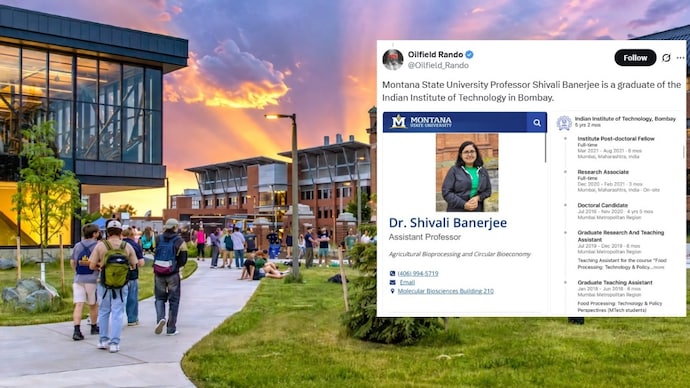
Picture of the Montana University (montana.edu) and the X post that introduced Dr Shivali Banerjee as a professor of the university (inset).
New Delhi,Oct 5, 2026 13:34 IST Last UpdatedOct 5, 2026 13:34 IST
  Published byWritten ByDeebashree Mohanty
Last UpdatedOct 5, 2026 13:34 IST Published byDeebashree Mohanty
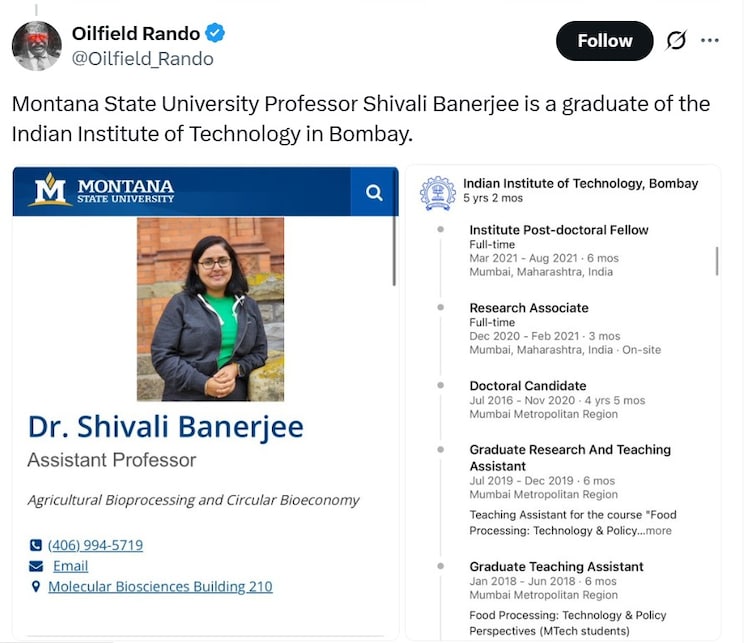
Oct 5, 2026 12:29 ISTWritten ByDeebashree MohantyWhat happens when you try to make an Indian professor the problem and people start looking at her CV instead? That is more or less what happened on X after an American user, posting under the pseudonym “Oilfield Rando”, shared a list of Indian and Indian-origin professors at Montana State University.
One of the names on the list was Dr Shivali Banerjee, an Assistant Professor of Agricultural Process Engineering at the university. The detail highlighted about her was that she had earned her PhD from IIT Bombay.
The post did not explicitly call Banerjee a racial slur. But its focus on Indian and Indian-origin academics was widely read on social media as a racial or anti-Indian jab. And the reaction that followed turned the intended target into something else entirely. A reminder of just how much Indian academic talent has made its way into American universities.
THE IIT TAG CHANGED THE CONVERSATION
Instead of asking why an Indian professor was teaching at Montana State, users began asking why an American university would not want an IIT-trained academic. “IIT is one of the most difficult colleges in THE WORLD to get into. Montana being able to recruit her is a HUGE win for them!” data scientist Armand Domalewski wrote.
Another user, Dan Waterfield, called it an “incredible win for America” that an IIT graduate had chosen to work at Montana State.
Someone else responded with the kind of sarcasm that X does particularly well. They wrote, “Oh no a professor is from one of the most prestigious universities in Asia how will we ever recover.”
The pushback became sharper as the discussion continued. One user pointed to the irony of highly trained scholars from institutions such as IIT Bombay building careers in America and contributing to its universities, only to be mocked because of where they came from.
The original poster, meanwhile, doubled down rather than backing away from the argument.
And suddenly, a post that appeared to be about the presence of Indians at an American university had become a conversation about something much bigger. Why American universities want Indian talent in the first place.
THIS IS BIGGER THAN ONE PROFESSOR IN MONTANA
Banerjee’s academic journey is worth looking at beyond the viral exchange.
She holds a PhD from IIT Bombay and is now part of the faculty at Montana State University, where her work focusses on agricultural process engineering and areas including bioprocessing and resource-efficient technologies.
In other words, she is not simply an Indian student who went to America. She is part of the academic workforce there. And this distinction matters.
The movement of Indian talent abroad is often discussed through the familiar “brain drain” lens, the brightest students leave India, build careers overseas and the country loses its investment in their education, but the numbers tell a more complicated story.
Around 22,000 Indian-origin faculty members are estimated to be teaching at US colleges and universities, accounting for about 2.6% of the country’s full-time higher education faculty, according to data cited by Indiaspora and Boston Consulting Group.
That is not a small diaspora sitting quietly at the margins of American academia. It is a sizeable academic community. And it does reach well beyond engineering.
Indian-origin academics are present across medicine, computer science, engineering, business, public health, social sciences and the natural sciences. The Indiaspora 2026 report says 70% of the top 50 US universities have Indian-origin academics in senior positions such as deans or chancellors. So, when an Indian professor appears on an American campus, the more interesting question may not be “Why is she here?”
Instead, the question should be, “What did the university see in her?”
NUMBERS BEHIND INDIA'S ACADEMIC PIPELINE TO AMERICA
The professor's story is only one part of a much larger India-US education pipeline.
In the 2024-25 academic year, 363,019 Indian students were studying in the US, according to the Institute of International Education’s Open Doors data. India was the largest source of international students in America for the second consecutive year, accounting for 30.8% of all international students.
China was a distant second with 265,919 students.
And there is another interesting detail hidden inside India’s number. Of those Indian students, 177,892 were graduate students, while a substantial number were in the US through Optional Practical Training after completing their degrees.
Indian students are particularly concentrated in STEM fields: according to the US Department of Commerce, 43.4% studied mathematics and computer science and another 22.8% studied engineering in 2024-25. That means the pipeline does not necessarily end when the degree does.
Some students become researchers, some go on to become engineers, while some others join companies. Some start businesses.
And some, like Banerjee, become professors.
SO WHO REALLY LOST THIS ARGUMENT?
Perhaps that is the irony of the Montana State episode. The attempt to draw attention to Indian professors ended up drawing attention to their qualifications. The attempt to question their presence ended up inviting people to ask why American universities recruit them. And the attempt to make nationality the story turned the conversation back towards merit, research and academic achievement.
There is also a question here for India.
If an IIT graduate becomes a professor in the US, is that necessarily a failure of the Indian education system? Or is it also evidence that India’s universities are producing people capable of competing, and also succeeding, in the world’s most competitive academic markets?
The answer is probably somewhere in between. India can celebrate the global success of its scholars while still asking why its own universities sometimes struggle to retain them. But perhaps the bigger lesson from this particular online spat is simpler.
An Indian professor teaching in America is not an oddity any more, there are thousands of them. If an IIT-trained professor doing research and teaching in America can be reduced to her nationality, we should be asking what that says about the way we talk about academic talent today.
Indian education has its problems, but the fact that its best-trained scholars are being recruited by universities around the world is hardly something to sneer at. America benefits from that talent too. Push such people away because of where they come from, and the loss is not just India’s — it is America’s as well.
- Ends