
CBSE's 3-language policy has a problem: Nobody knows if English is "Indian"

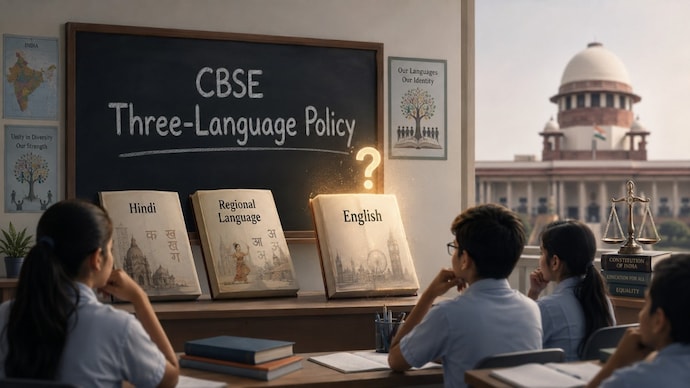
The Supreme Court, hearing petitions against CBSE's three-language rollout, questioned whether English can be considered indigenous to India. The remark has brought a long-unresolved legal and policy gap to the centre of the education debate.
 Last UpdatedAug 21, 2026 08:58 IST
 Published by
For nearly sixty years, India's three-language formula has quietly rested on one unexamined assumption. That English is not, and cannot be, an Indian language. Every education policy since 1968 has treated it as the outsider let in on merit. Useful, even necessary, but never quite indigenous.
But again, nobody had to defend that assumption in a courtroom.
Then, on July 14, hearing a batch of petitions against CBSE's mid-session rollout of the three-language policy for Classes 6 to 9, a Supreme Court bench headed by Chief Justice Surya Kant did exactly that. "Can Indians consider English an Indian indigenous language?" the CJI asked, adding that "nomenclature may require some re-look" even as "the spirit is very clear."
He reached for a precedent that unsettled the room. Persian, he noted, was once the language of this very court, yet it doesn't figure in the Eighth Schedule today.
That aside, almost a passing remark, is the real story here.
It brings to the fore a glaring gap that Indian law has never filled – the fact that there is no statutory or even a constitutional definition of what makes a language "indigenous" to India.
WHY THE DEFINITION MATTERS TO A 13-YEAR-OLD
Take away the legal language, and here is the problem in plain terms. If (as per the CBSE circular) English is not counted as an "Indian" or native language, it cannot fill either of the two mandatory Indian-language slots.
What does that mean for a student in class 6? That leaves no room for anything else. No French, no German, no Japanese, no Spanish because all three language slots are now spoken for. It's English, plus two compulsory Indian languages.
Catch up on our detailed explainer tracing the rollout of the CBSE three-language formula from its announcement in May 2026.
What has changed, you ask? Under the older, less rigid version of the formula, a student could actually count English as one of their languages and use the remaining slot for a foreign language of their choice. Once English is defined out of the "Indian" or "indigenous" category, that choice suddenly disappears for students.
This is not because any rule explicitly bans foreign languages, but because the arithmetic of "three languages, two must be Indian" simply doesn't leave space for one any more.
This lands hardest on English-medium schools, and for a fairly intuitive reason. In these schools, English isn't just a subject on the timetable, it's the language the child already thinks, writes and is examined every day.
The NEP 2020 stresses a mother-tongue medium of instruction for younger children. Their reasoning is that learning is easier in a language a child already speaks at home. English-medium students, by definition, skip that stage. So as and when the three-language rule kicks in, these students aren't just picking up an "extra" subject the way a Hindi-medium student picks up English.
They are being asked to build fluency in two additional Indian languages more or less from scratch, on top of an English-medium curriculum that was never designed around that requirement, with textbooks and trained teachers for only a fraction of the 22 languages actually available.
Our in-depth analysis explores the implications of the policy especially for English-medium schools.
WHY THE QUESTION LANDED IN COURT AT ALL
The petitions before the bench did not set out to litigate linguistics. They challenged a CBSE circular of May 15, which aligned its scheme of studies with NEP 2020 and the National Curriculum Framework for School Education 2023, requiring students of Classes 6–9 to study three languages, at least two of them Indian, from the 2026-27 session.
The complaints were procedural – textbooks were available for only three of 22 recognised languages at the time of hearing, teachers were untrained, and a Class 9 student studying French for years was suddenly told to add a third language and sit an exam in April.
Senior Advocate Gopal Sankaranarayanan went further, arguing CBSE had "taken a 300-year-old language and treated English as a non-native language" while making Indian languages compulsory.
The Court declined an interim stay. According to the Bench, the language policy appeared to advance the constitutional goal of promoting Hindi and regional languages. But the court did not dismiss the English question altogether. It listed the matter for July 22 and gave the Centre and CBSE time to respond.
On August 20, the Supreme Court asked CBSE, the Centre and NCERT to go back to the drawing board and reconsider the practical implementation of the policy. The Court specifically asked CBSE to explore whether the current Class 6 batch could be given a one-time reprieve, rather than being locked into the new arrangement midway through their schooling. It also raised concerns about the availability of trained teachers and textbooks and asked the board to consider how the policy could be implemented more smoothly.
The Court has not struck down the three-language policy. Nor has it declared English to be an Indian language. What it has done is question both the terminology and the manner in which the policy is being implemented.
SIX DECADES OF DEBATING "ENGLISH"
The three-language formula was never designed to answer whether English belongs. It was a political compromise. The Kothari Commission (1964-66) proposed it to bridge the Hindi-versus-South India divide without forcing a single national language.
The National Policy on Education (NPE)1968 adopted it as mother tongue (or you may refer to this as a native language), plus Hindi or English depending on the state, plus a third modern language.
NPE 1986 kept the architecture, the National Education Policy (NEP) 2020 only reiterated it. However, the NEP added a firmer condition. At least two of the three languages must be "native to India," while the third, effectively, is where English usually sits.
What changed in 2026 was not the formula but its enforcement. CBSE moved from broad guidelines to a hard classroom mandate, mid-session, for a language whose "Indian-ness" the law had simply never had to define.
But August 20 has now added another layer.
The Court's concern is no longer limited to the philosophical question of what makes a language Indian. It is also asking whether the policy can be implemented fairly when schools do not yet have enough teachers, textbooks or time to make the required language choices workable.
TIMELINE: THE THREE LANGUAGE FORMULA
1964–66: The Kothari Commission recommended mother tongue, plus Hindi/English, plus a modern Indian or European language to be taught in schools.
1968: First National Policy on Education (NPE) formally adopts the three-language formula.
1986: National Policy on Education reiterates the formula largely unchanged.
1992/2003: 71st and 92nd Constitutional Amendments expand the Eighth Schedule to 18, then 22 languages; English is still not in the list.
2020: NEP 2020 mandates at least two of the three languages be "native to India"; recommends mother-tongue medium of instruction till Class 5, preferably Class 8.
2023: National Curriculum Framework for School Education operationalises NEP's language provisions.
May 15, 2026: The CBSE circular applies the 3-language formula as a mandate for Classes 6-9 from the 2026–27 session.
June 29, 2026: Another circular dilutes some requirements for senior classes; the assessment debate re-surfaces.
July 14, 2026: Supreme Court declines interim stay, questions whether English is "indigenous," issues notice. The matter is listed for July 22.
August 20, 2026: The Supreme Court asks CBSE, the Centre and NCERT to reconsider the practical implementation of the policy, urges CBSE to explore a one-time reprieve for the current Class 6 batch, and raises concerns over teachers, textbooks and the classification of English as non-native. The Court does not strike down the policy.
ENGLISH REMAINS THE UNRESOLVED CORE OF THE DEBATE
Every strand of this dispute, the missing textbooks, the mid-session shock, the asymmetric burden on non-Hindi states, is a downstream implementation failure.
The English question, however, is a different one. It is upstream, structural, and has been avoided by every policy document since 1968 rather than resolved by any of them.
Two centuries of use, a status as the de-facto language of aspiration, courts, commerce and much of urban schooling, still haven't earned English a place in the Eighth Schedule or a legal definition that would settle whether it counts as "native."
The Supreme Court's July 14 remark did not answer that question. It wasn't meant to, but by naming it out loud, in open court, it has made avoidance harder for the next fifty years than it was for the last fifty.
And now, on August 20, the Court has widened the inquiry.
It has told CBSE that even if the goal of multilingual education is accepted, its implementation cannot simply be imposed without adequate preparation. The suggestion of a one-time reprieve for the current Class 6 batch is significant: there is a difference between introducing a policy prospectively and imposing it on children already inside the system.
There is also an important clarification on foreign languages.
The latest hearing does not mean French, German, Japanese or Spanish are being banned. Instead, the Court has asked CBSE to reconsider the transition for students already studying foreign languages and avoid unnecessarily disrupting their choices.
That is why August 20 matters. The Supreme Court has not killed the three-language formula. It has told its architects to rethink how it reaches the classroom.
And it has put two questions on the table: what exactly makes a language "Indian" in 2026, and what happens when a policy is introduced before the teachers, textbooks and transition mechanisms needed to deliver it are in place?
For the first time, India's three-language formula is being asked to defend not just its objective, but its assumptions. And English remains at the centre of that reckoning.
