
Four college students built a device called Otomate. Now they're taking India to the US

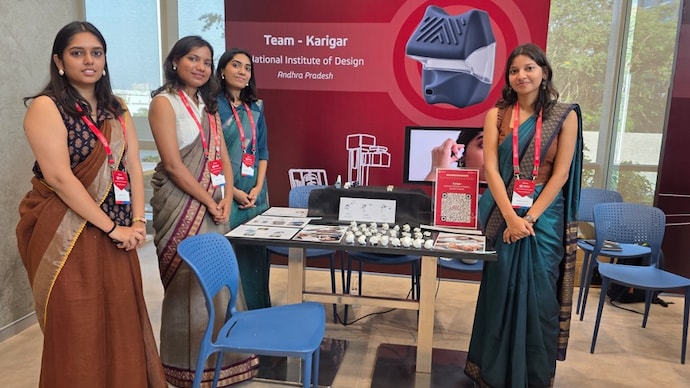
Team Karigar, an all-girls team, developed a controlled eye and ear drop device after witnessing a grandfather's medication struggle. The student innovation will represent India at an international competition in the US.
 Last UpdatedNov 26, 2026 21:20 IST
 Published by
Sometimes, the next big innovation does not begin with a complicated problem. It starts with something as simple as watching a loved one struggle with an everyday task. For four college students, that moment came when they saw how difficult it was for a grandfather to administer his ear medication without depending on someone else. What followed was a four-and-a-half-month journey of research, late-night discussions, multiple prototypes and user testing that eventually took their idea beyond the classroom to Otomate.
Today, the all-girls team, calling themselves Team Karigar, has earned a place at the global stage.
The students from the National Institute of Design, Andhra Pradesh, won the India finale of the 16th AAKRUTI Innovation Competition 2026.
The achievement is particularly crucial given that they emerged among the winners from 2,443 teams comprising more than 15,000 students across India.
Team Karigar also received the Best All-Girls Team award.
The India finale was held in Pune, where the teams presented their innovations before a jury comprising senior industry and academic professionals, including representatives from Dassault Systmes, Mahindra & Mahindra and leading design institutions.
The jury included Suchit Jain, VP of Strategy & Business at Dassault Systmes SOLIDWORKS.
Now, the four students are preparing to represent India at the AAKRUTI Global Finale in Nashville, US, in February 2027, where they will compete alongside international teams.
The team includes 4 students from different cities, mostly the smaller ones where the big colleges and labs are often missing: Rajhans Adhav, a third-year Industrial Design student from Kopargaon; Prashansa Maurya, a second-year Industrial Design student from Bengaluru; Nidhi Kumari, a second-year Textile and Apparel Design student from Patna; and Ishika Varshneya, a third-year Industrial Design student from Pune.
Their innovation, Otomate, is a device designed to make administering eye and ear drops easier and more controlled, particularly for people who struggle to put the right number of drops in independently.
A GRANDFATHER'S EVERYDAY STRUGGLE BECAME THE STARTING POINT
The idea came from a problem that one of the team members had witnessed closely. Ishika's grandfather was experiencing ear-related problems and needed regular medication. She often helped him take his medicines on time, but something about the situation stayed with her.
Whenever she was not around, he would sometimes miss his medication, affecting his routine and making him dependent on someone else for a task that should ideally have been simple.
During their conversation, the team realised that this was not an isolated problem. Another member's experience with swimming had also exposed her to ear-related discomfort.
They began discussing how administering drops could be difficult, whether for the ears or the eyes, and how little attention was given to making the process easier for users.
Instead of treating it as a minor inconvenience, the four decided to explore it as a design problem. Their aim was to develop a device that could help users administer drops more accurately and reduce the difficulty involved in the process.
The journey from an initial discussion to a finalised product took around four-and-a-half months. It was not easy to find time together, particularly because all four students had different academic schedules and ongoing coursework. Their solution? Late-night meetings.
"We used to start our meetings at 11 pm and they would stretch until 2 or 2:30 am," Ishika shared during the interaction with India Today.
Between classes, assignments and project deadlines, the team continued discussing their findings, refining the design and coordinating user testing.
Their college faculty, seniors and external experts also played an important role. The team used the institute's 3D printers to develop prototypes, sought feedback from faculty members and consulted three ENT specialists, along with a doctor at their college.
The team of four did get a chance to visit AIIMS for user testing and gathered feedback from different people, including elderly individuals.
The team has so far tested the product with around 35 users.
FROM CLASSROOM PROTOTYPES TO REPRESENTING INDIA IN THE US
What makes the innovation interesting is the attention given to the actual user experience. The device is designed to help users control the number of drops being administered.
Its transparent central section allows users to see the medicine and monitor the drops, addressing one of the common difficulties people face while using eye and ear drops.
The current prototype uses polycarbonate and silicone, although the team is exploring other materials to improve hygiene and the overall user experience. The students are also working on further testing across different age groups and user categories before taking the product forward.
The design process involved several rounds of changes. Ishika explained that the team continued improving the mechanism even during the final presentation. They also used SolidWorks to develop and simulate different design possibilities before moving towards physical prototypes.
"User testing is something you can never compromise on," she said, explaining how feedback remained an important part of the development process.
The effort from the team has now earned them an opportunity to represent India at an international competition in the US in February.
For a team of students who began with an everyday problem and spent months working around their academic schedules, this is a significant milestone. It is also an encouraging example of what student-led innovation from Indian design institutes can achieve.
When asked what advice she would give young designers and students who want to build something of their own, Ishika offered a thought that captures the team's entire journey:
"Never stop noticing the small discomforts that you face in life."
She added that people often get used to everyday difficulties because they believe there is little they can do to change them.
But meaningful innovation can begin by recognising those small problems and believing that they can be solved.
For Team Karigar, that belief began with a grandfather's difficulty in administering his medication.
Four students took that observation seriously, and now they will represent India on the global stage.