
Diljit honours Nusrat Fateh Ali Khan at Wembley with a stirring Sanson Ki Mala act

Diljit Dosanjh performed Sanson Ki Mala at Wembley Stadium as a tribute to Ustad Nusrat Fateh Ali Khan. The rendition became one of the night's standout moments as his history-making concert drew huge cheers.
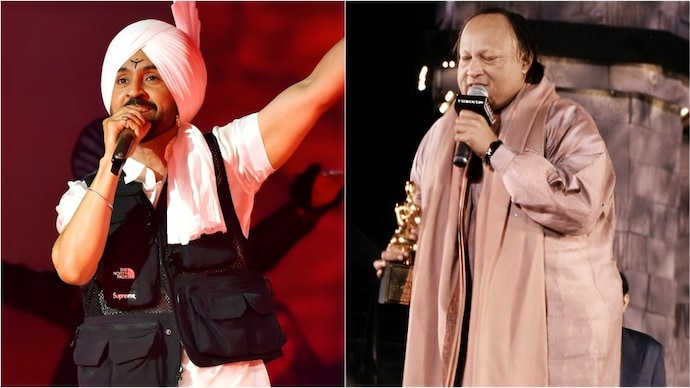

For Diljit Dosanjh, Wembley was always going to be about more than just filling a stadium. During his landmark concert in London, the Punjabi star paused the celebrations to pay tribute to Ustad Nusrat Fateh Ali Khan, singing the iconic Sanson Ki Mala as thousands of phone lights lit up the venue. It was one of those moments when the noise of a massive concert gave way to something quieter and deeply personal.
Dosanjh’s rendition of Sanson Ki Mala quickly became one of the most talked-about moments from the show. As he sang, fans raised their phones and swayed with the music, turning Wembley into a sea of lights. Clips from the performance soon made their way online, with fans calling the tribute emotional and saying it gave them goosebumps.
The tribute also carried extra weight given the scale of the evening. Dosanjh made history as the first Indian artist to perform at Wembley Stadium, reportedly performing for around 92,000 people. And in the middle of that huge career milestone, he chose to honour one of the most influential voices in South Asian music.
Dosanjh brought his own energy to Sanson Ki Mala, but never let the spectacle overpower the song. His vocals carried the weight of the composition while the crowd sang along and held up their phone lights. For a few minutes, the stadium felt less like a concert venue and more like a shared tribute.
The rest of the night was every bit as grand. Dosanjh addressed the crowd and declared, “This moment will go down in the history books,” before launching into hits such as G.O.A.T. and Lover. Bhangra beats took over Wembley as the singer celebrated the moment with his fans.
There was also a playful twist to one of his familiar concert lines. Dosanjh often begins his shows by announcing, “Punjabi aa gaye oye (the Punjabis have arrived)”. At Wembley, the phrase returned as a parody of the standard slogan, fitting the larger-than-life occasion.
Diljit Dosanjh scripts history
The scale of the concert was hard to miss. A social media post comparing major Wembley shows noted that Michael Jackson’s 1988 performance and Queen’s 1986 concert reportedly drew around 75,000 people. Dosanjh’s show, meanwhile, was reported to have an audience of around 92,000.
The Wembley night also came with news of what is next. During the concert on Saturday, September 12, Dosanjh announced that his next stop on the Aura World Tour will be the Narendra Modi Stadium in Ahmedabad, drawing a loud response from the crowd.
The concert was another marker in a global journey that has taken Dosanjh far beyond Punjabi music’s traditional boundaries. Over the past two decades, he has built a worldwide following, topped charts and collaborated with artists including Ed Sheeran. Jimmy Fallon once introduced him as “the biggest Punjabi artist on the planet” and even joined him for some Bhangra moves.
Speaking to the BBC backstage in London, Dosanjh described performing at Wembley as “a dream”. The audience was largely South Asian, but not exclusively so, with fans arriving early and waiting through the afternoon for the historic show. And by the time Sanson Ki Mala filled the stadium, Wembley had become more than a career milestone — it had become a moment of music, memory and a tribute to a legend.