
In the Hand of Dante review: Oscar Isaac, Gal Gadot's ambitious drama loses its grip
For cinephiles drawn to literary adaptations and bold swings, director Julian Schnabel's In the Hand of Dante offers striking visuals and committed performances worth sampling. Does the film do justice to the noble but uneven journey through hell, purgatory and fleeting paradise? Here is our review.

Cast & Crew

Writer-director Julian Schnabel’s In the Hand of Dante, starring Oscar Isaac, Gal Gadot, Gerard Butler and an ensemble of heavyweights, weaves a dual-timeline tale of obsession, violence and redemption. Adapting Nick Tosches’ novel, the film follows modern-day Dante expert Nick Tosches (Isaac) as he is drawn into a dangerous hunt for a lost original manuscript of The Divine Comedy. Running parallel to this is the story of the exiled poet Dante Alighieri in 14th-century Italy, grappling with faith, love and political intrigue. Schnabel directs with painterly flair, blending gangster noir with philosophical biography.
The non-linear structure jumps relentlessly between present-day New York and Sicily and medieval Florence, creating curiosity even as the back-and-forth grows repetitive. What begins as a heist thriller involving mobsters and Vatican secrets gradually reveals deeper metaphorical parallels between the two men’s quests for transcendence amid corruption and loss. Yet, somewhere the blending of gritty crime elements with Dante’s lofty philosophy feels a touch forced, as if the film is constantly reminding us of its own ambition rather than letting the connections breathe organically.
Oscar Isaac throws himself into the dual role with complete commitment. As the jaded contemporary scholar Nick, he carries quiet cynicism and grief; as the historical Dante, he brings tormented intensity and poetic fervour. He remains convincing in both roles, anchoring the film even when the timelines threaten to overwhelm. His ability to suggest an eternal soul cycling through the centuries gives the central conceit its emotional spine, though the weight of two full narratives occasionally stretches him thin.
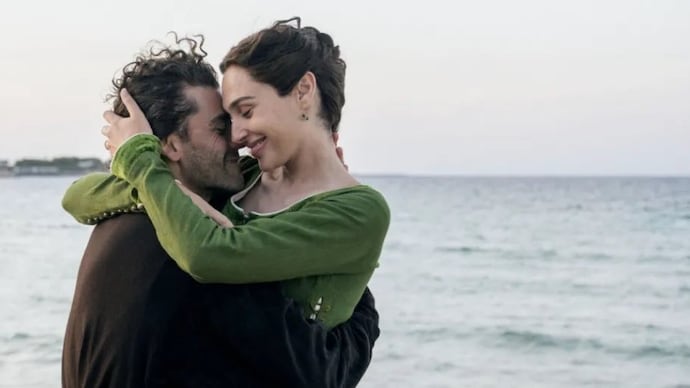
Gal Gadot delivers a decent, grounded performance as Giulietta in the modern strand and Gemma in the medieval one. She brings emotional depth as the supportive yet neglected partner across eras, conveying quiet resilience and lingering hurt. Her versatility shines in portraying both a contemporary urban woman navigating danger and a medieval wife bound by duty and unspoken longing. The chemistry with Isaac lends the island climax a tender, almost redemptive quality that hints at reincarnation and second chances.
Gerard Butler, however, steals several scenes with his chilling turn as the sociopathic hitman Louie in the present and the corrupt Pope Boniface VIII in the past. As Louie, he is ice-cold and unpredictably violent, dispatching victims with casual menace that makes the underworld segments crackle with tension. In the dual role of the papal antagonist, he embodies institutional power laced with cruelty, creating eerie echoes between timelines. His presence injects raw, infernal energy that the film sorely needs.
Director Martin Scorsese appears briefly but effectively as Isaiah, Dante’s mystical mentor, his gravitas lending quiet authority to the medieval sequences. Al Pacino, who appears in flashbacks as Uncle Carmine, channels the commanding screen weight familiar from classics like The Godfather, Scarface, Donnie Brasco and The Irishman. Even in limited time, he feels utterly believable as a streetwise father figure. Actor Jason Momoa brings frightening screen presence as the ruthless Rosario, though his role skirts a few stereotypical villain cliches.
The film’s visual language impresses. Schnabel’s direction captures medieval Italy with rich, authentic costumes, meticulous set design and evocative art direction that feel spot-on. The black-and-white modern segments contrast effectively with vibrant historical ones, and the cinematography adds stylistic polish. Yet the editing could have been tighter; repetitive transitions blunt momentum, and despite genuine character actions, an emotional link to the audience remains elusive amid the parallel chaos. The metaphorical parallels are intelligently drawn by writers, director and cast alike, but the narrative somehow lacks a deeper soul that might have made the grand themes resonate more powerfully.
In the Hand of Dante stands as an ambitious attempt at crafting an emotionally and morally complex narrative by thrusting Dante into a contemporary world of greed and violence. At two hours and 35 minutes, however, the vision gradually fades under its own weight, leaving an intellectually stimulating but emotionally distant experience.