
How Trinamool Congress poked BJP's Modi@25 campaign with Bengal crime data

The BJP's counter: the cases registered account for all those citizens who weren't allowed to report crimes during Mamata Banerjee's reign
 Last UpdatedOct 8, 2026 20:12 IST
 Published byEdited byAshish Mukherjee
 The Trinamool Congress (TMC) has sought to puncture the West Bengal BJP’s celebrations over Prime Minister Narendra Modi completing 25 years in public office by highlighting data that it says dents the ruling party’s governance claims—in this case, crime statistics from the first five months of BJP rule in the state.
The TMC shared on social media data furnished from the State Crime Records Bureau (SCRB)—2,454 rape cases, 600 murders, 13,114 attempts to murder, and 32,341 cases of assault causing grievous hurt, all registered between May and September 24.
The data was provided by SCRB in response to an RTI (Right to Information) application filed by Saket Gokhale, Rajya Sabha MP of the TMC faction led by Mamata Banerjee.
The timing of the TMC's salvo is significant. October 7 marks 25 years since Modi first headed a government, as Gujarat chief minister in 2001. The BJP in Bengal has been observing the milestone through a month-long campaign, with programmes highlighting the prime minister's record in governance and public service.
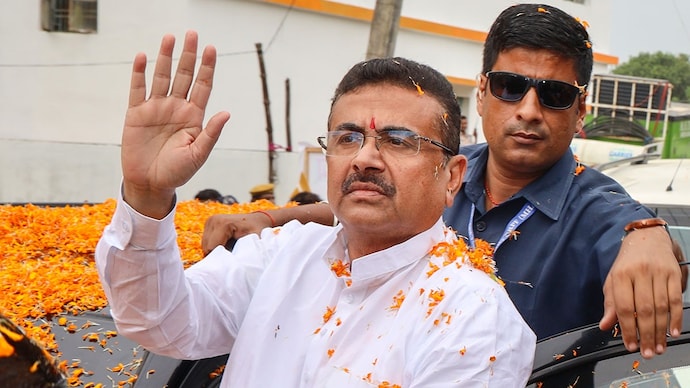
The Bengal BJP and Suvendu Adhikari government have been organising a series of programmes, including Seva Jyoti yatras, welfare camps and public outreach initiatives, as part of the celebrations. Against this backdrop, the TMC has tried to turn the attention towards law and order in Bengal.
The month-wise crime figures show that May, when the BJP assumed office, recorded 125 murders, 2,947 attempts to murder, 349 rape cases and 7,794 cases of assault causing grievous hurt. June saw 134 murders, 3,096 attempts to murder, 389 rapes and 6,922 cases of grievous hurt.
July recorded the highest number of rape cases in the period: 786 cases. There were 133 murders, 2,562 attempts to murder and 6,191 cases of assault causing grievous hurt. In August, the state recorded 111 murders, 2,498 attempts to murder, 459 rapes and 6,334 cases of assault causing grievous hurt. The September figures, till the month’s 24th, show 97 murders, 2,011 attempts to murder, 471 rapes and 5,100 cases of assault causing grievous hurt.
The district-wise annexures supplied by the SCRB contain details of FIRs registered, cases under investigation, chargesheets filed and cases closed or in which final reports were submitted. The data covers the state's police districts as well as Kolkata police.
TMC national general secretary Abhishek Banerjee amplified the figures on X, writing: “A snapshot of the BJP’s ‘DOUBLE ENGINE’ disaster in West Bengal. Just 5 months: Rape: 2,454 cases, 16 every day; murder: 600 cases, 4 every day; attempt to murder: 13,114 cases, 87 every day; grievous assault: 32,341 cases, 216 every day. They promised a ‘double engine’. Bengal got DOUBLE ENGINE DISASTER. This is what SIR and VoteChori have delivered. Power at any cost. Bengal paying the price.”
Kunal Ghosh, an MLA of Mamata’s TMC faction, suggested the figures themselves were enough to indicate the situation in Bengal. “In addition, there are thousands of Didi’s Trinamool workers who have been arrested, subjected to false cases and threatened. Those figures also need to be seen alongside this data,” he said.
The BJP criticised the attempt to link the figures directly to any deterioration in law and order under its government. The party’s state spokesperson Debjit Roy claimed the increase in registered cases was partly because victims of post-poll violence, who had been unable to approach the police under the previous regime, were now being allowed to register complaints.
“Victims of post-poll violence could not register their complaints under the TMC regime. Our government has enabled them to lodge delayed FIRs. This is why the number of registered cases have gone up in the last five months,” Roy said.
He alleged that crime data had not been properly reported during the previous government. “Under the TMC, the NCRB (National Crime Records Bureau) was kept in complete darkness. The rate of conviction in such cases was only 2.5 per cent,” he said.
The SCRB document does not provide comparable figures for the corresponding period before the BJP came to power. Therefore, it cannot, on its own, establish whether crime has increased or decreased compared with TMC rule. The political battle, however, is clear. On a day the BJP celebrated Modi's 25-year-long administrative journey and showcased the governance credentials of its new dispensation in Bengal, the TMC threw in the state's recent crime statistics to challenge the narrative.
Subscribe to India Today Magazine
Arkamoy Datta Majumdar is an Assistant Editor with India Today magazine, based in Kolkata. He writes about politics, international relationship, football, and society, with a particular focus on eastern India and the political transformation of West Bengal. He oversees the editorial operations in the eastern states of West Bengal, Odisha and Sikkim.
His reporting sits at the intersection of politics and everyday life. He covers elections and political parties, governance and public policy, political movements, identity and cultural politics, federalism, border issues and the changing relationship between the state and its citizens. In West Bengal, his work has closely followed the rise of the BJP, the evolution of the Trinamool Congress, the Left and Congress, electoral politics, voter-list and citizenship questions, welfare politics and the ways in which political competition increasingly plays out through culture, religion, education and public institutions. He has covered the crucial Bangladesh elections of 2026 from Dhaka.
He also follows the wider politics of the eastern region, particularly where questions of borders, migration, regional identity, security and diplomacy intersect with domestic politics.
For Arkamoy, political journalism is as much about understanding people and places as it is about following politicians. He is interested in what happens between an announcement and its implementation, between a political slogan and its impact on the ground, and in the quieter social and cultural shifts that often reveal where politics is heading.
READ MORE