
Need to create fear in minds of hooligans, SC tells cops on Delhi rape cases

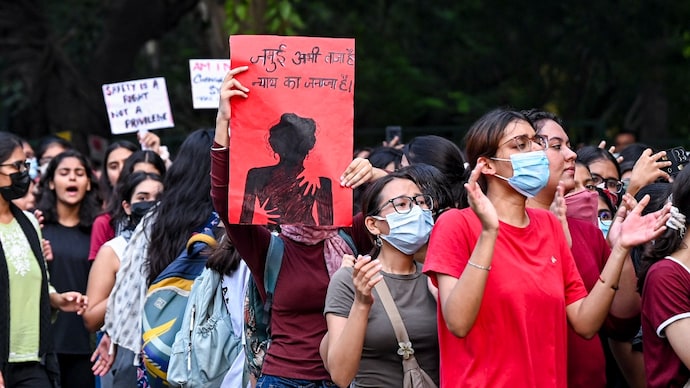
This comes days after the court took note of the recent spate of sexual assault incidents reported from various parts of the wider National Capital Region (NCR).
 Last UpdatedOct 5, 2026 16:35 IST
  Published byWritten ByMayukh Debnath
The Supreme Court on Monday called for a tougher and more robust policing strategy in Delhi to deter “anti-social elements” from committing sexual crimes against women and children, stressing that effective policing must create a sense of fear among potential offenders.
The court's observations came days after it took note of a recent spate of sexual assault incidents reported from different parts of the wider National Capital Region (NCR). During the hearing, the bench told the Delhi Police that deterrence was essential and that policing on the ground needed to be strengthened.
"You need to create fear in the minds of anti-social elements," the bench, comprised of Justices J B Pardiwala and K Vinod Chandran, told Delhi Police.
Justice Pardiwala said offenders should be made to believe that they would face serious consequences if they attempted to commit crimes. "They (anti-social elements) should think 'ab kuch kiya toh marr jaenge' ('if we do something now, we'll get killed')," he said.
The bench also made it clear that the police should not hesitate from taking stringent action when the situation warrants it.
"Do not hesitate to be a little more harsh and strict – there may be people who raise hue and cry about Article 21 – but you take action as required," the bench said.
Article 21 of the Constitution of India protects the right to life and personal liberty.
Addressing a senior police official present in the courtroom on behalf of Delhi Police, Justice Pardiwala said, "We are asking you with great hope. Please rise to the occasion. Every girl molested or raped is our sister—it's a challenge for the police."
"Live up to our expectations. Don't allow such things to happen just because there are some shortcomings," he added.
SUPREME COURT STRESSES ROBUST POLICING
The Supreme Court stressed that beat patrolling is central to ensuring public safety, and directed the Delhi Police to ensure that personnel remain mobile and actively patrol their assigned areas instead of merely maintaining a visible presence at fixed points.
Questioning the practice of police vans remaining parked at one location for prolonged periods, the bench asked why they were not being moved around as part of regular beat patrolling.
With the festive season approaching, the court also cautioned that "these miscreants will be high" during occasions such as Durga Puja and Diwali, underscoring the need for heightened vigilance and patrolling.
The bench also sought details from the police on measures taken to illuminate dark and poorly lit stretches, underlining the need to identify and address vulnerable spots that could pose safety risks, particularly to women and children.
The court further asked the police to engage directly with local residents and listen to their complaints, including concerns over inadequate street lighting and the presence of hooligans in their neighbourhoods.
It also flagged illegal eateries and liquor stores as places where hooligans could congregate and asked the police to address such concerns as part of a broader preventive policing strategy.
The court also questioned whether CCTV footage was being actively monitored, stressing that surveillance should serve not only as a tool for investigating crimes after they occur but also as a means of preventing them.
"Is there any monitoring of CCTV footage? CCTV can check who was there — will help you solve a crime — but what about preventing crime?" the bench asked.
Last week, the Supreme Court took note of the alleged gang-rape of a 17-year-old girl at Aastha Kunj Park in Delhi, gang-rape and murder of a teenage girl in Swaroop Nagar area of the city and the purported gangrape of a minor girl inside a moving sleeper bus which the law enforcement agencies failed to intercept while it traversed a distance of over 47 km from Greater Noida to the national capital.

Aneesha Mathur is a Special Correspondent for India Today where she puts her LLB degree to use covering Legal issues and cases in the Supreme Court of India, Delhi High court and other courts/tribunals.
Aneesha joined India Today in October 2018. After graduating from St Stephen's College and Faculty of law,Delhi University, she spent the formative years of her career in print Media.
Her interest in journalism stems from experience while interning with Legal services and Juvenile justice board as a law student, where she learnt the importance of ensuring that accurate information reaches the world, and that stories about individual experiences and statistics that show a "bigger picture" must supplement each other so other people can see what the large impact of a small thing can be. When not working or thinking about the law and it's state, Aneesha hides from reality in fantasy novels, rom-coms and food.
READ MORE
I am Sanjay Shrama Deputy Editor with Aajtak. I am with this prestigious organisation and one of the torch bearer of our motto `Golden standard of journalism` since two decades.. In 2001 I jjoined Aajtak as assistant producer. and since 2003 I am with reporting team.
During this period I have been covering mainly legal beat as Supreme Court, Law ministry, Law commission, Election commission. I have covered Culture ministry as well Tourism and Water resource ministry.. Alongwith legal I am fortunate to do political stories and human interest stories.
Very fond of art culture and Indian classical music. I have been deciple of Padma Vibhushan Pandit Jasraj ji, great doyan of Mewati Gharana. Apart from this great achievement I have covered great congragation of the world The Kumbh mela at all four vanues twice.
Eager to learm languages. I can read and speak many languages apart from Hindi and English I acan read, speak and understand Urdu, Nepali, Rajasthani, Maithili, Bhojpuri and Haryanavi...
READ MORE