
Sit-in protest, Form 7 charge: DK Shivakumar back in form with EC showdown

DK Shivakumar's confrontation with the Election Commission over alleged bulk filing of Form 7 applications marks a return to a more combative political style after a consensus-focused first 100 days.
 Last UpdatedOct 2, 2026 14:54 IST
  Published byEdited byAkshat Trivedi
Karnataka Chief Minister DK Shivakumar’s confrontation with the Election Commission over allegations of bulk filing of Form 7 applications has brought back a more combative side of the Congress leader that had been less visible during his first 100 days in office.
Since taking charge, Shivakumar has largely focused on consensus and governance. He has sought to convene an all-party meeting on the drought situation and has repeatedly said in the Assembly that his government would take all sections and political parties along.
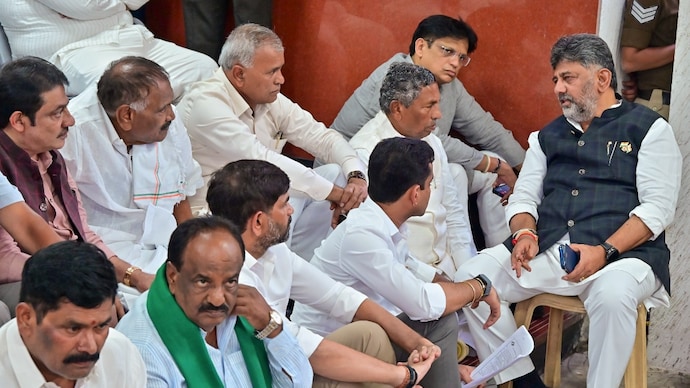
That approach was visible in his handling of several issues during the first three months of his tenure. The tone changed on Thursday when Shivakumar put a scheduled Cabinet meeting on hold and led his ministers and ruling Congress MLAs to the Chief Electoral Officer’s office over allegations that Form 7 applications were being filed in bulk to seek the deletion of voters from electoral rolls.
Shivakumar staged a sit-in outside CEO V Anbukkumar’s office and demanded an FIR over what he described as “electoral fraud” during the ongoing Special Intensive Revision (SIR) of electoral rolls.
The protest lasted around five hours. It ended after Anbukkumar directed election officials to initiate action against applicants found to have knowingly made false statements or declarations in electoral forms amid allegations of bulk filing of Form 7 applications to delete names of eligible voters.
Form 7 is a voter application form for raising an objection to the proposed inclusion or deletion of a name from an existing electoral roll.
Shivakumar had met Anbukkumar for about two-and-a-half hours before announcing the sit-in. He said he would not leave the CEO’s office until an inquiry was ordered and an FIR registered.
“I will remain here until I get the satisfaction that, under the law, I can protect the people through our fight,” Shivakumar said when asked how long he would stay at the election office.
Asked about the Election Commission’s response, he said, “You should ask them that.”
Shivakumar said the CEO had understood the issue and had seen the alleged “misuse” himself.
“He has understood it. He has seen it with his eyes,” he said.
The Chief Minister said officials had issued Form 7 and sought a day, but he expressed apprehension that the matter could subsequently be diluted through the intervention of senior leaders.
The entire Cabinet backed Shivakumar, while former Chief Minister Siddaramaiah also joined the protest. Congress Karnataka president BK Hariprasad also participated in the demonstration.
SHIVAKUMAR’S ALLEGATIONS OVER FORM 7 FILINGS
Shivakumar handed over a memorandum to the CEO seeking an immediate, impartial and time-bound probe into the bulk filing of Form 7 applications seeking deletion of voters’ names during the ongoing SIR.
In his letter to the CEO, Shivakumar said it was his “bounden duty” as Chief Minister to protect the rights of every eligible voter and ensure that the revision process remained free, fair, transparent and legally compliant.
He said he had been informed that a large number of Form 7 objections had been filed in bulk, particularly on September 22, 23 and 24, towards the end of the claims and objections period.
He cited reports of approximately 3,000 applications in Belagavi North, 6,259 in Mudigere, 1,373 in Babaleshwar, 1,200 in Narasimha Raja and 2,285 in Bhalki constituencies, besides “similarly large numbers” in other constituencies.
According to Shivakumar, the scale and manner of the filings raised concerns over whether eligible voters belonging to minority communities, Scheduled Castes, Scheduled Tribes and Other Backward Classes were being selectively targeted.
“A substantial proportion of the voters proposed for deletion reportedly belong to minority communities, Scheduled Castes, Scheduled Tribes and Other Backward Classes,” he said, adding that the pattern required “immediate and impartial verification”.
He also flagged instances where the names, EPIC numbers and other particulars of voters proposed for deletion appeared to have been pre-printed on Form 7 applications, with the objectors’ details filled in subsequently.
EPIC refers to the Election Photo Identity Card number, a 10-digit unique identification number assigned to each voter.
Shivakumar asked the CEO to verify reports of individuals filing unusually large numbers of Form 7 applications and independently examine the reported political affiliations of some applicants, including their alleged association with BJP and JD(S) workers.
BELAGAVI NORTH ALLEGATIONS
Referring to Belagavi North, Shivakumar said defeated BJP candidate Dr Ravi B Patil had publicly acknowledged that Form 7 applications were filed in large numbers through his associates.
He also referred to an alleged public acknowledgement by Jadav of the Belagavi District Yuva BJP Morcha.
Shivakumar said video recordings of the statements had been widely circulated and enclosed with his letter for investigation.
He said some Booth Level Officers had returned bulk Form 7 applications. He asked the CEO to collect details from the concerned BLOs, including the constituencies and booths involved, the people who submitted the applications, the number of forms and the reasons for their return.
The Chief Minister sought an objective probe into allegations regarding the possible involvement, direction or knowledge of political functionaries and asked the Election Commission to establish responsibility based on evidence.
He requested a constituency-wise and booth-wise examination of Form 7 filings, identification of people who submitted unusually large numbers of applications, their relationship with the voters concerned, and the source of the voter and EPIC details used in pre-printed forms.
He urged the CEO to investigate the matter “immediately and on the highest priority”, register FIRs in cases where offences were established and initiate appropriate criminal action against those responsible.
Shivakumar also called upon the CEO to ensure that the integrity of the electoral rolls and the rights of all eligible voters were fully protected.
FROM CONSENSUS TO CONFRONTATION
The confrontation marks a shift in Shivakumar’s political posture after a first 100 days largely defined by governance and consensus-building.
The Chief Minister has sought to convene an all-party meeting on the drought situation and has repeatedly maintained in the Assembly that his government would take all sections and political parties along.
The latest confrontation, however, has placed him at the centre of a politically charged dispute over the electoral-roll revision process. The Congress has made the SIR a national political issue and stepped up its demand for the resignation of Chief Election Commissioner Gyanesh Kumar.
The episode has consequently given Shivakumar greater visibility within the Congress at a time when the party is mounting a nationwide campaign against the Election Commission over the SIR.
The confrontation comes after a series of policy initiatives announced by the Karnataka government, including free bus passes for students and the move to recognise Tulu as a second official language.
With the 2028 Assembly election still ahead, Shivakumar faces the task of taking these governance measures forward while preparing the Congress for a contest with the BJP and JD(S), with anti-incumbency likely to remain a key political issue.
