
Agnipath scheme for four-year military tour of duty unveiled

The government has approved a new short-term recruitment policy called "Agnipath" for Indian youth to serve in the armed forces as "agniveers".
 Last UpdatedJun 14, 2022 15:52 IST
 Published by
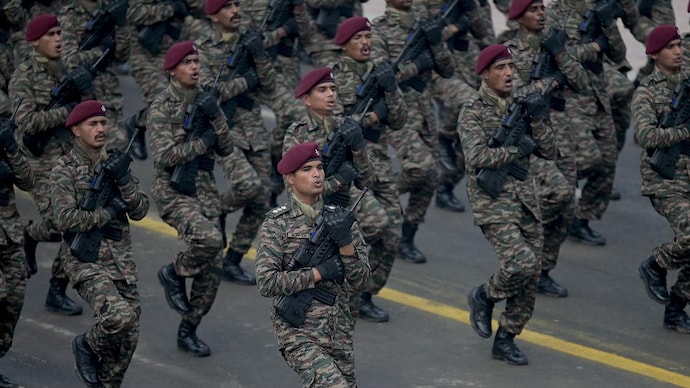
The Centre on Tuesday today unveiled a new short-term recruitment policy for Indian youth to serve in the armed forces. Termed Agnipath, the scheme will enable youngsters aged 17.5 to 21 to be inducted into any of the three services as “agniveers” for a period of four years.
The Agnipath scheme, earlier christened as "Tour of Duty", was launched in the presence of Union Minister of Defence Rajnath Singh and the chiefs of the three services.
The radical recruitment policy was announced after the Cabinet Committee on Security approved it following extensive deliberations over the last two years.
Defence Minister Rajnath Singh hailed the Agnipath recruitment scheme as a “transformative initiative” that will bring about a huge change and open up opportunities for the nation’s youth. He said the Agnipath scheme will strengthen India's security while also providing a youthful profile to the Armed Forces.
Enter India's 'Agniveers' | Announcing the Agnipath scheme, Defence Minister Rajnath Singh (@rajnathsingh) said it was a "historic" move taken by Cabinet Committee on Security.#AgnipathScheme pic.twitter.com/TA24I7VEAA — IndiaToday (@IndiaToday) June 14, 2022
“All look at the armed forces with respect and youth want to wear the uniform. The profile will be youthful. The health and fitness level be quite better. Higher skilled force will be available. Agniveer will be given a good package, along and with an exit package,” Singh said while addressing a joint press conference with the three service chiefs.
Army chief General Manoj Pande said the Agnipath scheme aims to make the Army a future-ready fighting force capable of meeting multiple challenges across full spectrum of conflict. It will increase technical threshold of the Army by recruiting Agniveers through IIT and other tech institutes, he added.
READ | Agnipath scheme launched. Here are the FAQs
ELIGIBILITY
Soldiers will be recruited in the age limit of 17.5 to 21 year age at a salary of around Rs 30,000-40,000. Women are eligible for the recruitment scheme.
Agniveers must meet the medical eligibility conditions laid down for enrolment in the armed forces as applicable to respective categories/trades.
The soldiers recruited under Agnipath will be released from service after four years, though the new system will have a provision for retaining around 25 per cent of them after another round of screening.
"The screening and selection based on a sound, fair, transparent and a robust assessment system will ensure that the Army retains the best of the best for a longer serving duration and these personnel will form the core of our organisation," Army chief General Manoj Pande said.
Army chief General Manoj Pande said the Agnipath scheme aims to make the Army a future-ready fighting force capable of meeting multiple challenges across full spectrum of conflict.#AgnipathScheme pic.twitter.com/6mMWzs3Tp6 — IndiaToday (@IndiaToday) June 14, 2022
ENROLMENT
Enrolment will be undertaken through an online centralised system for all three services with specialised rallies and campus interviews from recognised technical institutes such as Industrial Training Institutes and National Skills Qualifications Framework, among others.
Enrolment will be based on ‘All India All Class’ basis and the educational qualification for Agniveers will remain as in vogue for enrolment in various categories. {For example: For entry into General Duty (GD) soldier, the educational qualification is Class 10}.
REMUNERATION AND BENEFITS
According to an official statement, Agniveers will be given an attractive customised monthly package along with risk and hardship allowances as applicable in the three services.
On completion of the engagement period of four years, Agniveers will be paid one time ‘Seva Nidhi’ package which shall comprise their contribution including accrued interest thereon, and matching contribution from the Government equal to the accumulated amount of their contribution including interest.
The ‘Seva Nidhi’ will be exempt from Income Tax. There shall be no entitlement to gratuity and pension benefits. Agniveers will be provided non-contributory Life Insurance Cover of Rs 48 lakhs for the duration of their engagement period in the Indian Armed Forces.

Born in Pauri district of Uttarakhand, Manjeet Negi did his early schooling from his village school near Rishikesh and then moved to the town for secondary education. Later, he did his graduation from Hemavati Nandan Bahuguna University. In the year 2000, he did his journalism diploma from Kurukshetra University and started his career with Doordarshan News and started reporting on defence forces from the 2001 Bhuj earthquake. In his career as a defence correspondent, Negi has had the opportunity to report exclusives from world's highest battlefield Siachen Glacier in the north to the Andamans in the South and from the Rann of Kutch in the west to the Arunachal Pradesh border with China in the East.
A regular news-breaker on matters of national security and military affairs, Negi considers the coverage of he Kedarnath tragedy of 2013 as the highest point of his career. During the grave disaster at Kedarnath in June 2013, Manjeet Negi was the first and only TV reporter who walked for 55 Kms on the hilly track to reach the Kedarnath shrine. Spending his first night in the complex amidst several hundred dead bodies around him, Negi says he saw Lord Kedar in his dream. After the Kedarnath disaster, the writer got another opportunity to cover another disaster in the Nepal earthquake in 2015 for the Aaj Tak channel. During the reporting of that disaster for about 10 days, the writer got an opportunity to witness and report the large scale relief and rescue operations undertaken by the Indian Army and the Indian Air Force.
Besides reporting, he is also a skilled mountaineer. With Nehru Institute of Mountaineering and Garhwal Regiment, he has undertaken mountaineering expedition to Satopanth via Gomukh. Accompanying the Mount Manaslu mountaineering expedition of a Garhwal Regiment unit, he also reported about the expedition. He has also scaled the Dronagiri mountain near Joshimath in Uttarakhand. Manjeet Negi has also been honoured with a special award by the Union Home Minister, Shri Rajnath Singh for his reporting of Kedarnath disaster. He was awarded the best reporter award for his coverage of Nepal earthquake by India Today Group. At present, the writer has been working as Editor with Aajtak Channel of India Today Group.
READ MORE