
China increases deployment of fighter aircraft near Indian territory| Exclusive

China has increased the deployment of fighter aircraft near Indian territory.
 Last UpdatedJun 10, 2022 18:44 IST
 Published by
Amid the assertion by an American military officer that the situation along the Eastern Ladakh sector was alarming, it is emerging that the Chinese Air Force has more than doubled the deployment of fighter aircraft at its main base near Indian territory.
The Chinese Air Force is operating from its main base in Hotan during the conflict. They are now maintaining around 25 fighter aircraft there. This is much higher than what they used to keep earlier, top government sources told India Today.
Indian agencies are closely monitoring the development and Indian agencies responsible are prepared for any eventuality, they said.
China is also developing a new fighter aircraft base in Shakche which is expected to strengthen Chinese Air Force along the LAC with India. The Indian side feels that Chinese have realised that the Indian Air Force was able to move faster in the conflict zone than them and that is why they have started working on new airbases.
The Chinese People’s Liberation Army Air Force (PLAAF) has upgraded a number of these bases in recent times, including the construction of hardened shelters, the extension of runway lengths and deployment of additional manpower.
Sources said military airbases under Indian watch include three opposite Eastern Ladakh -- Kashgar, Hotan and Ngari Gunsa. The other bases include Shigatse, Lhasa Gongkar, Nyingchi and Chamdo Pangta, the sources added.
US GENERAL REMARKS
The US Army's Pacific Commanding General Charles A Flynn, during his India visit, had raised concerns over the defence infrastructure being built by China along its border with India in Ladakh as "alarming".
Flynn also called the activities of the Chinese Communist Party (CCP) in the Indo-Pacific region "destabilising and corrosive" and said that Indo-US ties were working as a “counterweight to the corruptive behaviour of the Chinese”.
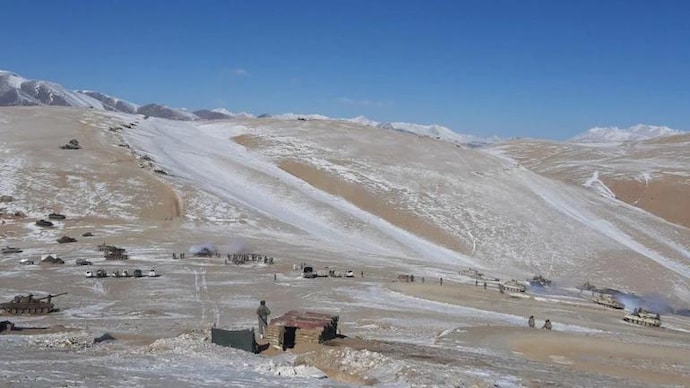
Indian and Chinese troops have been locked in a standoff in eastern Ladakh since May 5, 2020, when a violent clash between the two sides, that resulted in casualties on both sides, erupted in the Pangong lake area. Despite 15 rounds of military talks, tension prevails in the area. The western theatre command of the Chinese People's Liberation Army (PLA) oversees the India-China border.
The Chinese construction that Flynn was referring to came to the fore last month in the strategically important Pangong Tso area. This bridge could help its military to quickly mobilise its troops in the region.
Other Chinese infrastructure, such as roads and residential units, have also come up along the border with India. China is also involved in major maritime border disputes with various countries in the Indo-Pacific region, such as Vietnam and Japan.
Flynn said: "I believe that the activity level is eye-opening and some of the infrastructure that is being created in the (Chinese Army's) western theatre command is alarming." “One must ask 'why does China's military need such arsenal in all domains,” he said.
"So, I do not have a crystal ball to tell you how it (India-China border standoff) is going to end or where we will be at. I will express to you that it is worthy of asking this question and try to get their response as to what are their intentions," he said.

Born in Pauri district of Uttarakhand, Manjeet Negi did his early schooling from his village school near Rishikesh and then moved to the town for secondary education. Later, he did his graduation from Hemavati Nandan Bahuguna University. In the year 2000, he did his journalism diploma from Kurukshetra University and started his career with Doordarshan News and started reporting on defence forces from the 2001 Bhuj earthquake. In his career as a defence correspondent, Negi has had the opportunity to report exclusives from world's highest battlefield Siachen Glacier in the north to the Andamans in the South and from the Rann of Kutch in the west to the Arunachal Pradesh border with China in the East.
A regular news-breaker on matters of national security and military affairs, Negi considers the coverage of he Kedarnath tragedy of 2013 as the highest point of his career. During the grave disaster at Kedarnath in June 2013, Manjeet Negi was the first and only TV reporter who walked for 55 Kms on the hilly track to reach the Kedarnath shrine. Spending his first night in the complex amidst several hundred dead bodies around him, Negi says he saw Lord Kedar in his dream. After the Kedarnath disaster, the writer got another opportunity to cover another disaster in the Nepal earthquake in 2015 for the Aaj Tak channel. During the reporting of that disaster for about 10 days, the writer got an opportunity to witness and report the large scale relief and rescue operations undertaken by the Indian Army and the Indian Air Force.
Besides reporting, he is also a skilled mountaineer. With Nehru Institute of Mountaineering and Garhwal Regiment, he has undertaken mountaineering expedition to Satopanth via Gomukh. Accompanying the Mount Manaslu mountaineering expedition of a Garhwal Regiment unit, he also reported about the expedition. He has also scaled the Dronagiri mountain near Joshimath in Uttarakhand. Manjeet Negi has also been honoured with a special award by the Union Home Minister, Shri Rajnath Singh for his reporting of Kedarnath disaster. He was awarded the best reporter award for his coverage of Nepal earthquake by India Today Group. At present, the writer has been working as Editor with Aajtak Channel of India Today Group.
READ MORE