
Delimitation debate: Congress warns of South losing political voice, BJP-TDP hit back

Congress and BRS pressed for protection of the South's parliamentary share and stronger federal safeguards, while BJP and TDP argued that concerns could be addressed through more seats and existing constitutional institutions.
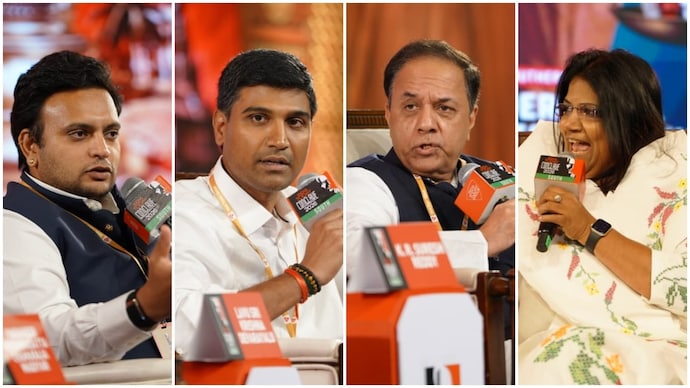


The proposed delimitation of Lok Sabha constituencies triggered a sharp debate at the India Today Conclave South, with Congress warning that a population-based exercise could reduce the political representation of southern states and deepen concerns over Centre-state relations, while the BJP and TDP defended delimitation as a constitutional process.
Congress leader Jabi Mather argued that delimitation was not merely an exercise to redraw constituency boundaries, but one that could have a direct impact on the political voice of southern states. BJP Lok Sabha MP Yaduveer Krishnadatta Chamaraja Wadiyar and TDP Lok Sabha MP and parliamentary party leader Lavu Sri Krishna Devarayalu countered her, arguing that Congress was “changing the goalposts.”
BRS leader KR Suresh Reddy, who also advocated ensuring the southern states receive their due share, said his party supports the delimitation process if it guarantees proportional representation and an equitable increase in the number of MPs. However, he said the proposed Bill remains ambiguous on this aspect.
“Delimitation is not just drawing of constituencies. It has serious repercussions,” Mather said.
She argued that southern states had implemented population-control measures more effectively and should not now be penalised for doing so.
“South implemented population measures in a very strict manner. Now we have reached a point that we are being punished for implementing the scheme perfectly,” she said.
Mather also questioned whether the Opposition could trust the government to conduct the exercise fairly, alleging that constitutional institutions had been misused.
“How can we trust this government? A government which misused every possible constitutional body,” she said.
On fears of gerrymandering, Mather said she had “no reason to believe the government” and questioned whether the proposed framework provided adequate safeguards for the existing share of representation.
BJP, TDP HIT BACK
Wadiyar rejected the Opposition's concerns and accused Congress of repeatedly changing its position on delimitation.
“If you observe the Congress, they have continuously changed the goalposts,” he said.
He argued that delimitation had been carried out several times in the past and that political parties must have faith in constitutional institutions.
“It has been done multiple times. You have to believe in the institution,” Wadiyar said.
He also argued that increasing the total number of parliamentary seats was the appropriate way to address concerns over representation.
“Increasing the number of seats is the most rightful way of doing it,” he said.
Wadiyar questioned the argument that delimitation would automatically benefit the political establishment overseeing the exercise.
He also criticised Opposition leaders for questioning institutions, saying such criticism reflected a lack of confidence in their own leadership to use institutional mechanisms.
“When Congress leaders say there is a lack of trust, it shows the lack of trust of their own leadership to come in and use the institutional framework and express the sentiments or the inaccuracies they claim to be having,” he said.
Invoking the phrase “Bad workmen blame the tool”, Wadiyar argued that political parties should examine their own leadership instead of blaming the institutional process.
He also said the government was considering a model that would ensure representation across the southern states.
BRS SEEKS PROTECTION OF SOUTH'S SHARE
Suresh Reddy said the BRS was not opposed to delimitation but wanted the existing political share of southern states to be protected.
“My party will stand with the stance to maintain the 24 per cent of strength in Parliament,” he said.
Calling southern India a “victim of delimitation”, Reddy referred to Andhra Pradesh's experience and said the state had been promised an increase in parliamentary seats that did not materialise as expected.
“We are okay with delimitation, if you maintain the existing share,” he said.
Reddy also linked the delimitation debate to the broader question of fiscal federalism, arguing that southern states needed a more structured mechanism to secure what they considered their fair share of central resources.
“It is a give and take, but the South is giving but not receiving,” he said.
He said federalism could not operate according to the convenience of either the Centre or individual states.
“Federalism is not to be by convenience. There shall be a mechanism,” Reddy said.
He called for a structured process through which states could raise their concerns, particularly when the Finance Commission is constituted.
CONGRESS RAISES FEDERALISM QUESTION
Mather said the Congress position was clear that women's reservation should not be linked to delimitation.
“Congress' stand is very clear. When you bring women reservation, do not link it with delimitation. But the government wants to show it as delimitation,” she said.
She also questioned why successive governments had extended the freeze on the allocation of Lok Sabha seats and argued that the South was not seeking special treatment.
“South India is not asking for a privilege. We are asking for equal political voice. We are not here to ask for any undue advantage. Do not snatch away the political voice,” she said.
Mather said the issue was ultimately about the balance of power between the Centre and the states.
“Federalism is being compromised. It is a one-way dictatorial trend happening,” she said.
She argued that federalism was a constitutional principle and not dependent on the goodwill of the Centre, and cited the Supreme Court's S R Bommai judgment.
Mather said the core dispute was also about fiscal federalism, alleging that funding to states had increasingly become conditional on their alignment with central government policies.
Devarayalu took a different position, arguing that Centre-state relations should be based on partnership rather than confrontation.
He said the TDP was not opposed to working with the Centre when doing so served Andhra Pradesh's interests.
Devarayalu also argued that states had access to institutional mechanisms such as the Finance Commission and GST Council to raise their concerns and seek greater devolution.
He said states needed to actively participate in these forums rather than remain absent from the process and later question its outcomes.
The TDP leader also opposed a proposed hybrid model of representation, arguing that it could benefit already prosperous regions while leaving economically backward areas further behind.