
Exclusive: Satellite images show Galwan standoff intensifying

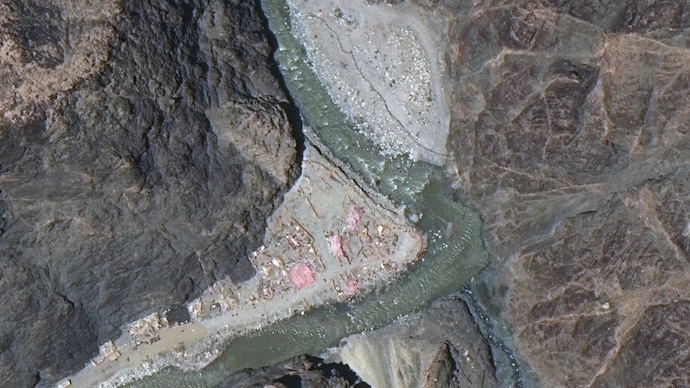
Even as India and China hold talks on disengagement, latest satellite images captured on June 22 — the day of Corps Commander-level talks in Ladakh — show a new forward build-up by the Chinese near Patrol Point 14.
 Last UpdatedJun 25, 2020 09:33 IST
 Published by
It’s not over in the Galwan Valley yet. Indian and Chinese troops have apparently taken up new positions in the Galwan Valley, fresh satellite images show. High-resolution satellite pictures of ground zero of the June 15 skirmish between Indian and Chinese troops show aggressive posturing by People’s Liberation Army troops near the Line of Actual Control (LAC).
Images captured on June 22 — the day of Corps Commander-level talks in Ladakh — show a new forward build-up by the Chinese near Patrol Point 14. Beyond this point, a large-scale construction site has been picked up by satellite imagery on the Chinese side. Images captured by Maxar’s Worldview-3 satellite and shared with India Today show earth-moving vehicles, JCB machines and pre-fabricated sheds brought by the Chinese army.

Satellite imagery expert Col. (Retd) Vinayak Bhat analysed these images from the Galwan Valley. “Both sides have deployed their troops on either side of the river but it seems that the PLA troops have not moved back as promised by them,” Col. Bhat told India Today.
He noted that while the Indian side has tents more than 500 metres away from the conflict point, the Chinese have a large spread of tents and storage starting very close to the point of conflict. “Most of the storage structures observed in these images are between 200m and 2km from the point of conflict.” Bulldozers, cranes and tar trucks used in road construction are also visible.


INDIAN POSITION
While the Chinese army seems to have an overwhelming position on the ground, the Indian army may have a vantage point from higher ground in Galwan, giving India a key strategic advantage during the negotiations. “The tracks leading to the mountains are only visible from the Indian side and not from the Chinese side in the imagery from June 22,” Col. Bhat said.

On ground, the Indian side has also built temporary fortifications on the other side of the river as captured in the images.

The Chinese foreign ministry has issued statements laying claim to the entire Galwan Valley, a stand rejected outright by New Delhi. “The position with regard to the Galwan Valley area has been historically clear. Attempts by the Chinese side to now advance exaggerated and untenable claims with regard to the LAC there are not acceptable,” a spokesperson from the ministry of external affairs said last week. Indian and Chinese military commanders held their second round of talks on Monday, which went for almost 11 hours. Both sides have reached a mutual consensus to disengage but the process of disengagement is yet to be finalised.
Ankit Kumar (a.k.a. Ankiit Koomar) – Editor, Open-Source Investigations, India Today TV & Aaj Tak
Ankit Kumar is the Editor of Open-Source Investigations (OSINT) and Visual Investigations at India Today TV and Aaj Tak. A two-time JournalismAI fellow with the London School of Economics (LSE), Ankit’s work lies at the intersection of investigative journalism and emerging digital tools as well as use of Artificial Intelligence (AI) in journalism. He has pioneered South Asia’s first dedicated OSINT journalism team, bringing cutting-edge technology into the newsroom.
His investigative reports have made national headlines and even been debated in the Indian Parliament. He was the first journalist to uncover the common link between middlemen networks in two of India’s most controversial defence deals—the VVIP AgustaWestland Chopper Deal and the Rafale Jet Deal . His reports have been frequently cited by both the Prime Minister and opposition leaders, shaping public discourse on key national security matters.
Ankit’s deep-dive investigation into the Indian Air Force’s Balakot Airstrikes was the first to feature key eyewitness accounts from the ground.
Following his report, a UK-based dubious news portal that propagated false claims of large-scale EVM fraud in India was shut down. His stories cover a wide spectrum—from finance, business, and cybersecurity to disinformation, artificial intelligence (AI), and emerging global threats.
His work has been recognized globally, with the Global Investigative Journalism Network (GIJN) listing his reporting among the year’s top investigative stories.
🔹 Connect with him: @AnkiitKoomar on X / LinkedIn
📩 Email: [email protected]
READ MORE