
Govt issues formal tender for 6 submarines under strategic partnership model

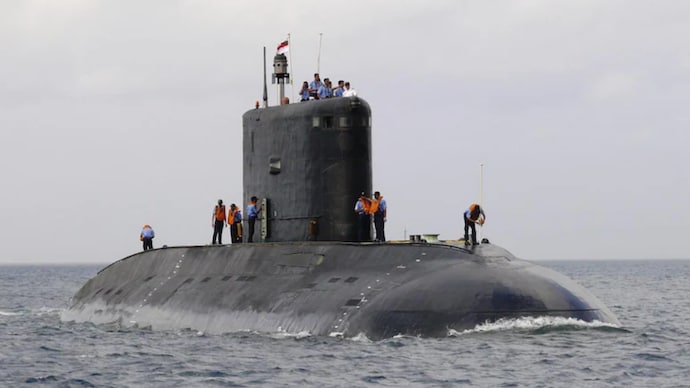
The Ministry of Defence issued the Request for Proposal (RFP) to domestically build indigenous submarines for the Navy at a cost of over Rs 40,000 crore.
 Last UpdatedJul 20, 2021 21:42 IST
 Published by
A long pending project of the Indian Navy for building of indigenous submarines is finally set to kick off as the Ministry of Defence has issued Request for Proposal (RFP) for its mega submarine programme.
The RFP was issued to shortlisted Strategic Partners (SPs) or Indian Applicant Companies for the project M/s Mazagaon Dock Shipbuilders Limited (MDL) and M/s Larsen & Tubro (L&T). The project cost is over Rs 40,000 crore, the defence ministry said.
This is the first acquisition programme under the Strategic Partnership Model for construction of six Conventional Submarines named Project-75 (India).
Read | Indian Navy receives first two 24 MH-60R helicopters from US
Last month, the decision to issue the RFP was taken in a meeting of the defence acquisition council chaired by Defence Minister Rajnath Singh on June 4.
The project had got a clearance from the Cabinet Committee on Security (CCS) way back in 1999 and acceptance of necessity granted in 2007.
The project is part of the strategic partnership model under which the two Indian companies will work with a foreign company and subsequently offer their bids.
The shortlisted strategic partners to whom the RFP has been issued would be collaborating with any of the shortlisted foreign manufacturers — M/s Naval Group-France, M/s TKMS-Germany, M/s JSC ROE-Russia, M/s Daewoo Shipbuilding and Marine Engineering Co Ltd-South Korea and M/s Navantia-Spain.
“These five foreign firms are the world leaders in the field of conventional submarine design, construction and all other related technologies,” the defence ministry said.
The foreign manufacturers will enable Indian strategic partners for construction of submarines, achieving high levels of indigenisation and transfer of technology (ToT). They would enable setting up of dedicated manufacturing lines for these submarines in India by providing ToT for submarine design and other technologies and make India the global hub for submarine design and production.
The project would not only aid in boosting the core submarine or ship building industry but would also greatly enhance manufacturing or industrial sector, especially the MSME by development of an industrial eco-system for manufacture of associated spares, systems and equipment related to submarines.
In order to achieve these objectives, the RFP has key features such as mandatory level of indigenous manufacture of platforms, ToT for design, manufacture and maintenance of submarines and a few critical equipment and systems, setting up of an eco-system in India for such indigenisation and incentivisation for other key technologies.
The strategic partnership model aims at promoting India as a manufacturing hub for defence equipment, in addition to establishing an industrial and R&D eco-system capable of meeting the future requirements of the Armed Forces besides giving boost to exports.
“The overall aim would be to progressively build indigenous capabilities in the public-private sector to design, develop and manufacture complex weapon systems for the future needs of the Armed Forces. This will be an important step towards meeting broader national objectives, encouraging self reliance and aligning the defence sector with the 'Make in India' initiative of the government,” the defence ministry said.
The Indian Navy currently has 12 submarines. In addition, there are two nuclear submarines INS Arihant and INS Chakra in the Indian Navy's fleet.
Upgrading its submarine operations and the naval fleet has been the top priority for the Indian Navy in wake of the increased presence of Chinese vessels in the Indian Ocean Region.
Under Project-75, another submarine programme, three of the six superior and advanced indigenous submarines based on the Scorpene-class category are now functional. These are INS Karanj, INS Kalvari and INS Khanderi.
While INS Vela is undergoing sea trials, INS Vagir was launched last year and the sixth one, INS Vagsheer, is under construction.
Also read | Two years of Operation Sankalp: Warships deployed in Gulf region for safe passage of merchant ships

Abhishek Bhalla is an Editor with India Today TV chasing news stories on defence, strategic affairs, security and conflict. His work takes him to military zones to report accurately on the ground realities. Working as a journalist since 2005, his experience spans working across platforms -- newspaper, magazine, broadcast and now trying new things on the digital space. In the past has extensively covered crime, investigationg agencies and courts.
Now based in Delhi, Abhishek is originally from Lucknow. He grew up in the Kumaon Hills of Nainital studying at a boarding school. He completed his graduation from Hansraj College, Delhi University with majors in History, following which he pursued a post graduate degree in Journalism Studies from Cardiff University, Wales, UK. Passionate about story telling Abhishek is always on the move. A keen sportsman, he looks out for a game of squash over weekends while also trying his hand at gourmet cooking.
READ MORE

Born in Pauri district of Uttarakhand, Manjeet Negi did his early schooling from his village school near Rishikesh and then moved to the town for secondary education. Later, he did his graduation from Hemavati Nandan Bahuguna University. In the year 2000, he did his journalism diploma from Kurukshetra University and started his career with Doordarshan News and started reporting on defence forces from the 2001 Bhuj earthquake. In his career as a defence correspondent, Negi has had the opportunity to report exclusives from world's highest battlefield Siachen Glacier in the north to the Andamans in the South and from the Rann of Kutch in the west to the Arunachal Pradesh border with China in the East.
A regular news-breaker on matters of national security and military affairs, Negi considers the coverage of he Kedarnath tragedy of 2013 as the highest point of his career. During the grave disaster at Kedarnath in June 2013, Manjeet Negi was the first and only TV reporter who walked for 55 Kms on the hilly track to reach the Kedarnath shrine. Spending his first night in the complex amidst several hundred dead bodies around him, Negi says he saw Lord Kedar in his dream. After the Kedarnath disaster, the writer got another opportunity to cover another disaster in the Nepal earthquake in 2015 for the Aaj Tak channel. During the reporting of that disaster for about 10 days, the writer got an opportunity to witness and report the large scale relief and rescue operations undertaken by the Indian Army and the Indian Air Force.
Besides reporting, he is also a skilled mountaineer. With Nehru Institute of Mountaineering and Garhwal Regiment, he has undertaken mountaineering expedition to Satopanth via Gomukh. Accompanying the Mount Manaslu mountaineering expedition of a Garhwal Regiment unit, he also reported about the expedition. He has also scaled the Dronagiri mountain near Joshimath in Uttarakhand. Manjeet Negi has also been honoured with a special award by the Union Home Minister, Shri Rajnath Singh for his reporting of Kedarnath disaster. He was awarded the best reporter award for his coverage of Nepal earthquake by India Today Group. At present, the writer has been working as Editor with Aajtak Channel of India Today Group.
READ MORE