
India-China military talks end after 14 hours: Chinese reluctant to retreat from Pangong fingers, say sources

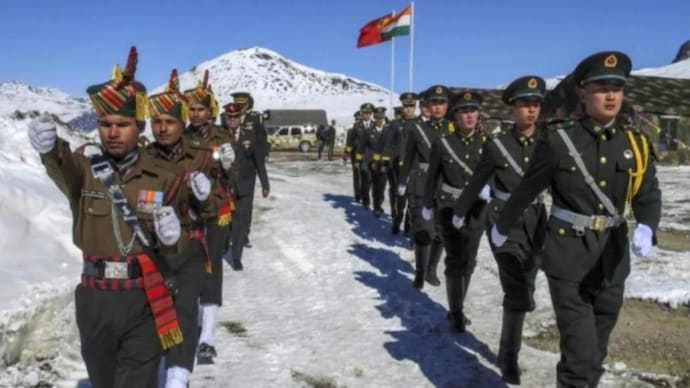
After a 14-hour long marathon meeting between Indian and Chinese military leader, the two sides have agreed to a total disengagement from all flashpoints along the Line of Actual Control. However, the Chinese seem reluctant to move back from the fingers.
 Last UpdatedJul 16, 2020 01:11 IST
 Published by
After a 14-hour marathon meeting between Indian and Chinese military leaders, the two sides agreed on total disengagement from all flashpoints along the Line of Actual Control (LAC) with the exception of finger area. This comes after more than two months of a bitter standoff between India and China along the LAC in eastern Ladakh.
Earlier, it was reported that both India and China have agreed on total disengagement but top sources in the government now tell India Today that the Chinese are showing reluctance in moving back completely out of the Pangong finger area. India, during the discussions, made it amply clear to China that anything short of complete retreat from both sides to their permanent locations Ante April-May, will be unacceptable. For now, both sides have decided to monitor and verify the disengagement process until July 21-22. Sources said Indian and Chinese commanders will verify mutual disengagement of frontline soldiers to ease tension.
The People’s Liberation Army (PLA) has apprehensions that after its withdrawal, India might use its vantage points to gain a tactical edge in and around patrolling points 17 and 17A. The Chinese troops have, however, begun dismantling their temporary structures from ‘black top’ and ‘green top’ and China has agreed to disengage on all the other friction points.
During his interaction with Chinese Foreign Minister Wang Yi, National Security Advisor (NSA) Ajit Doval had made it clear that both sides will have to move back to their permanent locations for resolution of the military buildup.
More rounds of talks are likely to be held for further de-escalation and ultimately de-induction of troops in the region, sources said, adding that the military talks are heading in a "positive direction".
Since early May, India and China have caught in a massive standoff at various places along the Line of Actual Control in eastern Ladakh. This resulted in massive military build-up on both sides, escalated tensions and soured relations.
The tensions rose further on June 15 when 20 Indian soldiers, including a Colonel-rank officer, were killed in a violent face-off with the Chinese troops in the strategically sensitive Galwan Valley. Though no bullet was fired, there were severe casualties on both sides. However, China is yet to revel details of its loss so far.
On Monday, India and China had the fourth round of Corps Commander-level meet to resolve the issue.
ALSO READ | After bloodshed, Army engineers toil 72 hours to finish Galwan bridge that triggered China
ALSO WATCH | Exclusive details of Ladakh face-off: Clubs wrapped in barbed wire, stones used to attack Indian soldiers
An alumnus of the St Stephen's College, Delhi University Gaurav C Sawant is Senior Executive Editor, India Today TV. Gaurav joined The Indian Express as a Trainee in 1994 and covered the Kargil conflict in 1999. He has authored a book: Dateline Kargil: A Correspondent's nine Week account from the BattleFront published by Macmillan. Gaurav has also written on the valour of the Param Vir Chakra awardees as part of he Veer Gatha series. Gaurav has been a part of the India Today Group since 2008. He has covered conflict in Iraq, Libya and Egypt and UN operations in Sierra Leone and Lebanon.
In December 2007 Gaurav was awarded `Wings'by the Indian Navy and has done 5 para jumps at INS DEGA at Vishakhapatanam. He has also done one assisted free fall and one tandem jump with the Indian Navy. Gaurav recently became the first journalist to reach Daulat Begh Oldie (DBO) in midst of the India China stand-off and reported on the 255 km long DS-DBO strategic road. Gaurav anchors India First weeknights 10 pm on India Today and Desh Ka Gaurav weeknights 8 pm on Tez.
READ MORE
Born in Pauri district of Uttarakhand, Manjeet Negi did his early schooling from his village school near Rishikesh and then moved to the town for secondary education. Later, he did his graduation from Hemavati Nandan Bahuguna University. In the year 2000, he did his journalism diploma from Kurukshetra University and started his career with Doordarshan News and started reporting on defence forces from the 2001 Bhuj earthquake. In his career as a defence correspondent, Negi has had the opportunity to report exclusives from world's highest battlefield Siachen Glacier in the north to the Andamans in the South and from the Rann of Kutch in the west to the Arunachal Pradesh border with China in the East.
A regular news-breaker on matters of national security and military affairs, Negi considers the coverage of he Kedarnath tragedy of 2013 as the highest point of his career. During the grave disaster at Kedarnath in June 2013, Manjeet Negi was the first and only TV reporter who walked for 55 Kms on the hilly track to reach the Kedarnath shrine. Spending his first night in the complex amidst several hundred dead bodies around him, Negi says he saw Lord Kedar in his dream. After the Kedarnath disaster, the writer got another opportunity to cover another disaster in the Nepal earthquake in 2015 for the Aaj Tak channel. During the reporting of that disaster for about 10 days, the writer got an opportunity to witness and report the large scale relief and rescue operations undertaken by the Indian Army and the Indian Air Force.
Besides reporting, he is also a skilled mountaineer. With Nehru Institute of Mountaineering and Garhwal Regiment, he has undertaken mountaineering expedition to Satopanth via Gomukh. Accompanying the Mount Manaslu mountaineering expedition of a Garhwal Regiment unit, he also reported about the expedition. He has also scaled the Dronagiri mountain near Joshimath in Uttarakhand. Manjeet Negi has also been honoured with a special award by the Union Home Minister, Shri Rajnath Singh for his reporting of Kedarnath disaster. He was awarded the best reporter award for his coverage of Nepal earthquake by India Today Group. At present, the writer has been working as Editor with Aajtak Channel of India Today Group.
READ MORE