
India gets third nuclear submarine with INS Aridhaman

INS Aridhaman is the third indigenous submarine inducted into the Navy and follows the earlier induction of INS Arihant (2016) and INS Arighaat (August 2024).
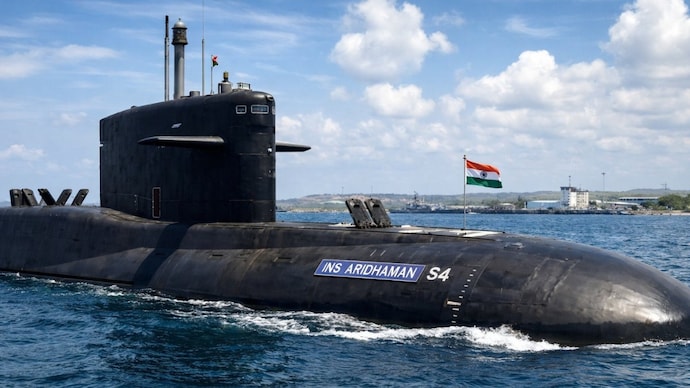


In a major boost to India’s strategic deterrence capabilities, Defence Minister Rajnath Singh on Friday commissioned the indigenously built nuclear-powered ballistic missile submarine (SSBN) INS Aridhaman into the Indian Navy.
The submarine, also known as S4, is the third in India’s indigenous SSBN programme and follows the earlier induction of INS Arihant (2016) and INS Arighaat (August 2024). Its commissioning marks a significant step in strengthening the naval leg of India’s nuclear triad — the ability to launch nuclear weapons from land, air and sea.
INS Aridhaman has completed its final phase of sea trials and is expected to join the Strategic Forces Command, which oversees India’s nuclear arsenal. The programme remains one of the country’s most closely guarded defence projects.
BIGGER, QUIETER, MORE LETHAL
At around 7,000 tonnes, INS Aridhaman is slightly larger than its predecessors and features a more streamlined hull designed to improve stealth and acoustic performance — a critical factor for underwater survivability.
The submarine is powered by an upgraded 83 MW pressurised water reactor (PWR) developed by the Bhabha Atomic Research Centre (BARC), underscoring India’s growing indigenous technological capability in nuclear propulsion.
A key upgrade lies in its firepower. Unlike earlier boats, INS Aridhaman is equipped with eight vertical launch tubes, doubling the missile capacity of INS Arihant. This allows it to carry either:
- Up to 8 K-4 ballistic missiles with a range of about 3,500 km, or
- As many as 24 K-15 missiles with a range of around 750 km
STRENGTHENING NUCLEAR DETERRENCE
The induction of INS Aridhaman is expected to significantly enhance India’s ability to maintain a “continuous at-sea deterrence” — ensuring that at least one nuclear-armed submarine remains on patrol at all times, a key element of credible nuclear deterrence.
India is among a select group of countries — including the US, Russia, the UK, France and China — that operate nuclear-powered submarines.
While India has already demonstrated land- and air-based nuclear capabilities, the expansion of its submarine fleet signals a clear focus on strengthening its underwater nuclear posture.
WHAT LIES AHEAD
The Navy is already working on the next submarine in the series, referred to as S4*, as well as the more advanced S5-class submarines, which are expected to be significantly larger, with an estimated displacement of around 14,000 tonnes.
The commissioning of INS Aridhaman comes amid a broader push towards defence self-reliance and indigenous military capability, reinforcing India’s position as an emerging maritime power in an increasingly complex security environment.

Born in Pauri district of Uttarakhand, Manjeet Negi did his early schooling from his village school near Rishikesh and then moved to the town for secondary education. Later, he did his graduation from Hemavati Nandan Bahuguna University. In the year 2000, he did his journalism diploma from Kurukshetra University and started his career with Doordarshan News and started reporting on defence forces from the 2001 Bhuj earthquake. In his career as a defence correspondent, Negi has had the opportunity to report exclusives from world's highest battlefield Siachen Glacier in the north to the Andamans in the South and from the Rann of Kutch in the west to the Arunachal Pradesh border with China in the East.
A regular news-breaker on matters of national security and military affairs, Negi considers the coverage of he Kedarnath tragedy of 2013 as the highest point of his career. During the grave disaster at Kedarnath in June 2013, Manjeet Negi was the first and only TV reporter who walked for 55 Kms on the hilly track to reach the Kedarnath shrine. Spending his first night in the complex amidst several hundred dead bodies around him, Negi says he saw Lord Kedar in his dream. After the Kedarnath disaster, the writer got another opportunity to cover another disaster in the Nepal earthquake in 2015 for the Aaj Tak channel. During the reporting of that disaster for about 10 days, the writer got an opportunity to witness and report the large scale relief and rescue operations undertaken by the Indian Army and the Indian Air Force.
Besides reporting, he is also a skilled mountaineer. With Nehru Institute of Mountaineering and Garhwal Regiment, he has undertaken mountaineering expedition to Satopanth via Gomukh. Accompanying the Mount Manaslu mountaineering expedition of a Garhwal Regiment unit, he also reported about the expedition. He has also scaled the Dronagiri mountain near Joshimath in Uttarakhand. Manjeet Negi has also been honoured with a special award by the Union Home Minister, Shri Rajnath Singh for his reporting of Kedarnath disaster. He was awarded the best reporter award for his coverage of Nepal earthquake by India Today Group. At present, the writer has been working as Editor with Aajtak Channel of India Today Group.
READ MORE