
Indian Navy signs contract with BEL for supply of anti-drone system

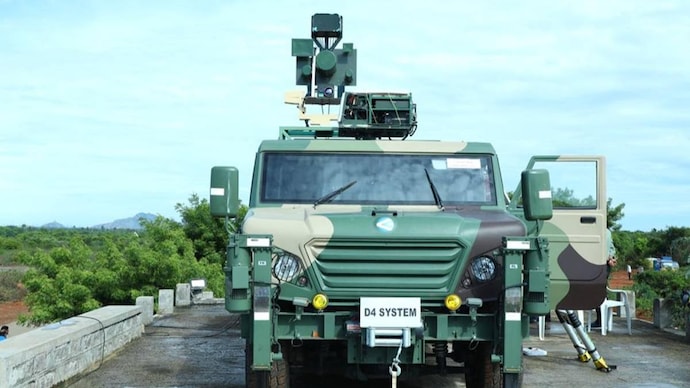
The indigenously developed Naval Anti Drone System by DRDO and manufactured by BEL will have both hard kill and soft kill capabilities.
 Last UpdatedSep 1, 2021 17:06 IST
 Published by
The Indian Navy has signed a contract with Navratna Defence public sector unit (PSU) Bharat Limited (BEL) for the supply of the first indigenous comprehensive Naval Anti Drone System (NADS), with both 'hard kill' and 'soft kill' capabilities.
The contract was signed in the presence of senior Naval officers and Defence Research and Development Organisation (DRDO) representatives in New Delhi on Tuesday, August 31. The Indian Navy has provided consistent support and has led in the joint development of the anti-drone system with DRDO and BEL.
The NADS, developed by DRDO and manufactured by BEL, is the first indigenously developed anti-drone system to be inducted into the Indian Armed Forces. Multiple units of BEL in Bangaluru, Hyderabad, Pune and Machilipatanam were involved in the making of this fully indigenous system.
The BEL units worked in collaboration with the Indian Navy and DRDO labs, namely Electronics & Radar Development Establishment (LRDE), Bangaluru; Defence Electronics Research Laboratory (DLRL) and Centre for High Energy Systems and Sciences (CHESS), Hyderabad and Instruments Research & Development Establishment (IRDE) Dehradun; in the making of this system.
The NADS can instantly detect and jam micro drones and use a laser-based kill mechanism to terminate targets. It will be an effective all-encompassing counter to the increased drone threat to strategic naval installations.
The anti-drone system was first deployed to provide security cover for the Republic Day Parade this year and later during Prime Minister Narendra Modi's Independence Day address from the ramparts of the Red Fort. The system, which offers 360-degree coverage, was also deployed in Ahmedabad for the Modi-Trump roadshow.
The NADS uses the help of radar, electro-optical/infrared (EO/IR) sensors and radio frequency (RF) detectors to detect and jam the micro drones. The DRDO’s RF/Global Navigation Satellite System (GNSS) detects the frequency which is being used by the controller and the signals are then jammed.
The anti-drone technology system of DRDO provides for both 'soft kill' and 'hard kill' options to the Indian Armed Forces to tackle fast-emerging aerial threats. Both the static and mobile versions of NADS will be supplied to the Indian Navy within a short time from the signing of the contract.
Also Read: Indian Navy’s procurement of amphibious ships revived after hitting dead end last year
Also Read: Indian Navy to take part in sea phase of Exercise Malabar 2021 from August 26 29

Born in Pauri district of Uttarakhand, Manjeet Negi did his early schooling from his village school near Rishikesh and then moved to the town for secondary education. Later, he did his graduation from Hemavati Nandan Bahuguna University. In the year 2000, he did his journalism diploma from Kurukshetra University and started his career with Doordarshan News and started reporting on defence forces from the 2001 Bhuj earthquake. In his career as a defence correspondent, Negi has had the opportunity to report exclusives from world's highest battlefield Siachen Glacier in the north to the Andamans in the South and from the Rann of Kutch in the west to the Arunachal Pradesh border with China in the East.
A regular news-breaker on matters of national security and military affairs, Negi considers the coverage of he Kedarnath tragedy of 2013 as the highest point of his career. During the grave disaster at Kedarnath in June 2013, Manjeet Negi was the first and only TV reporter who walked for 55 Kms on the hilly track to reach the Kedarnath shrine. Spending his first night in the complex amidst several hundred dead bodies around him, Negi says he saw Lord Kedar in his dream. After the Kedarnath disaster, the writer got another opportunity to cover another disaster in the Nepal earthquake in 2015 for the Aaj Tak channel. During the reporting of that disaster for about 10 days, the writer got an opportunity to witness and report the large scale relief and rescue operations undertaken by the Indian Army and the Indian Air Force.
Besides reporting, he is also a skilled mountaineer. With Nehru Institute of Mountaineering and Garhwal Regiment, he has undertaken mountaineering expedition to Satopanth via Gomukh. Accompanying the Mount Manaslu mountaineering expedition of a Garhwal Regiment unit, he also reported about the expedition. He has also scaled the Dronagiri mountain near Joshimath in Uttarakhand. Manjeet Negi has also been honoured with a special award by the Union Home Minister, Shri Rajnath Singh for his reporting of Kedarnath disaster. He was awarded the best reporter award for his coverage of Nepal earthquake by India Today Group. At present, the writer has been working as Editor with Aajtak Channel of India Today Group.
READ MORE