
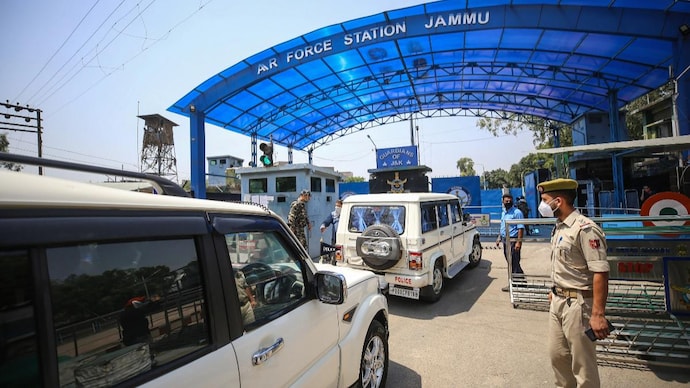
Jammu air base attack: Agencies suspect terrorists launched drones from close proximity

According to agencies, the two drones that had launched an attack on the Jammu air base, were flown from a close range.
 Last UpdatedJun 27, 2021 20:23 IST
 Published by
In the initial probe by security agencies, it is suspected that the terrorists launched the drones from close proximity to the air base.
The drones used in the attack by terrorists are small quadcopters and it is possible that they took off from close proximity to attack the air base using improvised explosives, sources told India Today TV.
The investigations in the incident are still going on and more details would emerge once they are completed, they said. Multiple agencies have been involved even as all the air bases have been put on high alert to prevent any such possible attempt by terrorists.
ALSO READ: Twin explosions rock Air Force-operated area of Jammu airport | Highlights
Two drones were used to carry out an attack inside the Air Force base in Jammu on Sunday, sources said.
"There is no damage to any aircraft in the blasts. Two personnel suffered minor injuries," they added. Meanwhile, the Indian Air Force (IAF) informed us that two low-intensity explosions took place in the technical area of Jammu Air Force Station.
One of the blasts caused minor damage to the roof of a building while the other exploded in an open area. There was no damage to any equipment, the IAF said. An investigation into the matter is in progress along with civil agencies, it added.
LOW INTENSITY EXPLOSIONS
"Two low intensity explosions were reported early Sunday morning in the technical area of Jammu Air Force Station. One caused minor damage to the roof of a building while the other exploded in an open area. There was no damage to any equipment. Investigation is in progress along with civil agencies," the official Twitter handle of the Indian Air Force tweeted on Sunday morning.
ALSO READ: In a first, drones used to drop explosives on Jammu air base
The first blast ripped off the roof of a building at 1:37 am while the second one was on the ground at 1:42 am. The area was cordoned off by security forces within minutes.
NO CASUALTIES, MINOR INJURIES
There were no casualties in the incident. Two Indian Air Force personnel suffered minor injuries. They did not require hospitalisation and are out of danger.
The two soldiers are under observation of the Air Force medical authorities and are doing fine, IAF officials said.
THE DRONE ATTACK
It is suspected that low-flying drones were used to drop the two improvised explosive devices (IED). This is probably the first drone attack on any defence establishment in the country. An IAF patrol team saw the ammunition being dropped, sources said.
"Use of drone with payload in both the blasts at Jammu airfield suspected to drop the explosive material. Police have registered an FIR and an investigation is on," DGP Dilbagh Singh said, adding that the drone was operated by site near the scene of the attack.
ALSO READ: Jammu air base blast: Initial probe hints at drone attack, helicopters possible targets
Sources in the security establishment told India Today TV that no remnants of the drone were found at the blast site. Only splinters and remnants of explosives used in the blast have been recovered as of yet.
The drone was used only to drop the IEDs. Once the payload was dropped, the drone returned to wherever it came from, sources added.
Moreover, security agencies say news reports suggesting that the drone itself was an IED, are incorrect.

Born in Pauri district of Uttarakhand, Manjeet Negi did his early schooling from his village school near Rishikesh and then moved to the town for secondary education. Later, he did his graduation from Hemavati Nandan Bahuguna University. In the year 2000, he did his journalism diploma from Kurukshetra University and started his career with Doordarshan News and started reporting on defence forces from the 2001 Bhuj earthquake. In his career as a defence correspondent, Negi has had the opportunity to report exclusives from world's highest battlefield Siachen Glacier in the north to the Andamans in the South and from the Rann of Kutch in the west to the Arunachal Pradesh border with China in the East.
A regular news-breaker on matters of national security and military affairs, Negi considers the coverage of he Kedarnath tragedy of 2013 as the highest point of his career. During the grave disaster at Kedarnath in June 2013, Manjeet Negi was the first and only TV reporter who walked for 55 Kms on the hilly track to reach the Kedarnath shrine. Spending his first night in the complex amidst several hundred dead bodies around him, Negi says he saw Lord Kedar in his dream. After the Kedarnath disaster, the writer got another opportunity to cover another disaster in the Nepal earthquake in 2015 for the Aaj Tak channel. During the reporting of that disaster for about 10 days, the writer got an opportunity to witness and report the large scale relief and rescue operations undertaken by the Indian Army and the Indian Air Force.
Besides reporting, he is also a skilled mountaineer. With Nehru Institute of Mountaineering and Garhwal Regiment, he has undertaken mountaineering expedition to Satopanth via Gomukh. Accompanying the Mount Manaslu mountaineering expedition of a Garhwal Regiment unit, he also reported about the expedition. He has also scaled the Dronagiri mountain near Joshimath in Uttarakhand. Manjeet Negi has also been honoured with a special award by the Union Home Minister, Shri Rajnath Singh for his reporting of Kedarnath disaster. He was awarded the best reporter award for his coverage of Nepal earthquake by India Today Group. At present, the writer has been working as Editor with Aajtak Channel of India Today Group.
READ MORE