
Lake formation near Rishiganga could pose new threat, satellite images show

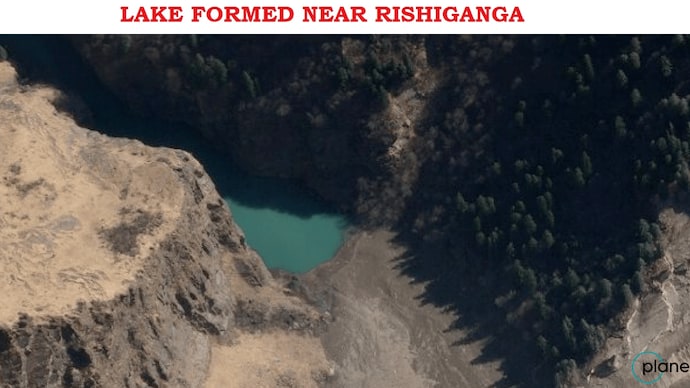
The existence of the lake which was formed due to the accumulation of debris carried by Rishiganga was later confirmed through high-resolution satellite images. Experts have said there is a possibility that some changes are still going on in the upper reaches.
 Last UpdatedFeb 13, 2021 00:36 IST
 Published by
Even as Uttarakhand's Chamoli is recovering from the tragedy caused by the devastating flash floods, there could be another disaster waiting to happen. First identified by local villagers and Dr Naresh Rana, a geologist at the Garhwal University, the lake poses a serious threat to the ongoing rescue operation as it could lead to another flash flood in the area.
The existence of the lake which was formed due to the accumulation of debris carried by Rishiganga was later confirmed through high-resolution satellite images. Experts have said there is a possibility that some changes are still going on in the upper reaches.
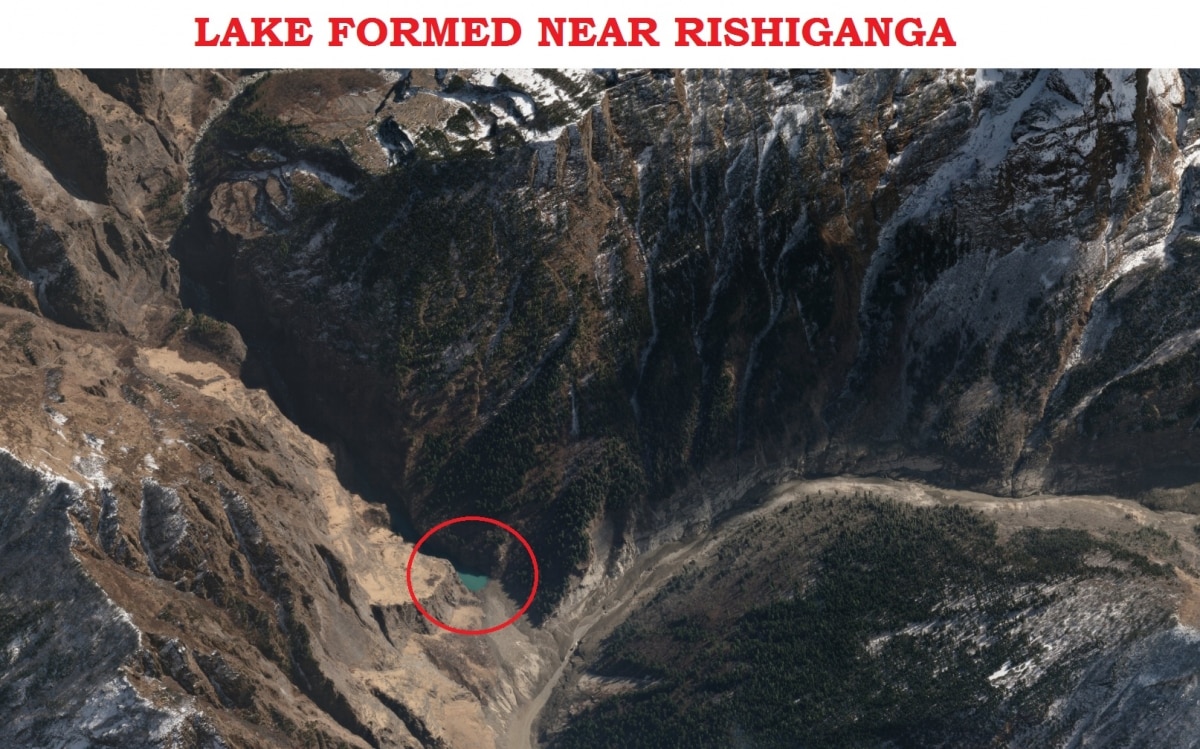
India Today accessed a satellite image from 2015 which confirms that there was no lake in the area.

Another set of high-resolution satellite imagery captured from another angle shows the portion created by silting which has blocked the river stream, leading to a sudden formation of the blue-coloured lake.

On February 7, flash floods triggered by a probable landslide in the higher reaches of the Himalayas led to massive destruction of life and property, including the National Thermal Power Corporation (NTPC) power plant at Chamoli's Tapovan area. As many as 38 bodies have been recovered so far and around 170 people are still missing. Rescue operation at the Tapovan tunnel is underway to rescue the 35 people trapped inside the tunnel.
According to the Central Water Commission, the lake formed on river Rishiganga has a length of 350m and height of 60m with a slope of 10 degrees.
An artificial Lake has formed on river #Rishiganga in #Chamoli Dist #Uttarakhand with length of 350 m height of 60 m with slope of 10deg. Video showing the lakse is uploaded. pic.twitter.com/nNRzVrExlX— Central Water Commission Official Flood Forecast (@CWCOfficial_FF) February 12, 2021
Dr Naresh Rana, who was present at the site where this lake is formed, in a 2.11-minute video showed the way from where the flood emerged. He added that the villagers were able to identify the place from where the landslide occurred because they have seen it before.
Dr Rana further explained that the flood created a temporarily dam, leading to the blockage of the Rishiganga river. He said the blue-coloured lake is visible, and it is clear that the water has been collecting for some time now. “One thing is clear that the Rishiganga river is blocked. In the future, if it breaks down again, there could be floods, and the people involved in the rescue operation could also suffer. The people of Raini village in the Tapovan area of Chamoli are already deeply affected by the disaster,” Dr Rana added.
Uttarakhand Chief Minister Trivendra Singh Rawat on Friday said the government is also using satellite imagery to monitor the formation of the lake. "It is almost 400m in length, but its depth is not known. The silt carried by Rishiganga is almost 12m high, but it is not clear how much water the lake contains."
The chief minister also confirmed that a team of scientists is being sent by chopper to survey the lake and attempts are also being made to drop a team. "The Air Force is ready, but we will have to see if we have trained people for this. Once we find trained people, we will drop them to assess the situation and report back," he said.
He further added that "we need to be aware but there is no cause for panic."
Disaster Management Secretary (Incharge) SA Murugesan has written to different agencies, asking them to investigate the flood. He told the agencies that a report should be made available after the investigation. On Thursday, relief and rescue operations had to be stopped after rising water in the river made it difficult for rescuers to go any further.
Murugesan said so far it seems that the lake is formed after Sunday's disaster. "How big the lake is, how dangerous it can be, and other questions can only be answered after an investigation report is received," he added.
ALSO READ: Divine punishment? Raini village elders blame removal of temple for Chamoli tragedy
Ankit Kumar (a.k.a. Ankiit Koomar) – Editor, Open-Source Investigations, India Today TV & Aaj Tak
Ankit Kumar is the Editor of Open-Source Investigations (OSINT) and Visual Investigations at India Today TV and Aaj Tak. A two-time JournalismAI fellow with the London School of Economics (LSE), Ankit’s work lies at the intersection of investigative journalism and emerging digital tools as well as use of Artificial Intelligence (AI) in journalism. He has pioneered South Asia’s first dedicated OSINT journalism team, bringing cutting-edge technology into the newsroom.
His investigative reports have made national headlines and even been debated in the Indian Parliament. He was the first journalist to uncover the common link between middlemen networks in two of India’s most controversial defence deals—the VVIP AgustaWestland Chopper Deal and the Rafale Jet Deal . His reports have been frequently cited by both the Prime Minister and opposition leaders, shaping public discourse on key national security matters.
Ankit’s deep-dive investigation into the Indian Air Force’s Balakot Airstrikes was the first to feature key eyewitness accounts from the ground.
Following his report, a UK-based dubious news portal that propagated false claims of large-scale EVM fraud in India was shut down. His stories cover a wide spectrum—from finance, business, and cybersecurity to disinformation, artificial intelligence (AI), and emerging global threats.
His work has been recognized globally, with the Global Investigative Journalism Network (GIJN) listing his reporting among the year’s top investigative stories.
🔹 Connect with him: @AnkiitKoomar on X / LinkedIn
📩 Email: [email protected]
READ MORE

Born in Pauri district of Uttarakhand, Manjeet Negi did his early schooling from his village school near Rishikesh and then moved to the town for secondary education. Later, he did his graduation from Hemavati Nandan Bahuguna University. In the year 2000, he did his journalism diploma from Kurukshetra University and started his career with Doordarshan News and started reporting on defence forces from the 2001 Bhuj earthquake. In his career as a defence correspondent, Negi has had the opportunity to report exclusives from world's highest battlefield Siachen Glacier in the north to the Andamans in the South and from the Rann of Kutch in the west to the Arunachal Pradesh border with China in the East.
A regular news-breaker on matters of national security and military affairs, Negi considers the coverage of he Kedarnath tragedy of 2013 as the highest point of his career. During the grave disaster at Kedarnath in June 2013, Manjeet Negi was the first and only TV reporter who walked for 55 Kms on the hilly track to reach the Kedarnath shrine. Spending his first night in the complex amidst several hundred dead bodies around him, Negi says he saw Lord Kedar in his dream. After the Kedarnath disaster, the writer got another opportunity to cover another disaster in the Nepal earthquake in 2015 for the Aaj Tak channel. During the reporting of that disaster for about 10 days, the writer got an opportunity to witness and report the large scale relief and rescue operations undertaken by the Indian Army and the Indian Air Force.
Besides reporting, he is also a skilled mountaineer. With Nehru Institute of Mountaineering and Garhwal Regiment, he has undertaken mountaineering expedition to Satopanth via Gomukh. Accompanying the Mount Manaslu mountaineering expedition of a Garhwal Regiment unit, he also reported about the expedition. He has also scaled the Dronagiri mountain near Joshimath in Uttarakhand. Manjeet Negi has also been honoured with a special award by the Union Home Minister, Shri Rajnath Singh for his reporting of Kedarnath disaster. He was awarded the best reporter award for his coverage of Nepal earthquake by India Today Group. At present, the writer has been working as Editor with Aajtak Channel of India Today Group.
READ MORE