Modi-Xi meet may speed up India-China thaw, but border remains key test: Ex-envoy

Speaking at an India Today BRICS Roundtable, former Indian Ambassador to China Ashok Kantha said the PM Modi-Xi Jinping meeting could result in "some signalling" that the ongoing process of rebuilding bilateral ties will be accelerated.
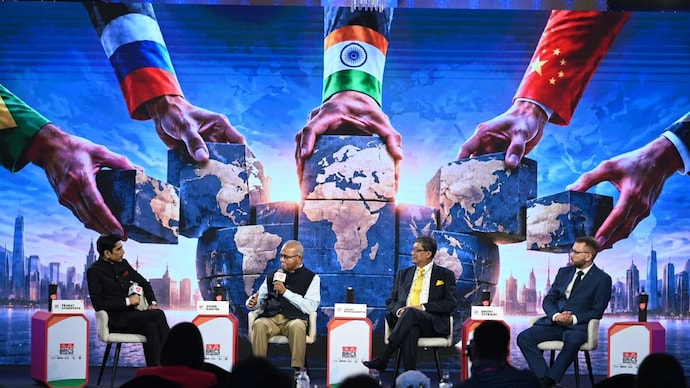

Chinese President Xi Jinping's upcoming meeting with Prime Minister Narendra Modi in New Delhi could accelerate the gradual rebuilding of India-China ties, but progress along the Line of Actual Control (LAC) will remain the key test of whether relations can return to normal, former Indian Ambassador to China Ashok Kantha said.
Xi is set to arrive in New Delhi on Saturday for the BRICS Summit, where he is expected to meet Modi for the first time on Indian soil since the 2020 Galwan Valley clash.
Speaking at an India Today BRICS Roundtable on Thursday, Kantha said the meeting could result in "some signalling" that the ongoing process of rebuilding bilateral ties will be accelerated.
Kantha said India-China relations have been gradually recovering since Modi and Xi met in Kazan in October 2024, following years of tensions triggered by the military standoff in eastern Ladakh.
"We are nowhere close to a reset in ties," he said, adding that the focus so far has been on people-centric contacts and that greater emphasis could now be placed on economic engagement.
China is India's largest trading partner, but the growing trade imbalance remains a major concern. According to Chinese statistics cited by Kantha, China's trade surplus with India stood at USD 116 billion last year.
He said investment flows, China's tighter regime for outward direct investment and technology transfer are among the issues that need to be discussed upfront.
BORDER REMAINS THE BIG TEST
On the security front, Kantha said India is looking for an "early and substantial harvest" in efforts to address the 3,488-km LAC.
He said a limited agreement confined to the Sikkim sector would be of little interest to India, adding that New Delhi wants progress covering Sikkim, the Middle Sector and the highest watershed principle.
While the border is currently stable, Kantha stressed that it is "not normal" yet.
He reiterated India's position that the "state of borders" determines the "state of relations", saying ties cannot become fully normal unless peace and tranquillity prevail along the frontier.
BHATTACHARYA ON BRICS' BIGGER ROLE
Former BRICS Sherpa Sanjay Bhattacharya said bilateral disputes generally do not form part of the BRICS agenda, but India-China tensions have been an exception, with diplomatic mechanisms helping the grouping survive despite the strains between the two countries.
Bhattacharyya said India sees the grouping as a platform for greater cooperation on resilience, innovation, technology sharing and sustainable economic growth.
He said BRICS has grown significantly since its formation and can play a larger role in global governance reform. Despite internal differences within the expanded 11-member bloc, India has sought to give the grouping a more contemporary, issue-based agenda with a focus on tangible economic outcomes.
RUSSIA-INDIA TRADE SHIFTS TO LOCAL CURRENCIES
Dmitry Sotnikov, Deputy CEO of Russian bank VTB, highlighted the rapid expansion of local currency settlements between India and Russia, with bilateral trade turnover crossing Rs 500 billion.
He stressed that reliable financial infrastructure and workable payment mechanisms matter more than symbolic declarations as BRICS countries explore alternatives to traditional international payment systems. The discussion also examined the challenges posed by differing interests within the expanded bloc and its evolving relationship with Western financial institutions.