
NSA Ajit Doval calls for seamless coordination among maritime security agencies

National Security Advisor Ajit Doval on Thursday called for seamless coordination among maritime security agencies.
 Last UpdatedJul 1, 2022 03:33 IST
 Published by
National Security Advisor Ajit Doval on Thursday called for seamless coordination among various agencies involved in protecting India's maritime interests in the face of emerging security challenges and increasing rivalries and competition in the Indian Ocean.
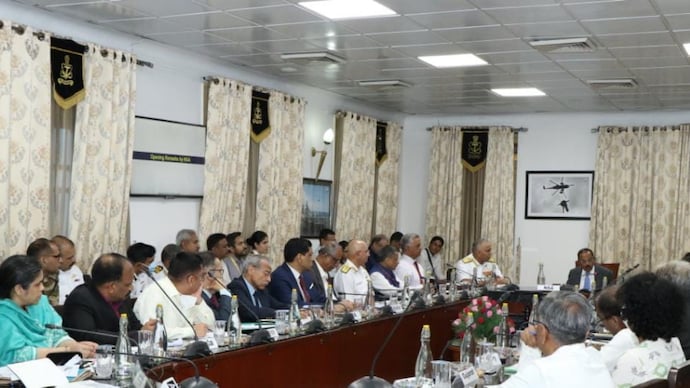
In his address at the first-ever meeting of the Multi Agency Maritime Security Group (MAMSG), Doval said there must be common protocols, standard operating procedures and operational framework among various stakeholders, noting that India will not be able to become the power it deserves to be in the absence of a very strong maritime security apparatus.
India's security planners have consistently been pressing for a coordinated approach in dealing with maritime security challenges following the 26/11 Mumbai terror attacks 14 years ago when a group of sea-borne terrorists struck at the heart of the country's financial capital.
Doval said the National Maritime Security Coordinator (NMSC) should be the focal point to bring in synergy in the maritime security domain and galvanise coordination in various aspects including operational matters.
In the context of a changing geopolitical scenario, Doval said that the Indian Ocean, which has been an "ocean of peace", is witnessing increasing rivalries and competitions and India needs to protect its interests as the region has the potential to witness clash of interests.
His comments came amid growing concerns over China's increasing forays into the Indian Ocean, considered the backyard of the Indian Navy.
The meeting was chaired by Vice Admiral G Ashok Kumar (Retd), the country's first National Maritime Security Coordinator (NMSC), a post created with a mandate to ensure coordination among various key stakeholders with an overall objective to strengthen the country's maritime security.
The meeting was attended by top maritime and coastal security brass from all 13 coastal states and Union territories as well as the Indian Navy and other central agencies.
Doval said security at the high seas and economic wellbeing is inextricably linked and all stakeholders must work unitedly.
"The trajectory of this nation is well defined. We know where we are going. Our time will come...We as a nation have to be strong. India will not be able to become the power it deserves to be unless it has a very strong maritime system," Doval said.
Describing the Indian ocean as a "great asset" for India, Doval said the country's vulnerabilities are directly proportional to its assets and that India's responsibility as a premier maritime power is extremely important.
"More we develop, the more assets we create, the more prosperous we get, the greater would be the vulnerability and the need for security in the maritime domain," he said.
In national security discourse, the importance of land and maritime borders are very different, Doval said, adding one cannot fence the maritime borders and that the disputes in seas are resolved under the framework of international laws while land disputes are bilateral in nature.
"Conventional borders had their pre-eminence because wars were fought on land borders, but maritime and land borders are different. Maritime borders cannot be fenced..We can't have the concept of zero percent tolerance for intrusion. So, we need to have technology and other ways to counter this," he said.
He also said denying accessibility to foreign intelligence agencies looking to undertake espionage activities is a major challenge.
Doval referred to initiatives like the Colombo security conclave for cooperation among like-minded countries in the maritime domain and that it could be expanded further.
"Our responsibility as a premier maritime power is extremely important," he said.
"In the changing geopolitical scenario, the Indian Ocean, which has been an ocean of peace, is gradually becoming competitive. We see a potential for having a clash of interests, we need to protect it and be vigilant," he said.
In his remarks, Doval referred to the 26/11 Mumbai attack while underlining the importance of the National Maritime Security Coordinator (NMSC).
He said the standard operating procedures need to be built and all the stakeholders and agencies need to speak the same language in dealing with maritime security challenges.
There is a requirement for a common operational picture, coordination has to be in an actionable fashion, Doval said, noting that "access to the data banks that we have at various levels is very important".
"A well-integrated system is needed. From the beat constable to the officers at the national level, everyone has a critical role to play. Any lapse anywhere can be a problem," he said.
There is a requirement for standardisation of protocols, SOPs, which need to be made through consensus. The NMSC's doors will always be open for each one of you, he noted.
Doval also said that India has certain responsibilities towards its maritime neighbours in areas of disaster management and security.
In a major decision to reform coordination of maritime security affairs at the apex level, the Union Cabinet in November last year approved the creation of the post of NMSC under the NSA.
With this decision, a longstanding recommendation of the 2001 Group of Ministers (GOM) report on 'Reforming the National Security System' was implemented.
Kumar assumed charge as the country's first NMSC on February 16.
The MAMSG is envisaged to provide a standing and effective mechanism to ensure coordination of all aspects of maritime security including coastal and offshore security, as well as fill the institutional, policy, technological and operational gaps in meeting present and future security challenges. The group will also address maritime contingencies requiring an urgent and coordinated response, officials said.

Born in Pauri district of Uttarakhand, Manjeet Negi did his early schooling from his village school near Rishikesh and then moved to the town for secondary education. Later, he did his graduation from Hemavati Nandan Bahuguna University. In the year 2000, he did his journalism diploma from Kurukshetra University and started his career with Doordarshan News and started reporting on defence forces from the 2001 Bhuj earthquake. In his career as a defence correspondent, Negi has had the opportunity to report exclusives from world's highest battlefield Siachen Glacier in the north to the Andamans in the South and from the Rann of Kutch in the west to the Arunachal Pradesh border with China in the East.
A regular news-breaker on matters of national security and military affairs, Negi considers the coverage of he Kedarnath tragedy of 2013 as the highest point of his career. During the grave disaster at Kedarnath in June 2013, Manjeet Negi was the first and only TV reporter who walked for 55 Kms on the hilly track to reach the Kedarnath shrine. Spending his first night in the complex amidst several hundred dead bodies around him, Negi says he saw Lord Kedar in his dream. After the Kedarnath disaster, the writer got another opportunity to cover another disaster in the Nepal earthquake in 2015 for the Aaj Tak channel. During the reporting of that disaster for about 10 days, the writer got an opportunity to witness and report the large scale relief and rescue operations undertaken by the Indian Army and the Indian Air Force.
Besides reporting, he is also a skilled mountaineer. With Nehru Institute of Mountaineering and Garhwal Regiment, he has undertaken mountaineering expedition to Satopanth via Gomukh. Accompanying the Mount Manaslu mountaineering expedition of a Garhwal Regiment unit, he also reported about the expedition. He has also scaled the Dronagiri mountain near Joshimath in Uttarakhand. Manjeet Negi has also been honoured with a special award by the Union Home Minister, Shri Rajnath Singh for his reporting of Kedarnath disaster. He was awarded the best reporter award for his coverage of Nepal earthquake by India Today Group. At present, the writer has been working as Editor with Aajtak Channel of India Today Group.
READ MORE