
Voter IDs, Candyland chocolates, GPS: Trail of Pahalgam terrorists leads to Pak

Findings drawn from the post-encounter evidence released by security agencies establish beyond doubt that the Pahalgam terrorists were from Pakistan.
 Last UpdatedAug 4, 2025 13:02 IST
 Published byWritten ByAbhishek De
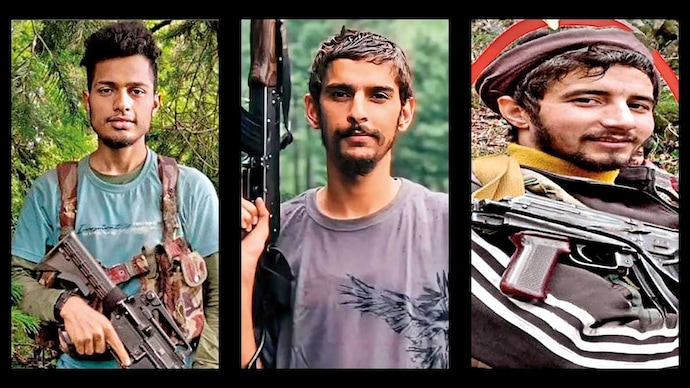
Recovery of Pakistani voter ID cards, Karachi-manufactured chocolates, and a micro-SD chip containing biometric records established that the three Lashkar terrorists killed on July 28 in Operation Mahadev were from Pakistan.
Moreover, ballistic analysis of shell casings found in the Pahalgam attack site also matched the striation marks on the AK-47 rifles seized from the terrorists, leaving no doubt that the trio were behind the April 22 massacre that left 26 civilians dead.
The findings were drawn from the post-encounter evidence released by security agencies recently.
VOTER ID CARDS, MICRO SD NAIL PAK LINK
Nearly three months after the Pahalgam attack, security forces eliminated the terror trio on July 28 in the Dachigam area of Srinagar in Operation Mahadev.
The report released by the security agencies identified Suleman Shah as the mastermind of the Pahalgam attack and lead shooter. Abu Hamza "Afghani" was the second gunman while Yasir, alias Jibran, was the third shooter.
Two laminated voter ID slips issued by the Election Commission of Pakistan were recovered from the bodies of Suleman Shah and Abu Hamza.
The voter serial numbers have been found on the electoral rolls in Lahore (NA-125) and Gujranwala (NA-79) respectively.
In a further technological breakthrough, a micro-SD card recovered from a damaged satellite phone contained the NADRA (Pakistan's national citizen registry) biometric records of all the three men, confirming their Pakistani citizenship.
The recovered data included fingerprints, facial templates, and family tree records. Their registered addresses are in Changa Manga (Kasur District) and Koiyan village near Rawalakot, Pakistan-occupied Kashmir (POK).
Moreover, wrappers of 'Candyland' and 'Chocomax' chocolates (both brands produced in Karachi) were found in the belongings of the slain terrorists, further establishing their Pakistani links.
LINK TO PAHALGAM ATTACK
Forensic and ballistic analysis further confirmed that the trio were the terrorists who went on a rampage on April 22, killing innocent tourists who were picnicking and enjoying the beauty of the picturesque Baisaran Valley.
Analysis of the 7.62x39 mm shell casings found at the Baisaran attack site matched the striation marks on the three AK-47rifles seized from the terrorists.
Moreover, mitochondrial profiles extracted from blood found on a torn shirt in Pahalgam were identical to the DNA of the three bodies recovered in Dachigam.
INFILTRATION TIMELINE
The movement of the terrorists has also been traced by the intelligence agencies. The trio crossed the Line of Control (LoC) near Gurez sector way back in May 2022. This was confirmed after intelligence agencies intercepted their first radio check-in from the Pakistani side.
On April 21, 2025, the terrorists moved into a seasonal hut (known in local parlance as dhok) at Hill Park, which is 2 km from Baisaran.
This was corroborated by the two Kashmiri locals, Parvaiz and Bashir Ahmad, who confessed to sheltering them overnight and providing cooked meals.
On April 22, the terrorists trekked to the Baisaran meadow, where they carried out the attack at 2.30 pm before fleeing northeast towards the dense forest of Dachigam.
The GPS coordinates recovered from Suleman Shah's Garmin watch match the exact firing positions reported by eyewitnesses.

Born in Pauri district of Uttarakhand, Manjeet Negi did his early schooling from his village school near Rishikesh and then moved to the town for secondary education. Later, he did his graduation from Hemavati Nandan Bahuguna University. In the year 2000, he did his journalism diploma from Kurukshetra University and started his career with Doordarshan News and started reporting on defence forces from the 2001 Bhuj earthquake. In his career as a defence correspondent, Negi has had the opportunity to report exclusives from world's highest battlefield Siachen Glacier in the north to the Andamans in the South and from the Rann of Kutch in the west to the Arunachal Pradesh border with China in the East.
A regular news-breaker on matters of national security and military affairs, Negi considers the coverage of he Kedarnath tragedy of 2013 as the highest point of his career. During the grave disaster at Kedarnath in June 2013, Manjeet Negi was the first and only TV reporter who walked for 55 Kms on the hilly track to reach the Kedarnath shrine. Spending his first night in the complex amidst several hundred dead bodies around him, Negi says he saw Lord Kedar in his dream. After the Kedarnath disaster, the writer got another opportunity to cover another disaster in the Nepal earthquake in 2015 for the Aaj Tak channel. During the reporting of that disaster for about 10 days, the writer got an opportunity to witness and report the large scale relief and rescue operations undertaken by the Indian Army and the Indian Air Force.
Besides reporting, he is also a skilled mountaineer. With Nehru Institute of Mountaineering and Garhwal Regiment, he has undertaken mountaineering expedition to Satopanth via Gomukh. Accompanying the Mount Manaslu mountaineering expedition of a Garhwal Regiment unit, he also reported about the expedition. He has also scaled the Dronagiri mountain near Joshimath in Uttarakhand. Manjeet Negi has also been honoured with a special award by the Union Home Minister, Shri Rajnath Singh for his reporting of Kedarnath disaster. He was awarded the best reporter award for his coverage of Nepal earthquake by India Today Group. At present, the writer has been working as Editor with Aajtak Channel of India Today Group.
READ MORE