
Uri attack: An inside story of how it happened

Army recovered a map from slain terrorists on which markings were made in Pashtun language leaving no doubt that they were trained in Pakistan and sent across the LoC to launch suicide attacks.
 Last UpdatedSep 19, 2016 09:43 IST
 Published by
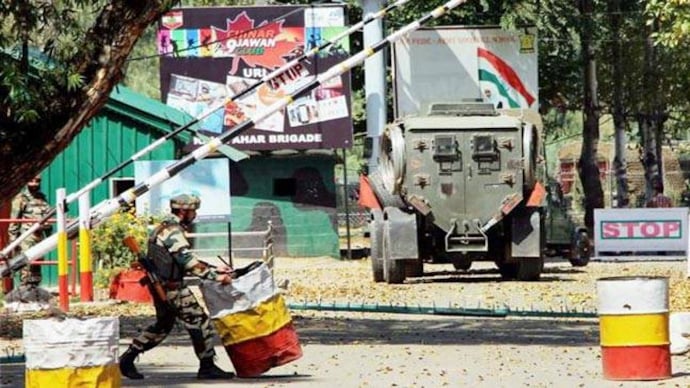
Four terrorists attacked 12th Brigade of the army in Uri sector on Sunday. At around 5.15 am, terrorists attacked the administrative block of the army. Unarmed soldiers were there, refilling diesel in barrels from fuel tanks.
Springing a surprise, terrorists lobbed 17 grenades in 3 minutes. This caused a massive fire in the barracks and tents in about 150-metre radius, where 13 jawans were burnt alive instantaneously. Many others received severe burns.

SEE PICS: Combing operations in Uri post fidayeen attack
ALSO READ | Those behind 'cowardly' Uri terror attack won't go unpunished, says PM Modi
Four jawans succumbed to their injuries later in army hospital. After the six-hour gun-battle all the four terrorists were eliminated. More than 20 jawans were injured, who were sent to hospital for treatment.

This was the biggest terrorist attack on an army camp in 26 years.
PASHTUN SPEAKING TERRORISTS
The army recovered a map from the slain terrorists revealing their detailed plan of action. The map was elaborately marked and locations were indicated in Pashtun language.
Pashtun is one the tribal languages spoken in Pakistan.
TERRORISTS HAD THEIR HOMEWORK DONE
The timing of the attack shows that the terrorists had good idea about the routine of the army camp. The fidayeens launched the attack when battalions were changing duty.
ALSO READ | 17 jawans killed, all LeT terrorists dead; Army Chief reaches Srinagar
Sources said that the terrorists' original plan was to kill unarmed troops, storm Medical Aid Unit near Brigade Administration Area. And, then they planned to explode themselves after entering officers' mess.

HOW TERRORISTS WERE NEUTRALISED
The moment diesel dump exploded due to smog and subsequent explosion militants got disoriented and headed straight towards soldiers' barracks.
One militant was gunned down by a 19-year-old Dogra soldier, who also challenged the remaining three militants. The soldier also sustained severe head injury, when a bullet hit his Helmet. He was later evacuated by his colleagues.
Since the barracks were empty, militants took defensive position inside the barracks on the second floor, which has 16 rooms. They kept firing from the barracks till four Para-commandoes stormed the building and killed the three terrorists.
JAISH-E-MOHAMMED BEHIND ATTACK
Briefing about the terror attack on the army camp in Uri, Director General of Military Operations Lt General Ranbir Singh said that all the four killed were foreign terrorists. The slain terrorists had some items, which had Pakistani markings.
Initial reports indicate that the slain terrorists belong to Jaish-e-Mohammed tanzeem, said the DGMO. Four AK-47 rifles and four Under Barrel Grenade Launchers along with a large number of other war like ammunitions were recovered from them.

DGMO SPEAKS TO HIS COUNTERPART
Since, the terrorists had some items with Pakistani markings, Lt General Singh said that he spoke to Pakistan's DGMO and conveyed "our serious concerns" on the matter.
Defence minister Manohar Parrikar visited Srinagar and met injured jawans in the hospital. Meanwhile, the Army chief General Dalbir Singh visited the site of operation to take an 'on the ground' assessment of the situation.
PAKISTAN'S DGMO DENIES INDIA'S CLAIMS
In the backdrop of Uri terrorist attack, Director General of Military Operations (DGMO) Lt Gen Ranbir Singh established hotline contact with his Pakistani counterpart on Sunday afternoon and conveyed India's serious concerns on the issue.
However, Pakistan DGMO termed India's claim as "unfounded and pre-mature". He also reiterated that no infiltration is allowed from Pakistani soil and water tight arrangements were in place on both sides of the LoC. On the other hand, the Pakistan DGMO asked Singh to share with him actionable intelligence.
ALSO READ:
EXCLUSIVE | Uri attack: There was specific intelligence inputs; IB alerted army units on Thursday

Born in Pauri district of Uttarakhand, Manjeet Negi did his early schooling from his village school near Rishikesh and then moved to the town for secondary education. Later, he did his graduation from Hemavati Nandan Bahuguna University. In the year 2000, he did his journalism diploma from Kurukshetra University and started his career with Doordarshan News and started reporting on defence forces from the 2001 Bhuj earthquake. In his career as a defence correspondent, Negi has had the opportunity to report exclusives from world's highest battlefield Siachen Glacier in the north to the Andamans in the South and from the Rann of Kutch in the west to the Arunachal Pradesh border with China in the East.
A regular news-breaker on matters of national security and military affairs, Negi considers the coverage of he Kedarnath tragedy of 2013 as the highest point of his career. During the grave disaster at Kedarnath in June 2013, Manjeet Negi was the first and only TV reporter who walked for 55 Kms on the hilly track to reach the Kedarnath shrine. Spending his first night in the complex amidst several hundred dead bodies around him, Negi says he saw Lord Kedar in his dream. After the Kedarnath disaster, the writer got another opportunity to cover another disaster in the Nepal earthquake in 2015 for the Aaj Tak channel. During the reporting of that disaster for about 10 days, the writer got an opportunity to witness and report the large scale relief and rescue operations undertaken by the Indian Army and the Indian Air Force.
Besides reporting, he is also a skilled mountaineer. With Nehru Institute of Mountaineering and Garhwal Regiment, he has undertaken mountaineering expedition to Satopanth via Gomukh. Accompanying the Mount Manaslu mountaineering expedition of a Garhwal Regiment unit, he also reported about the expedition. He has also scaled the Dronagiri mountain near Joshimath in Uttarakhand. Manjeet Negi has also been honoured with a special award by the Union Home Minister, Shri Rajnath Singh for his reporting of Kedarnath disaster. He was awarded the best reporter award for his coverage of Nepal earthquake by India Today Group. At present, the writer has been working as Editor with Aajtak Channel of India Today Group.
READ MORE