
We will sit on dharna: SC warns govt over missing footpath, crossing near Delhi HC

Supreme Court judges warned they may stage a dharna unless authorities improve pedestrian access near the Delhi High Court. The court said safe walking is a fundamental right and demanded action beyond committees.
 Last UpdatedOct 17, 2026 08:07 IST
 Published byEdited byNitish K Singh
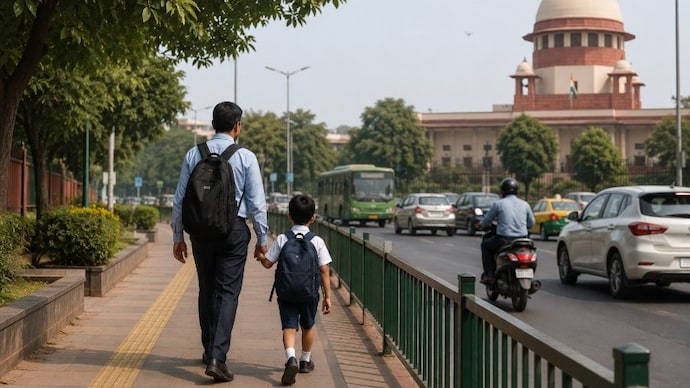
In an unusual warning to the authorities over the lack of proper footpath and pedestrian crossing near the Delhi High Court, the Supreme Court has said its judges may stage a dharna at the court's main gate if the problem is not resolved before the next date of hearing.
A bench of Justices JB Pardiwala and KV Vinod Chandran expressed strong displeasure over the failure to ensure basic pedestrian infrastructure, making it clear that forming committees would not suffice and that concrete action on the ground was necessary.
The judges, however, delivered their warning in a lighter vein while addressing Additional Solicitor General (ASG) Vikramjit Banerjee, saying they would not leave the site until the work was completed.
“If you don't do it before the next date of hearing, both of us will be at the main gate of the Delhi High Court, and we will not go home until you complete the work. That's for sure. Baith jaayenge wahan dharna karne ke liye wahan (We will sit there on dharna), and we will not allow Mr. Banerjee to also go home,” the bench said.
The court indicated that it would not accept further delays and warned that the Delhi government's chief secretary could be summoned in person if the authorities failed to take effective steps.
SAFE FOOTPATHS A FUNDAMENTAL RIGHT
The Supreme Court emphasised that pedestrians' access to safe footpaths is a fundamental right protected under Article 21, which guarantees the right to life, and Article 19(1)(d), which provides for freedom of movement.
The court has directed all states and Union Territories to ensure that roads have safe, clearly marked footpaths free from encroachments. In its recent directions on pedestrian safety, it stressed that the rights of pedestrians must take precedence over the movement of motorised vehicles.
“Pedestrians’ rights are primary and will override the movement of motorised vehicles,” the court said.
FOOTPATHS CANNOT BE OPTIONAL
The court has directed governments and local authorities to construct and maintain footpaths alongside roads, making it clear that pedestrian infrastructure cannot be treated as an optional addition to road projects.
It has also called for the removal of encroachments and obstructions, including unauthorised stalls, electricity poles, garbage and illegal parking, to ensure that pedestrians are not forced to walk on the main carriageway.
The Supreme Court has asked the Centre to establish or designate a central authority to monitor compliance with its directions. It has also called for a pilot project to develop footpaths in five cities in the initial phase.
SAFETY AUDITS AND GRIEVANCE REDRESSAL
The court has directed authorities to follow the Indian Roads Congress' guidelines, including IRC 103:2022, as minimum standards for footpath design and safety. These include anti-skid surfaces, ramps and wheelchair-accessible facilities.
It has also called for regular safety audits of footpaths and pedestrian crossings in major cities and along national highways under the National Highways Authority of India's jurisdiction.
To improve accountability, the court has directed authorities to develop a public grievance redressal mechanism, including an online portal through which people can report encroachments and poorly maintained footpaths.
The court has further directed states and Union Territories to frame stricter rules under the Motor Vehicles Act to regulate pedestrian movement and non-motorised transport, including bicycles.
The court's message is that urban development cannot be measured solely by wider roads and smoother traffic movement. Authorities must also ensure that people can walk safely and with dignity.

I am Sanjay Shrama Deputy Editor with Aajtak. I am with this prestigious organisation and one of the torch bearer of our motto `Golden standard of journalism` since two decades.. In 2001 I jjoined Aajtak as assistant producer. and since 2003 I am with reporting team.
During this period I have been covering mainly legal beat as Supreme Court, Law ministry, Law commission, Election commission. I have covered Culture ministry as well Tourism and Water resource ministry.. Alongwith legal I am fortunate to do political stories and human interest stories.
Very fond of art culture and Indian classical music. I have been deciple of Padma Vibhushan Pandit Jasraj ji, great doyan of Mewati Gharana. Apart from this great achievement I have covered great congragation of the world The Kumbh mela at all four vanues twice.
Eager to learm languages. I can read and speak many languages apart from Hindi and English I acan read, speak and understand Urdu, Nepali, Rajasthani, Maithili, Bhojpuri and Haryanavi...
READ MORE