
India is rebuilding how goods move, 1 crore jobs could follow: IIM Mumbai Director

India is changing how goods move across the country. New freight projects could cut costs, save Rs 7 lakh crore and create 1 crore jobs. A new research led by IIM Mumbai Director Professor Manoj Kumar Tiwari estimates 1.15 crore additional professionals may be needed by 2030 and explains what could drive the change.
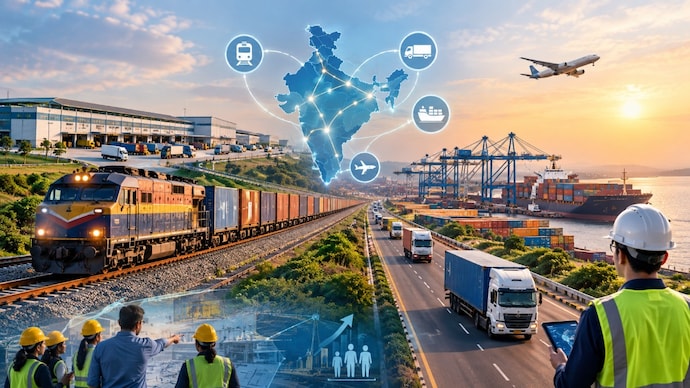

India could save nearly Rs 7 lakh crore every year and create more than 1 crore jobs by changing how goods are moved across the country, according to research led by IIM Mumbai Director Professor Manoj Kumar Tiwari.
The research, Future Talent Requirements in Logistics: Vision 2047, points to Dedicated Freight Corridors (DFCs) and Multi-Modal Logistics Parks (MMLPs) as key parts of this transformation. Together, they could make the movement of goods faster, cheaper and more organised.
“The DFCs and MMLPs would emerge as the real game-changer for India,” Professor Tiwari said.
The need for such a shift is growing as India’s logistics sector expands. The research estimates that the sector could require around 1.15 crore additional professionals by 2030, creating demand across transportation, warehousing, distribution and freight forwarding.
WHY INDIA NEEDS A FASTER FREIGHT SYSTEM
Freight simply means the movement of goods from one place to another. At present, goods often move through different transport systems, including roads and railways, which can add time and cost to supply chains.
DFCs and MMLPs are aimed at making this process more efficient.
Dedicated Freight Corridors are railway routes built mainly for carrying goods, while Multi-Modal Logistics Parks bring different transport and storage facilities together at one location.
The idea is simple: goods should be able to move between rail, road and other transport modes with fewer delays and less handling.
This can reduce travel time, improve the reliability of deliveries and bring down the cost of moving goods across the country.
WESTERN FREIGHT CORRIDOR GIVES INDIA A BIG PUSH
The push for a more efficient freight network comes as India expands its dedicated freight infrastructure.
Prime Minister Narendra Modi recently inaugurated three key sections of the Western Dedicated Freight Corridor (WDFC), completing the 1,506-km route between JNPT near Navi Mumbai and Dadri in Uttar Pradesh.
Unlike regular railway routes that carry both passengers and goods, the WDFC is designed specifically for freight. This allows goods trains to move with fewer disruptions and increases the capacity of the rail network.
Professor Tiwari described the WDFC as an important step towards transforming India's freight and logistics system.
“The WDFC is a significant step towards transforming India’s freight and logistics network,” he said, calling it “a great infrastructure project” that could deliver long-term benefits for businesses and the wider economy.
LOGISTICS MARKET COULD MORE THAN DOUBLE
The changes come as India's logistics market is expected to grow sharply.
According to Professor Tiwari, the logistics sector currently contributes around 13 per cent to India's GDP. The market, which was estimated at about Rs 22.95 lakh crore in 2022, is projected to reach Rs 47.12 lakh crore by 2030.
That growth will also create demand for more workers with the right skills.
The IIM Mumbai research highlights the need for better coordination between different transport systems, simpler GST and regulatory processes, easier business procedures and stronger digital connections across the logistics chain.
AI COULD CHANGE HOW GOODS MOVE
Technology is also expected to play a bigger role in India's freight system.
Advanced analytics and Agentic AI could help companies track goods in real time, identify delays, make faster decisions and coordinate different modes of transport.
For businesses, this could mean fewer delays and lower supply-chain costs. For workers, it could create new opportunities in areas such as logistics planning, data analysis, warehouse management and digital freight operations.
With DFCs, MMLPs and digital systems expanding together, India is looking to build a freight network where goods can move faster, businesses can spend less and more jobs are created along the way.